Course Title: Financial Accounting
III. The financial statements
The balance sheet
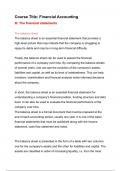
The balance sheet is an essential financial statement that provides a
high-level picture that may indicate that the company is struggling to
repay its debts and may be in long-term financial difficulty.
Finally, the balance sheet can be used to assess the financial
performance of a company over time. By comparing the balance sheets
of several years, one can see the evolution of the company's assets,
liabilities and capital, as well as its level of indebtedness. This can help
investors, shareholders and financial analysts make informed decisions
about the company.
In short, the balance sheet is an essential financial statement for
understanding a company's financial position, funding structure and debt
level. It can also be used to evaluate the financial performance of the
company over time.
The balance sheet is a formal document that must be prepared at the
end of each accounting period, usually one year. It is one of the basic
financial statements that must be published along with the income
statement, cash flow statement and notes.
The balance sheet is presented in the form of a table with two columns:
one for the company's assets and the other for liabilities and capital. The
assets are classified in order of increasing liquidity, i.e. from the most
, liquid to the least liquid. Liabilities are also classified in order of
increasing maturity, i.e. from short-term to long-term debt.
The balance sheet answers several important questions:
What are the company's assets, i.e. its property and rights, and what is
their value?
How does the company finance its assets, i.e. with what liabilities and
capital?
What is the company's level of indebtedness, i.e. its capacity to repay its
short and long-term debts?
What is the financing structure of the company, i.e. the distribution of
liabilities and capital between shareholders, lenders and suppliers?
The balance sheet is therefore an essential tool for evaluating the
financial situation of a company, its solvency and its capacity to invest
and develop. It is used by investors, banks, financial analysts,
shareholders, managers and accountants to make informed decisions.
Here is a simplified example of a balance sheet:
ASSETS Amount (in euros) LIABILITIES Amount (in euros)
Cash 10 000 Capital 50 000
III. The financial statements
The balance sheet
The balance sheet is an essential financial statement that provides a
high-level picture that may indicate that the company is struggling to
repay its debts and may be in long-term financial difficulty.
Finally, the balance sheet can be used to assess the financial
performance of a company over time. By comparing the balance sheets
of several years, one can see the evolution of the company's assets,
liabilities and capital, as well as its level of indebtedness. This can help
investors, shareholders and financial analysts make informed decisions
about the company.
In short, the balance sheet is an essential financial statement for
understanding a company's financial position, funding structure and debt
level. It can also be used to evaluate the financial performance of the
company over time.
The balance sheet is a formal document that must be prepared at the
end of each accounting period, usually one year. It is one of the basic
financial statements that must be published along with the income
statement, cash flow statement and notes.
The balance sheet is presented in the form of a table with two columns:
one for the company's assets and the other for liabilities and capital. The
assets are classified in order of increasing liquidity, i.e. from the most
, liquid to the least liquid. Liabilities are also classified in order of
increasing maturity, i.e. from short-term to long-term debt.
The balance sheet answers several important questions:
What are the company's assets, i.e. its property and rights, and what is
their value?
How does the company finance its assets, i.e. with what liabilities and
capital?
What is the company's level of indebtedness, i.e. its capacity to repay its
short and long-term debts?
What is the financing structure of the company, i.e. the distribution of
liabilities and capital between shareholders, lenders and suppliers?
The balance sheet is therefore an essential tool for evaluating the
financial situation of a company, its solvency and its capacity to invest
and develop. It is used by investors, banks, financial analysts,
shareholders, managers and accountants to make informed decisions.
Here is a simplified example of a balance sheet:
ASSETS Amount (in euros) LIABILITIES Amount (in euros)
Cash 10 000 Capital 50 000