BEK Chapter 26: Emergency Powers and Terrorism
BEK Chapter 18 – Freedom of Association and Assembly
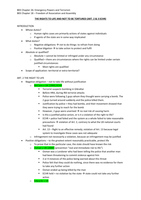
THE RIGHTS TO LIFE AND NOT TO BE TORTURED (ART. 2 & 3 ECHR)
INTRODUCTION
Whose duties?
o Human rights cases are primarily actions of states against individuals
o If agents of the state are in some way implicated
What duties?
o Negative obligations not to do things: to refrain from doing
o Positive bligation to take action to protect and fulfil
Absolute or qualified?
o Absolute = cannot be limited or infringed under any circumstance
o Qualified = there are circumstances where the rights can be limited under certain
justified circumstances
Most rights are qualified
Scope of application: territorial or extra-territorial?
ART. 2 THE RIGHT TO LIFE
Negative obligation – not to take life without justification
o McCann v UK [1995] ECHR
Terrorist suspects bombing in Gibraltar
Before HRA, during IRA terrorist attacks
Police were following 2 guys whom they thought were carrying a bomb. The
2 guys turned around suddenly and the police killed them.
Justification by police = they had bombs, and their movement showed that
they were trying to reach for the bomb
However, 2 guys were unarmed no real risk of causing harm
Is this a justified police action, or is it a violation of the right to life?
ECHR = police had failed and the system as a whole failed to take reasonable
precautions violation of Art. 2, contrary to what the UK national courts
had found
Art. 13 – Right to an effective remedy; violation of Art. 13 because legal
system to investigate these cases was not adequate
o Infringement not necessarily a violation, because an infringement may be justified
Positive obligations – to the greatest extent reasonably practicable, protect life
o To prove that in the particular case, the state should have known the risk
o Osman v UK [2000] (prevention “real and immediate risk to life”)
Osman was a Londoner who had been telling the police that another man
had been threatening to commit violence against him
3 or 4 instances of the police being warned about this threat
Police felt that they could do nothing, since there was no evidence for them
to take any further action
Osman ended up being killed by the man
ECHR held = no violation by the state state could not take any further
action
o Edwards v UK
BEK Chapter 18 – Freedom of Association and Assembly
THE RIGHTS TO LIFE AND NOT TO BE TORTURED (ART. 2 & 3 ECHR)
INTRODUCTION
Whose duties?
o Human rights cases are primarily actions of states against individuals
o If agents of the state are in some way implicated
What duties?
o Negative obligations not to do things: to refrain from doing
o Positive bligation to take action to protect and fulfil
Absolute or qualified?
o Absolute = cannot be limited or infringed under any circumstance
o Qualified = there are circumstances where the rights can be limited under certain
justified circumstances
Most rights are qualified
Scope of application: territorial or extra-territorial?
ART. 2 THE RIGHT TO LIFE
Negative obligation – not to take life without justification
o McCann v UK [1995] ECHR
Terrorist suspects bombing in Gibraltar
Before HRA, during IRA terrorist attacks
Police were following 2 guys whom they thought were carrying a bomb. The
2 guys turned around suddenly and the police killed them.
Justification by police = they had bombs, and their movement showed that
they were trying to reach for the bomb
However, 2 guys were unarmed no real risk of causing harm
Is this a justified police action, or is it a violation of the right to life?
ECHR = police had failed and the system as a whole failed to take reasonable
precautions violation of Art. 2, contrary to what the UK national courts
had found
Art. 13 – Right to an effective remedy; violation of Art. 13 because legal
system to investigate these cases was not adequate
o Infringement not necessarily a violation, because an infringement may be justified
Positive obligations – to the greatest extent reasonably practicable, protect life
o To prove that in the particular case, the state should have known the risk
o Osman v UK [2000] (prevention “real and immediate risk to life”)
Osman was a Londoner who had been telling the police that another man
had been threatening to commit violence against him
3 or 4 instances of the police being warned about this threat
Police felt that they could do nothing, since there was no evidence for them
to take any further action
Osman ended up being killed by the man
ECHR held = no violation by the state state could not take any further
action
o Edwards v UK