Genetics summary (exam 1+2)
1
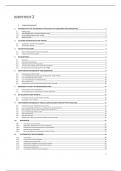
,Chapter 9 | Molecular structure of DNA and RNA 3
Chapter 12 | Gene transcription and RNA modi cation (processing) 5
Chapter 10 | Chromosome structure 10
Chapter 8 | Chromosome variation 14
Chapter 11 | DNA replication 17
Chapter 3 | Reproduction & chromosome transmission 21
Chapter 13 | Translation of mRNA 23
Chapter 2 | Mendelian inheritance 26
Chapter 4 | Extensions of mendelian inheritance 28
Chapter 5 | Non-mendelian inheritance 31
Chapter 7 | Genetic transfer and mapping in bacteria 34
Chapter 6 | Genetic linkage and mapping in eukaryotes 37
Chapter 14 | Gene regulation in bacteria 39
Chapter 15 | Gene regulation in eukaryotes I: transcriptional and translational
regulation 44
Chapter 16 | Gene regulation in eukaryotes II: epigenetics 49
Chapter 17.3 | RNA interference and miRNAs 53
Chapter 19 | Gene mutation, DNA repair and recombination 54
Chapter 24 | Medical genetics 60
Chapter 25 | Genetic basis of cancer 62
2
fi
, Chapter 9 | Molecular structure of DNA and RNA
Criteria of genetic material
1. Information - must obtain the information necessary to make an entire organism
2. Transmission - must be passed on from parents to o spring
3. Replication - must be copied
> So it can be passed from cell to cell, and parents to o spring
4. Variation - capable of changing
> To account for the known phenotypic variation in each species
> Leads to adaptation + evolution
> Mainly caused by mutation
Discovery of DNA
Friedrich Miescher ‘discovered’ DNA in 1869 by investigating the unknown phosphorus-
containing isolated substance from the nuclei of white blood cells found in waste surgical
bandages -> ‘nuclein’; better understanding of DNA+RNA structure determined that they were
acidic molecules (they release H+ in solution and have net negative charge at neutral pH) ->
‘nucleic acid’
Levels of complexity of nucleic acids
1. Nucleotides - form repeating structural unit of nucleic acids
2. Strand - nucleotides that are linked together in a linear manner
3. Double helix - two strands of DNA (sometimes RNA) interacted with each other
4. Three-dimensional structure of DNA - folding and bending of double helix
Nucleotides in DNA (deoxyribonucleic acid)
- A pentose sugar (2’-deoxyribose)
> Numbered 1’ to 5’
> -OH attached to 3’ C is important for covalent linkages between nucleotides
- Phosphate group (attached to 5’ C via an ester bond)
- A nitrogenous base
> Numbered 1 to 6/9
> Four bases: Adenine, Thymine, Guanine, Cytosine (attached to 1’ C)
> There are more: bases can be chemically modi ed
> In tRNA/mRNA several other modi ed bases
> A-T & G-C connected by hydrogen bonds
Nucleotides in RNA (ribonucleic acid)
- A pentose sugar (ribose)
- Phosphate group (attached to 5’ C)
- A nitrogenous base
- Has an extra OH instead of H
> Four bases: Adenine, Uracil, Guanine, Cytosine (attached to 1’ C)
Di erent bases
- Purine base - contains a double-ring structure
> Adenine + guanine
> Contains 9 C
- Pyrimidine base - contains a single-ring structure
> Thymine + cytosine + uracil
> Contains 6 C
Base + sugar -> nucleoside
> Example:
Adenine + ribose = adenosine
Guanine + ribose = guanosine
Uracil + ribose = uridine
Thymine + deoxyribose = deoxythymidine
3
ff fi ff fi ff
, Cytosine + deoxyribose = deoxycytidine
Base + sugar + phosphate(s) -> nucleotide
> Example:
Adenosine monophosphate (AMP)
Adenosine diphosphate (ADP)
Deoxyadenosine triphosphate (dATP)
Structure of DNA strand
- Phosphodiester linkage/bonds: phosphate group connects to 2 sugar molecules via 2 ester
bonds -> phosphates + sugars form backbone of strand; bases project from backbone;
backbone is negatively charged due to negative charge of phosphate
> A phosphate connects the 5’ C of one nucleotide to 3’ C of another; all sugar molecules
are oriented in same direction -> directionality (5’ > 3’)
Competition to determine the structure of DNA
- Franklin, Wilkins, Watson & Crick wanted to determine the structure of DNA because
knowledge towards understanding the functioning of genes was needed
- One important method was model building; in early 1950s, Pauling proposed that regions of
proteins can fold into a secondary structure (⍺ helix) -> ball-and-stick model
- Rosalind Franklin used X-ray di raction to study wet bers of DNA
> Pattern was consistent with helical structure
> Diameter of helical structure was too wide to be only single-stranded helix
> Di raction pattern indicated that the helix contains ~10 bp per complete turn
- Charga found that DNA has a biochemical composition in which the %A=%T & %C=%G
- Watson & Crick used previous observations, assuming that DNA is composed of nucleotides
linked together in linear way and that the chemical linkage between 2 nucleotides is always the
same -> built ball-and-stick model with identical base in opposite strand (A-A etc.), but couldn’t
t -> realization that hydrogen bonding of A-T was structurally similar to C-G -> published DNA
structure in ‘Nature’ in 1953 -> got Nobel Prize in physiology/medicine in 1962
> Wilkins (working in same laboratory as Franklin) shared her crucial data with them
Key features of DNA double helix
- Two DNA strands are twisted together around a common axis to form ‘spiral upstairs’ structure
- Double-stranded structure is stabilized by hydrogen-bonded base pairs
> One complete turn contains 10 bp with linear distance of 3,4 nm (0,34 nm per bp)
- A-T & G-C -> relatively constant width
> 3 hydrogen bonds between G-C, but 2 between A-T -> higher proportion of G+C tend
more stability
- Two complementary strands
- One strand 5’ > 3’; other 3’ > 5’ -> antiparallel
- Base stacking provides stability
Grooves = indentations where atoms of the bases are in contact with the water in the surrounding
cellular uid
> (Narrow) minor groove vs (wider) major groove
DNA can form alternative types of double helices
- B-DNA: predominant, right-handed, 10 bp per turn, centrally located bases, hydrogen bonds
between bp are oriented relatively perpendicular to central axis
- Under certain in vitro (and some places, in vivo) conditions, A-/Z-DNA can be formed
- Z-DNA: left-handed, helical backbone zigzags, 12 bp per turn, formation favored by GC-rich
sequences (at high salt concentration) & cytosine methylation (at low salt concentration),
evidence that it may play a role in transcription and determining chromosome structure
- A-DNA: right-handed, 11 bp per turn, occurs under conditions of low humidity, little evidence
that it’s biologically important
> Can be formed under certain in vitro (and some places, in vivo) conditions
4
fi
fffl ff ff fi
1
,Chapter 9 | Molecular structure of DNA and RNA 3
Chapter 12 | Gene transcription and RNA modi cation (processing) 5
Chapter 10 | Chromosome structure 10
Chapter 8 | Chromosome variation 14
Chapter 11 | DNA replication 17
Chapter 3 | Reproduction & chromosome transmission 21
Chapter 13 | Translation of mRNA 23
Chapter 2 | Mendelian inheritance 26
Chapter 4 | Extensions of mendelian inheritance 28
Chapter 5 | Non-mendelian inheritance 31
Chapter 7 | Genetic transfer and mapping in bacteria 34
Chapter 6 | Genetic linkage and mapping in eukaryotes 37
Chapter 14 | Gene regulation in bacteria 39
Chapter 15 | Gene regulation in eukaryotes I: transcriptional and translational
regulation 44
Chapter 16 | Gene regulation in eukaryotes II: epigenetics 49
Chapter 17.3 | RNA interference and miRNAs 53
Chapter 19 | Gene mutation, DNA repair and recombination 54
Chapter 24 | Medical genetics 60
Chapter 25 | Genetic basis of cancer 62
2
fi
, Chapter 9 | Molecular structure of DNA and RNA
Criteria of genetic material
1. Information - must obtain the information necessary to make an entire organism
2. Transmission - must be passed on from parents to o spring
3. Replication - must be copied
> So it can be passed from cell to cell, and parents to o spring
4. Variation - capable of changing
> To account for the known phenotypic variation in each species
> Leads to adaptation + evolution
> Mainly caused by mutation
Discovery of DNA
Friedrich Miescher ‘discovered’ DNA in 1869 by investigating the unknown phosphorus-
containing isolated substance from the nuclei of white blood cells found in waste surgical
bandages -> ‘nuclein’; better understanding of DNA+RNA structure determined that they were
acidic molecules (they release H+ in solution and have net negative charge at neutral pH) ->
‘nucleic acid’
Levels of complexity of nucleic acids
1. Nucleotides - form repeating structural unit of nucleic acids
2. Strand - nucleotides that are linked together in a linear manner
3. Double helix - two strands of DNA (sometimes RNA) interacted with each other
4. Three-dimensional structure of DNA - folding and bending of double helix
Nucleotides in DNA (deoxyribonucleic acid)
- A pentose sugar (2’-deoxyribose)
> Numbered 1’ to 5’
> -OH attached to 3’ C is important for covalent linkages between nucleotides
- Phosphate group (attached to 5’ C via an ester bond)
- A nitrogenous base
> Numbered 1 to 6/9
> Four bases: Adenine, Thymine, Guanine, Cytosine (attached to 1’ C)
> There are more: bases can be chemically modi ed
> In tRNA/mRNA several other modi ed bases
> A-T & G-C connected by hydrogen bonds
Nucleotides in RNA (ribonucleic acid)
- A pentose sugar (ribose)
- Phosphate group (attached to 5’ C)
- A nitrogenous base
- Has an extra OH instead of H
> Four bases: Adenine, Uracil, Guanine, Cytosine (attached to 1’ C)
Di erent bases
- Purine base - contains a double-ring structure
> Adenine + guanine
> Contains 9 C
- Pyrimidine base - contains a single-ring structure
> Thymine + cytosine + uracil
> Contains 6 C
Base + sugar -> nucleoside
> Example:
Adenine + ribose = adenosine
Guanine + ribose = guanosine
Uracil + ribose = uridine
Thymine + deoxyribose = deoxythymidine
3
ff fi ff fi ff
, Cytosine + deoxyribose = deoxycytidine
Base + sugar + phosphate(s) -> nucleotide
> Example:
Adenosine monophosphate (AMP)
Adenosine diphosphate (ADP)
Deoxyadenosine triphosphate (dATP)
Structure of DNA strand
- Phosphodiester linkage/bonds: phosphate group connects to 2 sugar molecules via 2 ester
bonds -> phosphates + sugars form backbone of strand; bases project from backbone;
backbone is negatively charged due to negative charge of phosphate
> A phosphate connects the 5’ C of one nucleotide to 3’ C of another; all sugar molecules
are oriented in same direction -> directionality (5’ > 3’)
Competition to determine the structure of DNA
- Franklin, Wilkins, Watson & Crick wanted to determine the structure of DNA because
knowledge towards understanding the functioning of genes was needed
- One important method was model building; in early 1950s, Pauling proposed that regions of
proteins can fold into a secondary structure (⍺ helix) -> ball-and-stick model
- Rosalind Franklin used X-ray di raction to study wet bers of DNA
> Pattern was consistent with helical structure
> Diameter of helical structure was too wide to be only single-stranded helix
> Di raction pattern indicated that the helix contains ~10 bp per complete turn
- Charga found that DNA has a biochemical composition in which the %A=%T & %C=%G
- Watson & Crick used previous observations, assuming that DNA is composed of nucleotides
linked together in linear way and that the chemical linkage between 2 nucleotides is always the
same -> built ball-and-stick model with identical base in opposite strand (A-A etc.), but couldn’t
t -> realization that hydrogen bonding of A-T was structurally similar to C-G -> published DNA
structure in ‘Nature’ in 1953 -> got Nobel Prize in physiology/medicine in 1962
> Wilkins (working in same laboratory as Franklin) shared her crucial data with them
Key features of DNA double helix
- Two DNA strands are twisted together around a common axis to form ‘spiral upstairs’ structure
- Double-stranded structure is stabilized by hydrogen-bonded base pairs
> One complete turn contains 10 bp with linear distance of 3,4 nm (0,34 nm per bp)
- A-T & G-C -> relatively constant width
> 3 hydrogen bonds between G-C, but 2 between A-T -> higher proportion of G+C tend
more stability
- Two complementary strands
- One strand 5’ > 3’; other 3’ > 5’ -> antiparallel
- Base stacking provides stability
Grooves = indentations where atoms of the bases are in contact with the water in the surrounding
cellular uid
> (Narrow) minor groove vs (wider) major groove
DNA can form alternative types of double helices
- B-DNA: predominant, right-handed, 10 bp per turn, centrally located bases, hydrogen bonds
between bp are oriented relatively perpendicular to central axis
- Under certain in vitro (and some places, in vivo) conditions, A-/Z-DNA can be formed
- Z-DNA: left-handed, helical backbone zigzags, 12 bp per turn, formation favored by GC-rich
sequences (at high salt concentration) & cytosine methylation (at low salt concentration),
evidence that it may play a role in transcription and determining chromosome structure
- A-DNA: right-handed, 11 bp per turn, occurs under conditions of low humidity, little evidence
that it’s biologically important
> Can be formed under certain in vitro (and some places, in vivo) conditions
4
fi
fffl ff ff fi