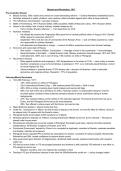
Dissent and Revolution, 1917
Pre-revolution Russia
● Bloody Sunday, 1905: tsarist army shoots on crowd demanding reforms → October Manifesto established Duma.
● Nicholas: awkward in public, stubborn, over-cautious, pitted ministers against each other to keep authority.
● 1913 (Romanov tercentenary) = last year of peace.
● Battle of Tannenburg, 1914: Russian defeat, 300k casualties. Battle of Masurian Lakes, 1914: Russian defeat.
● Issues in the military: lack of warm clothing, suitable weaponry etc.
○ Fall in morale, Brusilov offensive → 1.5m desertions by 1916.
● Nicholas’ mistakes:
○ He refused the chance the Progressive Bloc gave him to institute political reform in August 1915. Denied
Witte’s plans for economic reforms??
○ September 1915: took the role of Commander of the Russian Army → lack of military experience, made
him responsible for military disasters.
○ Left Alexandra and Rasputin in charge → rumours of affairs, suspicions around her German heritage.
● Economic and social state of Russia:
○ War credits → massive inflation. Conscription → shortage of men in the countryside → food shortages.
○ Naval blockades in the Baltic → halted Russian trade. Railway production halved between 1913 and 1916.
○ Unemployment, 300% rise in cost of living, 145k workers on strike in Petrograd.
● Discontent in Russia:
○ Riots against landlords and employers. -35C temperatures in the winter of 1916 → near mutiny in armies.
○ Guchkov considered a coup to force Nicholas to abdicate in 1917. Lvov indirectly asked Nicholas’ uncle if
he would replace the Tsar.
○ Urban proletariat = potential threat; 57.8% literacy rate + structure of factories = able to articulate
grievances and organise strikes. Peasants = 77% of population.
February/March Revolution
● 14th-28th February, 1917:
○ 14th: 100k workers on strike in Petrograd.
○ 23rd: International Women's Day → 90k workers joined IWD march = 240k in total.
○ 24th: 200k on strike, knocking down tsarist statues and waving red flags.
○ 25th: over half of the city’s workforce on strike. Factories closed, no news/public transport. Chief of
mounted police murdered. Many authority members refused to shoot, themselves being of worker
backgrounds.
○ 27th: Tsar ordered military control. Mutiny in the Volynskii regiment. Provisional Government set up by
Duma, and the Petrograd Soviet set up by revolutionaries.
○ 28th: Tsar offered to share power with the Duma, but was too late.
● Major Bolshevik leaders = absent during this time.
● Order No. 1 produced on 1 March: all units to elect a deputy to the Soviet, no honorific titles for officers, Duma to
be obeyed only if it agreed with the Soviet’s orders.
● Petrograd Soviet accumulated 3,000 members by 10 March.
● Nicholas agreed to abdicate on 2 March, naming Grand Duke Mikhail as his heir, but he refused → Romanovs
placed under house arrest.
● Revolutionary disturbances occurred outside of Petrograd: Kronstadt naval base, national minorities declared
independence, All-Russian Congress of Soviets June 1917.
● Provisional Government: headed by Prince Lvov, accepted as legitimate, consisted of liberals, moderate socialists
and Kadets, intended as temporary.
● Petrograd Soviet: regarded PG as tainted by associations to tsarism, consisted of radical socialists, Mensheviks,
Bolsheviks and SRs, lacked confidence to assume direct control.
● New government gave freedom of religion/press, abolished death penalty, replaced tsarist police with ‘people’s
militia’ etc.
● PG tried to ensure order vs. PS encouraged peasants and workers to defy authority. PG believed in war effort vs.
PS wanted an end to war.
○ Milyukov, Guchkov and Lvov replaced by socialists in April.
● Paralysis: PG put off elections because it was clear the SRs/Bolsheviks would win → policy changes halted.
, Developments between the revolutions
● Lenin arrived in Petrograd with German help, and was greeted by cheering crowds.
● Lenin didn’t believe in a ‘bourgeois revolution’; would hold the proletariat revolution back; ‘permanent revolution’.
● April Theses: end war, power to the soviets, land to the state then re-allocated to peasants
○ ‘Peace, bread and land’.
● Opposition to Lenin: allegations of Lenin paid by German, Mensheviks feared he would undermine their work by
provoking a right-wing reaction, some thought him unrealistic/too radical.
● Lenin won over the Bolshevik Party with his personality:
○ Abandoned call for an immediate overthrow of PG → won over those who feared civil war.
○ Claimed credit for Russia’s state and anti-war demonstration → Milyukov + Guchkov resigned in May.
● All- Russian Congress of Soviets, 3 June: vote of confidence in PG.
● July Days, 3-5 July.
○ Doubled grain prices, closure of >500 factories, loss of 100k jobs → 20k armed Kronstadt sailors rioted.
○ Bolsheviks helped force suppress the riot but were blamed for its bloodshed → Lenin fled (reputation fell),
Trotsky and Kamenev imprisoned.
○ 8 July: Kerensky replaced Lvov as Prime Minister.
● Situation in summer 1917 benefited Bolsheviks:
○ Failed Brusilov offensive, falling wages and rising prices, failure to redistribute land lost peasant support.
● Kornilov coup, August: failed due to Kerensky releasing imprisoned Bolsheviks to halt it → coup leaders arrested.
○ Bolsheviks benefited: more efficient Red Guard, poured scorn on Kerensky’s government.
■ 23k → 200k membership by October.
○ Kerensky sent radical army units out of the city → Bol. claimed he was allowing Petr. to fall to Germans.
● Lenin (hiding in Finland in Sep.) demanded preparation for revolution, but was voted against by the Committee.
○ Kamenev + Zinoviev wanted to wait for elections, Trotsky wanted to wait til Congress of Soviets 26/10.
○ Lenin finally persuaded the committee on 10 Oct, slipping into Russia in disguise.
● Trotsky organised most of the revolution: sent speakers to raise support in factories, massed troops at the SMolny
Institute, MRC set up, 15/18 garrison units declared allegiance. In total: 200k Red Guards, 60k sailors etc.
October/November Revolution
● Causes: weaknesses of PG, political manoeuvres under Lenin/Trotsky, deteriorating economy.
○ Kerensky’ attempt to take action on Oct 23 gave the Bolsheviks an excuse to act.
● 24th: Red Guards took over key government buildings.
● 25th: Winter Palace surrounded, shot by battleship Aurora. 2nd Congress of Soviets convened.
● 26th: Winter Palace captured. Lenin’s Decree on Peace passed.
● 27th: Lenin’s Decree on Land passed. Sovnarkom created.
● A relatively small affair: 30k involved = 5% of workforce, 15k outside Winter Palace = mostly bystanders, <5
deaths, Petrograd remained unaffected → public transport etc. ran as normal.
○ Idea of a ‘popular’ revolution suited Bolshevik propaganda. ‘Coup’ theory born out of Cold War.
● Sovnarkom = exclusively Bolshevik, Lenin as Chairman, ruled by decree without Soviet approval.
○ Moderates walked out of Congress in protest of socialist majority, leaving Bolshevik/SR coalition.
● Bolshevik needed to consolidate their power outside of Petr. and combat Kerensky:
○ Oct 31: Bol. took control of 17 provincial capitals.
○ Nov 2: Kerensky’s forces defeated. Declaration of Rights of the Peoples of Russia = min. Independence.
○ Nov 3: Kremlin taken. Lenin issued ultimatum to end Bol. division.
○ Nov 5: victory proclaimed.
○ Lenin = hostile to power-sharing, reluctantly agreed for 7 SRs to join Sovnarkom.
● Lenin’s decrease included: workers, social insurance, press, peace, land, nationality, workers’ control of factories,
judicial, outlaw sex discrimination, bank, military, church.
● Lenin believed in going through a stage of state capitalism → private markets remained. Veshenka established.
● To combat opposition: campaign against class enemies, anti-Bol. newspapers closed down, Cheka established,
opposition imprisoned.
Pre-revolution Russia
● Bloody Sunday, 1905: tsarist army shoots on crowd demanding reforms → October Manifesto established Duma.
● Nicholas: awkward in public, stubborn, over-cautious, pitted ministers against each other to keep authority.
● 1913 (Romanov tercentenary) = last year of peace.
● Battle of Tannenburg, 1914: Russian defeat, 300k casualties. Battle of Masurian Lakes, 1914: Russian defeat.
● Issues in the military: lack of warm clothing, suitable weaponry etc.
○ Fall in morale, Brusilov offensive → 1.5m desertions by 1916.
● Nicholas’ mistakes:
○ He refused the chance the Progressive Bloc gave him to institute political reform in August 1915. Denied
Witte’s plans for economic reforms??
○ September 1915: took the role of Commander of the Russian Army → lack of military experience, made
him responsible for military disasters.
○ Left Alexandra and Rasputin in charge → rumours of affairs, suspicions around her German heritage.
● Economic and social state of Russia:
○ War credits → massive inflation. Conscription → shortage of men in the countryside → food shortages.
○ Naval blockades in the Baltic → halted Russian trade. Railway production halved between 1913 and 1916.
○ Unemployment, 300% rise in cost of living, 145k workers on strike in Petrograd.
● Discontent in Russia:
○ Riots against landlords and employers. -35C temperatures in the winter of 1916 → near mutiny in armies.
○ Guchkov considered a coup to force Nicholas to abdicate in 1917. Lvov indirectly asked Nicholas’ uncle if
he would replace the Tsar.
○ Urban proletariat = potential threat; 57.8% literacy rate + structure of factories = able to articulate
grievances and organise strikes. Peasants = 77% of population.
February/March Revolution
● 14th-28th February, 1917:
○ 14th: 100k workers on strike in Petrograd.
○ 23rd: International Women's Day → 90k workers joined IWD march = 240k in total.
○ 24th: 200k on strike, knocking down tsarist statues and waving red flags.
○ 25th: over half of the city’s workforce on strike. Factories closed, no news/public transport. Chief of
mounted police murdered. Many authority members refused to shoot, themselves being of worker
backgrounds.
○ 27th: Tsar ordered military control. Mutiny in the Volynskii regiment. Provisional Government set up by
Duma, and the Petrograd Soviet set up by revolutionaries.
○ 28th: Tsar offered to share power with the Duma, but was too late.
● Major Bolshevik leaders = absent during this time.
● Order No. 1 produced on 1 March: all units to elect a deputy to the Soviet, no honorific titles for officers, Duma to
be obeyed only if it agreed with the Soviet’s orders.
● Petrograd Soviet accumulated 3,000 members by 10 March.
● Nicholas agreed to abdicate on 2 March, naming Grand Duke Mikhail as his heir, but he refused → Romanovs
placed under house arrest.
● Revolutionary disturbances occurred outside of Petrograd: Kronstadt naval base, national minorities declared
independence, All-Russian Congress of Soviets June 1917.
● Provisional Government: headed by Prince Lvov, accepted as legitimate, consisted of liberals, moderate socialists
and Kadets, intended as temporary.
● Petrograd Soviet: regarded PG as tainted by associations to tsarism, consisted of radical socialists, Mensheviks,
Bolsheviks and SRs, lacked confidence to assume direct control.
● New government gave freedom of religion/press, abolished death penalty, replaced tsarist police with ‘people’s
militia’ etc.
● PG tried to ensure order vs. PS encouraged peasants and workers to defy authority. PG believed in war effort vs.
PS wanted an end to war.
○ Milyukov, Guchkov and Lvov replaced by socialists in April.
● Paralysis: PG put off elections because it was clear the SRs/Bolsheviks would win → policy changes halted.
, Developments between the revolutions
● Lenin arrived in Petrograd with German help, and was greeted by cheering crowds.
● Lenin didn’t believe in a ‘bourgeois revolution’; would hold the proletariat revolution back; ‘permanent revolution’.
● April Theses: end war, power to the soviets, land to the state then re-allocated to peasants
○ ‘Peace, bread and land’.
● Opposition to Lenin: allegations of Lenin paid by German, Mensheviks feared he would undermine their work by
provoking a right-wing reaction, some thought him unrealistic/too radical.
● Lenin won over the Bolshevik Party with his personality:
○ Abandoned call for an immediate overthrow of PG → won over those who feared civil war.
○ Claimed credit for Russia’s state and anti-war demonstration → Milyukov + Guchkov resigned in May.
● All- Russian Congress of Soviets, 3 June: vote of confidence in PG.
● July Days, 3-5 July.
○ Doubled grain prices, closure of >500 factories, loss of 100k jobs → 20k armed Kronstadt sailors rioted.
○ Bolsheviks helped force suppress the riot but were blamed for its bloodshed → Lenin fled (reputation fell),
Trotsky and Kamenev imprisoned.
○ 8 July: Kerensky replaced Lvov as Prime Minister.
● Situation in summer 1917 benefited Bolsheviks:
○ Failed Brusilov offensive, falling wages and rising prices, failure to redistribute land lost peasant support.
● Kornilov coup, August: failed due to Kerensky releasing imprisoned Bolsheviks to halt it → coup leaders arrested.
○ Bolsheviks benefited: more efficient Red Guard, poured scorn on Kerensky’s government.
■ 23k → 200k membership by October.
○ Kerensky sent radical army units out of the city → Bol. claimed he was allowing Petr. to fall to Germans.
● Lenin (hiding in Finland in Sep.) demanded preparation for revolution, but was voted against by the Committee.
○ Kamenev + Zinoviev wanted to wait for elections, Trotsky wanted to wait til Congress of Soviets 26/10.
○ Lenin finally persuaded the committee on 10 Oct, slipping into Russia in disguise.
● Trotsky organised most of the revolution: sent speakers to raise support in factories, massed troops at the SMolny
Institute, MRC set up, 15/18 garrison units declared allegiance. In total: 200k Red Guards, 60k sailors etc.
October/November Revolution
● Causes: weaknesses of PG, political manoeuvres under Lenin/Trotsky, deteriorating economy.
○ Kerensky’ attempt to take action on Oct 23 gave the Bolsheviks an excuse to act.
● 24th: Red Guards took over key government buildings.
● 25th: Winter Palace surrounded, shot by battleship Aurora. 2nd Congress of Soviets convened.
● 26th: Winter Palace captured. Lenin’s Decree on Peace passed.
● 27th: Lenin’s Decree on Land passed. Sovnarkom created.
● A relatively small affair: 30k involved = 5% of workforce, 15k outside Winter Palace = mostly bystanders, <5
deaths, Petrograd remained unaffected → public transport etc. ran as normal.
○ Idea of a ‘popular’ revolution suited Bolshevik propaganda. ‘Coup’ theory born out of Cold War.
● Sovnarkom = exclusively Bolshevik, Lenin as Chairman, ruled by decree without Soviet approval.
○ Moderates walked out of Congress in protest of socialist majority, leaving Bolshevik/SR coalition.
● Bolshevik needed to consolidate their power outside of Petr. and combat Kerensky:
○ Oct 31: Bol. took control of 17 provincial capitals.
○ Nov 2: Kerensky’s forces defeated. Declaration of Rights of the Peoples of Russia = min. Independence.
○ Nov 3: Kremlin taken. Lenin issued ultimatum to end Bol. division.
○ Nov 5: victory proclaimed.
○ Lenin = hostile to power-sharing, reluctantly agreed for 7 SRs to join Sovnarkom.
● Lenin’s decrease included: workers, social insurance, press, peace, land, nationality, workers’ control of factories,
judicial, outlaw sex discrimination, bank, military, church.
● Lenin believed in going through a stage of state capitalism → private markets remained. Veshenka established.
● To combat opposition: campaign against class enemies, anti-Bol. newspapers closed down, Cheka established,
opposition imprisoned.