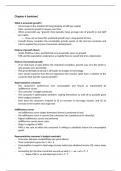
Chapter 4 (revision)
What is economic growth?
- An increase in the standard of living (looking at GDP per capita)
- Note, economic growth is always over time
- When economists say “growth: they typically mean average rate of growth in real GDP
per capita.
o How can we have this sustained growth over a long period of time
- Growth theory considers the remarkable growth events of the last two centuries and
tries to explain the process of economic development
History of growth theory
- Smith, Malthus, Marx, and Mill had very pessimistic views on growth
- Mill said the population would grow so rapidly that we would sink into a depression
History of economic growth
- If we look back at data before the industrial revolution, growth was very flat which is
why people were pessimistic
- The great divergence period is all thanks to changes in technology
- How would countries that did not experience the massive spike have a relation to the
countries that had the massive growth?
Representative consumer
- The consumer’s preferences over consumption and leisure as represented by
indifference curves
- The consumer’s budget constraint
- The consumer’s optimisation problem: making themselves as well off as possible given
their budget constrain
- How does the consumer respond to (i) an increase in non-wage income, and (ii) an
increase in the market real wage rate
Indifference curves
- An indifference curve slopes downward (more is preferred to less)
- An indifference curve is convex (the consumer has a preference for diversity)
- Higher indifference curves are preferred
- Indifference curves never cross
- Slope is negative of MRS
- MRS is the rate at which the consumer is willing to substitute leisure for consumption
goods
Representative consumer’s budget constraint
- Consumer behaves competitively (are price takers)
- Time constraint is given by l + Ns = h
- Consumption is equal to total wage income (wNs) plus dividend income (Π), minus taxes
(T).
- Accounting for the time constraint we end up with: C = -wl + wh + Π - T
o Slope of BC is -w and intercept is wh + Π - T
, Representative consumer’s
budget curve when T< Π
Consumer optimisation
- Assume the consumer is rational
The representative
consumer
chooses not to work
Changing real dividends or taxes for the
consumer
- Assume that consumption and leisure are both normal goods
- An increase in dividends or a decrease in taxes will then cause the consumer to increase
- consumption and reduce the quantity of labour supplied (increase leisure)
An increase in Π - T for the consumer
,An increase in the Market Real Wage Rate
- This has income and substitution effects
- Substitution effect: the price of leisure rises, so the consumer substitutes from leisure to
consumption
- Income effect: the consumer is effectively more wealthy and, since both goods are
normal, consumption increases and leisure increases
- Conclusion: consumption must rise, but leisure may rise or fall
Increase in the Real Wage Rate: income Labour supply curve
and substitution effects
, Effect of an increase in Dividend Income or a
decrease in taxes
The representative firm
- The production function
- Profit maximisation and labour demand
The Firm’s Production Function
Y = zF (K , Nd)
Standard properties of this function are:
- Constant returns to scale
- Output increases with increases in either labour input or capital input
- The marginal product of labour decreases as the labour input increases
- The marginal product of capital decreases as the capital input increases
- The marginal product of labour increases as the quantity of the capital input increases
Production function, fixing the quantity of
Production function, fixing the quantity
What is economic growth?
- An increase in the standard of living (looking at GDP per capita)
- Note, economic growth is always over time
- When economists say “growth: they typically mean average rate of growth in real GDP
per capita.
o How can we have this sustained growth over a long period of time
- Growth theory considers the remarkable growth events of the last two centuries and
tries to explain the process of economic development
History of growth theory
- Smith, Malthus, Marx, and Mill had very pessimistic views on growth
- Mill said the population would grow so rapidly that we would sink into a depression
History of economic growth
- If we look back at data before the industrial revolution, growth was very flat which is
why people were pessimistic
- The great divergence period is all thanks to changes in technology
- How would countries that did not experience the massive spike have a relation to the
countries that had the massive growth?
Representative consumer
- The consumer’s preferences over consumption and leisure as represented by
indifference curves
- The consumer’s budget constraint
- The consumer’s optimisation problem: making themselves as well off as possible given
their budget constrain
- How does the consumer respond to (i) an increase in non-wage income, and (ii) an
increase in the market real wage rate
Indifference curves
- An indifference curve slopes downward (more is preferred to less)
- An indifference curve is convex (the consumer has a preference for diversity)
- Higher indifference curves are preferred
- Indifference curves never cross
- Slope is negative of MRS
- MRS is the rate at which the consumer is willing to substitute leisure for consumption
goods
Representative consumer’s budget constraint
- Consumer behaves competitively (are price takers)
- Time constraint is given by l + Ns = h
- Consumption is equal to total wage income (wNs) plus dividend income (Π), minus taxes
(T).
- Accounting for the time constraint we end up with: C = -wl + wh + Π - T
o Slope of BC is -w and intercept is wh + Π - T
, Representative consumer’s
budget curve when T< Π
Consumer optimisation
- Assume the consumer is rational
The representative
consumer
chooses not to work
Changing real dividends or taxes for the
consumer
- Assume that consumption and leisure are both normal goods
- An increase in dividends or a decrease in taxes will then cause the consumer to increase
- consumption and reduce the quantity of labour supplied (increase leisure)
An increase in Π - T for the consumer
,An increase in the Market Real Wage Rate
- This has income and substitution effects
- Substitution effect: the price of leisure rises, so the consumer substitutes from leisure to
consumption
- Income effect: the consumer is effectively more wealthy and, since both goods are
normal, consumption increases and leisure increases
- Conclusion: consumption must rise, but leisure may rise or fall
Increase in the Real Wage Rate: income Labour supply curve
and substitution effects
, Effect of an increase in Dividend Income or a
decrease in taxes
The representative firm
- The production function
- Profit maximisation and labour demand
The Firm’s Production Function
Y = zF (K , Nd)
Standard properties of this function are:
- Constant returns to scale
- Output increases with increases in either labour input or capital input
- The marginal product of labour decreases as the labour input increases
- The marginal product of capital decreases as the capital input increases
- The marginal product of labour increases as the quantity of the capital input increases
Production function, fixing the quantity of
Production function, fixing the quantity