Garantie de satisfaction à 100% Disponible immédiatement après paiement En ligne et en PDF Tu n'es attaché à rien 4,6 TrustPilot
logo-home
Notes de cours

Social Research Methodology - UvA -

Note
-
Vendu
-
Pages
17
Publié le
06-03-2023
Écrit en
2022/2023

Notes from lectures 1 til 6, given by Gerben Moerman at UvA.

Établissement
Cours

Aperçu du contenu

Social Research Methodology, lecture 1, 31-10-2022
 Gerben’s beliefs:
o Methodology is related to philosophy of science, but not identical.
o The research question determines the superiority of a particular method
or research strategy.
o Students determine their own theoretical position on the basis of
substantiation.
o To know for sure must be doubted ferociously.
 Concept  abstract tern that describes a phenomenon.
 Law  regularity of facts (observations).
 Postulate  basic assumption in a theory.
 Proposition  explanatory relationship between concepts.
 Types of use of theories (distinction by Merton):
o Grand theories: abstract, very large scope
o Middle range theories: useful for empirical research, limited scope
o Background literature: focussed search for theories, empirical research,
limited scope
o Fact collection: hardly any theory, ad-hoc selection (when needed or
when there was a particular purpose)
 Induction (empirical  theoretical): verification logic  the form of reasoning,
in which from a limited number of observations a universal statement is made
about all cases.
 Deduction (theoretical  empirical): falsification logic  the form of reasoning,
in which from general statements predictions about observations are made.
 Verification logic (induction): A1, A2, A3, A4 and A5 have property P = all A
have property P.
 Falsification logic (deduction): all A have property P, K is an A = K has
property P.
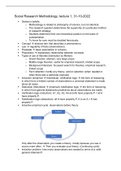
 Inductive empirical cycle: observations before theory

Problem


Evaluation

Observation


Theory


Only after the observation you create a theory, mostly because you see it
occurs more often.  Then you evaluate your theory. (Continuing cycle)
 Induction problem: how many observations are needed to arrive at a valid
general statement?

, o Solution 1: use falsification logic, falsification is stronger than
verification.
o solution 2: use probability.
 Deductive empirical cycle: theory before observations
Problem


Evaluation Theory


Test Hypothesis


Observation

In a deductive empirical cycle, the problem you start with is more theoretical.
 In the theory we try to explain the problem.  The hypothesis is a part of
the theory (a statement) that we can actually test.  Only then we do
observations!  We test the hypothesis in our observation.  Evaluate if
there is falsification. (Continuing cycle)
 Induction is not tabula rasa (wiped clean): ‘open mind’
Two main points of criticism:
1. A-priori assumptions and selections are necessary, because there are too
much data.
2. Observations are influenced by conscious or unconscious assumptions
about certain facts.
 ‘Complete’ empirical cycle:

,  ‘Complete’ empirical cycle in real life  pragmatic empirical cycle:

École, étude et sujet

Établissement
Cours
Cours

Infos sur le Document

Publié le
6 mars 2023
Nombre de pages
17
Écrit en
2022/2023
Type
Notes de cours
Professeur(s)
Gerben moerman
Contenu
Toutes les classes

Sujets

3,99 €
Accéder à l'intégralité du document:

Garantie de satisfaction à 100%
Disponible immédiatement après paiement
En ligne et en PDF
Tu n'es attaché à rien

Faites connaissance avec le vendeur

Seller avatar
Les scores de réputation sont basés sur le nombre de documents qu'un vendeur a vendus contre paiement ainsi que sur les avis qu'il a reçu pour ces documents. Il y a trois niveaux: Bronze, Argent et Or. Plus la réputation est bonne, plus vous pouvez faire confiance sur la qualité du travail des vendeurs.
sophiebruinzeel Universiteit van Amsterdam
S'abonner Vous devez être connecté afin de pouvoir suivre les étudiants ou les formations
Vendu
25
Membre depuis
3 année
Nombre de followers
9
Documents
17
Dernière vente
1 mois de cela

5,0

2 revues

5
2
4
0
3
0
2
0
1
0

Récemment consulté par vous

Pourquoi les étudiants choisissent Stuvia

Créé par d'autres étudiants, vérifié par les avis

Une qualité sur laquelle compter : rédigé par des étudiants qui ont réussi et évalué par d'autres qui ont utilisé ce document.

Le document ne convient pas ? Choisis un autre document

Aucun souci ! Tu peux sélectionner directement un autre document qui correspond mieux à ce que tu cherches.

Paye comme tu veux, apprends aussitôt

Aucun abonnement, aucun engagement. Paye selon tes habitudes par carte de crédit et télécharge ton document PDF instantanément.

Student with book image

“Acheté, téléchargé et réussi. C'est aussi simple que ça.”

Alisha Student

Foire aux questions