DNA Profiling and Variable Number Tandem Repeats
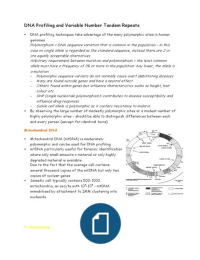
DNA profiling techniques take advantage of the many polymorphic sites in human
genomes
Polymorphism = DNA sequence variation that is common in the population – in this
case no single allele is regarded as the standard sequence, instead there are 2 or
ore equally acceptable alternatives
Arbitrary requirement between mutation and polymorphism = the least common
allele must have a frequency of 1% or more in the population. Any lower, the allele is
a mutation
- Polymorphic sequence variants do not normally cause overt debilitating diseases
- Many are found outside genes and have a neutral effect
- Others found within genes but influence characteristics suchs as height, hair
colour etc.
- SNP (single nucleotide polymorphism): contributes to disease susceptibility and
influence drug responses
- Sickle cell allele is polymorphic as it confers resistance to malaria
By observing the large number of modestly polymorphic sites or a modest number of
highly polymorphic sites – should be able to distinguish differences between each
and every person (except for identical twins)
Mitochondral DNA
Mitochondral DNA (mtDNA) is moderately
polymorphic and can be used for DNA profiling
mtDNA particularly useful for forensic identification
where only small amounts o material or only highly
degraded material is available
Due to the fact that the average cell contains
several thousand copies of the mtDNA but only two
copies of nuclear genes
Somatic cell typically contains 500-1000
mitochondria, an oocyte with 104-105 – mtDNA
immobilised by attachment to IMM clustering into
nucleoids
Y-chromosome
DNA profiling techniques take advantage of the many polymorphic sites in human
genomes
Polymorphism = DNA sequence variation that is common in the population – in this
case no single allele is regarded as the standard sequence, instead there are 2 or
ore equally acceptable alternatives
Arbitrary requirement between mutation and polymorphism = the least common
allele must have a frequency of 1% or more in the population. Any lower, the allele is
a mutation
- Polymorphic sequence variants do not normally cause overt debilitating diseases
- Many are found outside genes and have a neutral effect
- Others found within genes but influence characteristics suchs as height, hair
colour etc.
- SNP (single nucleotide polymorphism): contributes to disease susceptibility and
influence drug responses
- Sickle cell allele is polymorphic as it confers resistance to malaria
By observing the large number of modestly polymorphic sites or a modest number of
highly polymorphic sites – should be able to distinguish differences between each
and every person (except for identical twins)
Mitochondral DNA
Mitochondral DNA (mtDNA) is moderately
polymorphic and can be used for DNA profiling
mtDNA particularly useful for forensic identification
where only small amounts o material or only highly
degraded material is available
Due to the fact that the average cell contains
several thousand copies of the mtDNA but only two
copies of nuclear genes
Somatic cell typically contains 500-1000
mitochondria, an oocyte with 104-105 – mtDNA
immobilised by attachment to IMM clustering into
nucleoids
Y-chromosome