Chemistry Notes Topic 1.4 - Periodicity
The periodic table:
● All elements in a period have the same number of electron shells.
● This means that there are repeating trends in the physical/chemical properties.
These trends are known as periodicity.
● All elements in a group have the same number of electrons in their outer shell. This
means that they have similar chemical properties.
Chemical properties of groups:
● Electronic configuration (the number of outer shell electrons) decides the chemical
properties of an element.
● The s-block elements (groups 1 + 2) have 1 or 2 outer electrons which are easily lost
to form positive ions with an inert gas configuration.
● The d-block elements (transition metals) tend to lose s and d electrons to form
positive ions.
● The p-block elements (groups 5, 6 and 7) gain 1, 2 or 3 electrons to form negative
ions with an inert gas configuration.
● Groups 4 to 7 can also share electrons to form covalent bonds.
● Group 0 has full subshells.
Ionisation energy across a period:
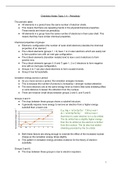
● As you move across a period, the ionisation energies increase.
● This is because the number of protons is increasing = stronger nuclear attraction.
● The extra electrons are at the same energy level so there's little extra shielding effect
or extra distance to lessen the attraction from the nucleus.
● There are however small drops between groups 2 and 3, and 5 and 6.
Groups 2 and 3:
● The drop between these groups shows a subshell structure.
● It generally requires more energy to remove an electron from a higher energy
subshell than a lower one.
E.g. Mg = 1s22s22p63s2 738 kJ mol-1
Al = 1s22s22p63s23p1 578 kJ mol-1
Aluminium’s outer electron is in a 3p orbital.
The 3p orbital has a slightly higher energy
than the 3s orbital so the electron is further
from the nucleus. The 3p also has added
shielding provided by the 3s orbital.
● Both these factors are strong enough to override the effect of the increased nuclear
charge so the ionisation energy drops slightly.
● This pattern in ionisation energy provides evidence for the theory of electron
subshells.
Groups 5 and 6:
● The drop between these groups is due to electron repulsion.
1
The periodic table:
● All elements in a period have the same number of electron shells.
● This means that there are repeating trends in the physical/chemical properties.
These trends are known as periodicity.
● All elements in a group have the same number of electrons in their outer shell. This
means that they have similar chemical properties.
Chemical properties of groups:
● Electronic configuration (the number of outer shell electrons) decides the chemical
properties of an element.
● The s-block elements (groups 1 + 2) have 1 or 2 outer electrons which are easily lost
to form positive ions with an inert gas configuration.
● The d-block elements (transition metals) tend to lose s and d electrons to form
positive ions.
● The p-block elements (groups 5, 6 and 7) gain 1, 2 or 3 electrons to form negative
ions with an inert gas configuration.
● Groups 4 to 7 can also share electrons to form covalent bonds.
● Group 0 has full subshells.
Ionisation energy across a period:
● As you move across a period, the ionisation energies increase.
● This is because the number of protons is increasing = stronger nuclear attraction.
● The extra electrons are at the same energy level so there's little extra shielding effect
or extra distance to lessen the attraction from the nucleus.
● There are however small drops between groups 2 and 3, and 5 and 6.
Groups 2 and 3:
● The drop between these groups shows a subshell structure.
● It generally requires more energy to remove an electron from a higher energy
subshell than a lower one.
E.g. Mg = 1s22s22p63s2 738 kJ mol-1
Al = 1s22s22p63s23p1 578 kJ mol-1
Aluminium’s outer electron is in a 3p orbital.
The 3p orbital has a slightly higher energy
than the 3s orbital so the electron is further
from the nucleus. The 3p also has added
shielding provided by the 3s orbital.
● Both these factors are strong enough to override the effect of the increased nuclear
charge so the ionisation energy drops slightly.
● This pattern in ionisation energy provides evidence for the theory of electron
subshells.
Groups 5 and 6:
● The drop between these groups is due to electron repulsion.
1