SEJPME Mod 2- National Military Command Structure Pre Test
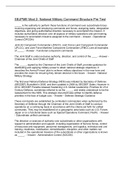
_____ is the authority to perform those functions of command over subordinate forces involving organizing and employing commands and forces, assigning tasks, designation
objectives, and giving authoritative direction necessary to accomplish the mission. It includes authoritative direction over all aspects of military operations and joint training necessary to accomplish missions assigned to the command. - Answer - Operational Control (OPCON)
Joint Air Component Commander (JFACC), Joint Force Land Component Commander (JFLCC), and Joint Force Maritime Component Commander (JFMCC) are all examples of _____ - Answer - Functional component commands
The Joint Staff is under exclusive authority, direction, and control of the ____ - Answer -
Chairman of the Joint Chiefs of Staff
The _____, signed by the Chairman of the Joint Chiefs of Staff, provides guidance for distributing and applying military power to attain national strategic objectives. It describes the Armed Forces' plan to achieve military objectives in the near term and provides the vision for ensuring they remain decisive in the future. - Answer - National Military Strategy
The first-ever National Defense Strategy (NDS) was initiated by Secretary of Defense (SECDEF) Rumsfeld in 2005, and then updated in 2008 by SECDEF Gates. However in
2012, SECDEF Panetta released Sustaining U.S. Global Leadership: Priorities for 21st Century Defense, sometimes referred to as the _____, and widely understood to be the replacement for the NDS. This strategic document was written to identify defense priorities in the face of budget cuts. - Answer - Defense Strategic Guidance
These commands are established by combatant commanders when authorized by the Secretary of Defense through the Chairman of the Joint Chiefs of Staff to conduct operations on a continuing basis in accordance with the criteria set forth for unified commands. They may be established on a geographic area basis such as U.S. Forces Japan or on a functional basis such as Special Operations Command, Pacific. - Answer - Subordinate unified commands
The direction or exercise of authority over subordinate or other organizations with respect to administration and support, including organization of Service forces, control of resources and equipment, personnel management, unit logistics, individual and unit training, readiness, mobilization, demobilization, discipline, and other matters not included in the operational missions of the subordinate or other organizations is known as _____. - Answer - Administrative Control (ADCON)
_____ is the authority to perform those functions of command over subordinate forces involving organizing and employing commands and forces, assigning tasks, designation
objectives, and giving authoritative direction necessary to accomplish the mission. It includes authoritative direction over all aspects of military operations and joint training necessary to accomplish missions assigned to the command. - Answer - Operational Control (OPCON)
Joint Air Component Commander (JFACC), Joint Force Land Component Commander (JFLCC), and Joint Force Maritime Component Commander (JFMCC) are all examples of _____ - Answer - Functional component commands
The Joint Staff is under exclusive authority, direction, and control of the ____ - Answer -
Chairman of the Joint Chiefs of Staff
The _____, signed by the Chairman of the Joint Chiefs of Staff, provides guidance for distributing and applying military power to attain national strategic objectives. It describes the Armed Forces' plan to achieve military objectives in the near term and provides the vision for ensuring they remain decisive in the future. - Answer - National Military Strategy
The first-ever National Defense Strategy (NDS) was initiated by Secretary of Defense (SECDEF) Rumsfeld in 2005, and then updated in 2008 by SECDEF Gates. However in
2012, SECDEF Panetta released Sustaining U.S. Global Leadership: Priorities for 21st Century Defense, sometimes referred to as the _____, and widely understood to be the replacement for the NDS. This strategic document was written to identify defense priorities in the face of budget cuts. - Answer - Defense Strategic Guidance
These commands are established by combatant commanders when authorized by the Secretary of Defense through the Chairman of the Joint Chiefs of Staff to conduct operations on a continuing basis in accordance with the criteria set forth for unified commands. They may be established on a geographic area basis such as U.S. Forces Japan or on a functional basis such as Special Operations Command, Pacific. - Answer - Subordinate unified commands
The direction or exercise of authority over subordinate or other organizations with respect to administration and support, including organization of Service forces, control of resources and equipment, personnel management, unit logistics, individual and unit training, readiness, mobilization, demobilization, discipline, and other matters not included in the operational missions of the subordinate or other organizations is known as _____. - Answer - Administrative Control (ADCON)