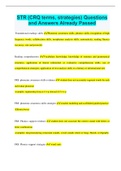
STR (CRQ terms, strategies) Questions and Answers Already Passed
STR (CRQ terms, strategies) Questions and Answers Already Passed Foundational readings skills Phonemic awareness skills, phonics skills, recognition of high frequency words, syllabication skills, morphemes analysis skills, automaticity, reading fluency (accuracy, rate and prosody) Reading comprehension Vocabulary knowledge, knowledge of sentence and grammatical structures, application of literal, inferential, or evaluative comprehension skills, use of comprehension strategies, application of text analysis skills to a literary or informational text FRS: phonemic awareness skills evidence -student does not accurately segment words by each individual phoneme -example: segmenting frog as f-o-g instead of f-r-o-g FRS: phonemic awareness skills strategies -teacher modeling and scaffolded guided practice -Elkonin boxes FRS: Phonics support evidence -student does not associate the correct sound with letters or letter combination -examples: mispronouncing consonant sounds, vowel sounds (short or long), blends, or digraphs FRS: Phonics support strategies -word sorts -explicit phonics instruction -chants and read aloud (students must be able to see the words for phonics practice, not just hear the sounds) FRS: Sight word automaticity evidence Student does not recognize high-frequency grade-level words that do not follow standard phonics rules (of, was, the, said, etc) FRS: Sight word automaticity strategies -practice with flash cards (students can have their own personal set based on sight word assessment) -provide word walls -practice reading in context (sight words underlined in simple sentences) FRS: Decoding multisyllabic words evidence -student pronounces only part of a multi syllabic word correctly -examples: student pronounces "mistake" as "missake" , or vocalizes the first "r" sound in "surprise" FRS: Decoding multisyllabic words strategies -teach student syllabication and the 6 syllable types (open, closed, vowel digraph/dipthong, r-controlled, VCe, final -le) -use foldable, cut and past activites, and syllable sorts -teach students how to recognized and annotate words according to their syllable type FRS: Decoding multisyllabic words with roots and affixes evidence -student leaves off or mispronounces prefixes or suffixes in words -examples: student pronouncing "biggest" as "Biggs", or a student omitting a word part, saying, "bad" instead of "badly" FRS: Decoding multisyllabic words with roots and affixes strategies -review morphology (word formation) and proper pronunciation -create a words part tree with students for common terms -haven students create their own words (real or fake) using word parts FRS: improve accuracy evidence Student mispronounces words or has other miscues, such as insertions, omissions, or substitution while reading FRS: improve accuracy strategies Automatic word recognition (slight words and automaticity in decoding) FRS: Use appropriate speed (rate) evidence Student reads too fast or too slow, interfering with ability to comprehend either way FRS: use appropriate speed (rate) strategies -paired, echos or choral reading -rereading familiar text FRS: improve prosody evidence Student does not read
École, étude et sujet
- Établissement
- STR
- Cours
- STR
Infos sur le Document
- Publié le
- 25 octobre 2022
- Nombre de pages
- 7
- Écrit en
- 2022/2023
- Type
- Examen
- Contenu
- Questions et réponses
Sujets
-
phonics skills
-
syllabication skills
-
morp
-
str crq terms
-
strategies questions and answers already passed
-
foundational readings skills phonemic awareness skills
-
recognition of high frequency words

Document également disponible en groupe