ACADEMIC COMPETENCES INFO SKILLS
MODULES
Module A: Understanding information
Popular, professional & scholarly sources
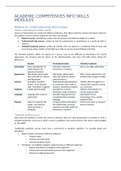
Sources of information are created for different audiences, that affects both the content and layout. Based on
the audience, sources can be categorizes into three main groups:
Popular sources: intended for readers who do not have specialist knowledge of a subject
Professional/trade sources: written by and for professionals or practitioners in a particular field or
industry
Scholarly/academic sources: written by scholars who are experts in a particular field of study and
serve to keep other scholars in that field up to date on recent research findings and ideas
The intended audience affects all aspects of a source, such as the difficulty of information, the overall
appearance, the presence and the nature of the advertisements, and more. The table below shows the
differences.
Popular Professional/trade Scholarly/academic
Advertising Many ads (typically for Ads (often related to No (or very little) advertising
retail products and profession or industry)
sponsored content)
Appearance Slick design, glossy paper, Slick design, glossy paper, Plain, serious appearance; may
with color pictures, photos with color pictures, photos include charts, graphs of tables
and illustrations and illustrations
Authors Journalists, freelance Professionals with experience Scholars who are experts in a
writers , or an editorial in a particular field, trade, or certain field, typically working
staff. Sometimes unsigned industry. Sometimes unsigned at a university.
Audience A large, general public Specialists in a certain Scholars and students of a
profession, trade of industry certain academic field
Language Language that is easy to Specialist language but less Specialized, formal
understand complicated than scholarly terminology from a certain
language academic field
Purpose Inform or entertain the Provide practical information Inform and report on research
reader, sell products, for professionals, promote done by scholars
and/or promote a education and skills within the
viewpoint profession or industry
Traditionally published sources
Apart from the audience to which the source is directed, there are other perspectives to consider as well. A
possible perspective is the way in which a source is publishes, how and by whom is the source made available
to the public?
Traditionally publishes sources come from a commercial or academic publisher. For example books and
periodicals:
Books/e-books, focusing on different audiences:
o Popular books
o Professional/trade books
o Scholarly/academic books
Periodicals, are publishes regularly. Again focusing on different audiences:
o Popular periodicals (newspapers and magazines)
o Professional/trade periodicals (journals and magazines)
o Scholarly periodicals (journals)
, A closer look at scholarly sources
Academics share their theories and research finding with the academic community in many ways, like talking to
colleagues, presenting papers at conferences, or posts in blogs or other websites. The most important way is by
publishing journal articles and books.
In order to effectively search for sources for writing an assignment, it’s critical that you can quickly identify
scholarly publications. Look for the following characteristics:
Authors: written by academics who are experts in the field of study
Language: advanced vocabulary
Citation: referring tot the origins of information and ideas the author has used
Citation is the practice of identifying the sources you have quoted, paraphrased or otherwise used in your
writing. Citation serves several purposes. It allows your reader to follow up on and verify claims that you make
in your writing. And it gives u the opportunity to acknowledge the people whose ideas you have used to
advance your argument.
Scholarly sources: Journals
Article types published by scholarly journals
Theoretical articles: present new or alternative ways of thinking about a subject
Research articles: report of new research.
Review articles: summarize the current state of knowledge about a research topic
Case studies: reports in which an individual, event or phenomenon is the subject of study.
Book reviews: relatively short articles that provide insight and opinion on recently publishes scholarly
books
The structure of scholarly articles is composed of the following components:
Article title
Abstract (the summary containing the key points discussed)
Introduction/literature review
Article text/body (for research articles the article body typically consists of methods and results
Discussion
Conclusion
References
One of the cornerstones of science is ‘peer review’. Peer review is the process whereby an article is assessed
for quality by his or her peers (experts working in the same field) before it’s published.
Scholarly sources: Books
Scholarly books are typically written for an expert audience and intended to share research findings. They
generally fall into four categories:
Monographs: books on a single specialized subject, usually written by a single author, but a
monograph may also be written by any number of authors.
Edited books: collections of articles/chapters on a subject, usually written by different authors,
gathered by one or more editors.
Conference proceedings: collections of papers presented at a conference, congress, or symposium
that are traditionally publishes in book form.
Textbooks: topically organized books of reference on a certain field of study, specifically for use as a
coursebook for students.
Reference works are useful to quickly get authoritative facts or information or an overview of a subject.
Examples of reference works are dictionaries, general encyclopedias, subject encyclopedias and handbooks.
MODULES
Module A: Understanding information
Popular, professional & scholarly sources
Sources of information are created for different audiences, that affects both the content and layout. Based on
the audience, sources can be categorizes into three main groups:
Popular sources: intended for readers who do not have specialist knowledge of a subject
Professional/trade sources: written by and for professionals or practitioners in a particular field or
industry
Scholarly/academic sources: written by scholars who are experts in a particular field of study and
serve to keep other scholars in that field up to date on recent research findings and ideas
The intended audience affects all aspects of a source, such as the difficulty of information, the overall
appearance, the presence and the nature of the advertisements, and more. The table below shows the
differences.
Popular Professional/trade Scholarly/academic
Advertising Many ads (typically for Ads (often related to No (or very little) advertising
retail products and profession or industry)
sponsored content)
Appearance Slick design, glossy paper, Slick design, glossy paper, Plain, serious appearance; may
with color pictures, photos with color pictures, photos include charts, graphs of tables
and illustrations and illustrations
Authors Journalists, freelance Professionals with experience Scholars who are experts in a
writers , or an editorial in a particular field, trade, or certain field, typically working
staff. Sometimes unsigned industry. Sometimes unsigned at a university.
Audience A large, general public Specialists in a certain Scholars and students of a
profession, trade of industry certain academic field
Language Language that is easy to Specialist language but less Specialized, formal
understand complicated than scholarly terminology from a certain
language academic field
Purpose Inform or entertain the Provide practical information Inform and report on research
reader, sell products, for professionals, promote done by scholars
and/or promote a education and skills within the
viewpoint profession or industry
Traditionally published sources
Apart from the audience to which the source is directed, there are other perspectives to consider as well. A
possible perspective is the way in which a source is publishes, how and by whom is the source made available
to the public?
Traditionally publishes sources come from a commercial or academic publisher. For example books and
periodicals:
Books/e-books, focusing on different audiences:
o Popular books
o Professional/trade books
o Scholarly/academic books
Periodicals, are publishes regularly. Again focusing on different audiences:
o Popular periodicals (newspapers and magazines)
o Professional/trade periodicals (journals and magazines)
o Scholarly periodicals (journals)
, A closer look at scholarly sources
Academics share their theories and research finding with the academic community in many ways, like talking to
colleagues, presenting papers at conferences, or posts in blogs or other websites. The most important way is by
publishing journal articles and books.
In order to effectively search for sources for writing an assignment, it’s critical that you can quickly identify
scholarly publications. Look for the following characteristics:
Authors: written by academics who are experts in the field of study
Language: advanced vocabulary
Citation: referring tot the origins of information and ideas the author has used
Citation is the practice of identifying the sources you have quoted, paraphrased or otherwise used in your
writing. Citation serves several purposes. It allows your reader to follow up on and verify claims that you make
in your writing. And it gives u the opportunity to acknowledge the people whose ideas you have used to
advance your argument.
Scholarly sources: Journals
Article types published by scholarly journals
Theoretical articles: present new or alternative ways of thinking about a subject
Research articles: report of new research.
Review articles: summarize the current state of knowledge about a research topic
Case studies: reports in which an individual, event or phenomenon is the subject of study.
Book reviews: relatively short articles that provide insight and opinion on recently publishes scholarly
books
The structure of scholarly articles is composed of the following components:
Article title
Abstract (the summary containing the key points discussed)
Introduction/literature review
Article text/body (for research articles the article body typically consists of methods and results
Discussion
Conclusion
References
One of the cornerstones of science is ‘peer review’. Peer review is the process whereby an article is assessed
for quality by his or her peers (experts working in the same field) before it’s published.
Scholarly sources: Books
Scholarly books are typically written for an expert audience and intended to share research findings. They
generally fall into four categories:
Monographs: books on a single specialized subject, usually written by a single author, but a
monograph may also be written by any number of authors.
Edited books: collections of articles/chapters on a subject, usually written by different authors,
gathered by one or more editors.
Conference proceedings: collections of papers presented at a conference, congress, or symposium
that are traditionally publishes in book form.
Textbooks: topically organized books of reference on a certain field of study, specifically for use as a
coursebook for students.
Reference works are useful to quickly get authoritative facts or information or an overview of a subject.
Examples of reference works are dictionaries, general encyclopedias, subject encyclopedias and handbooks.