Basic Characteristic of Science / 3 levels of investigation of science (DPC)
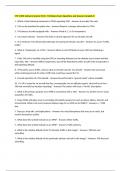
BCBA EXAM TERMS PART 1 Chapter 1: Definition and Characteristics of Applied Behavior Analysis Task List Number / Item Basic Characteristic of Science / 3 levels of investigation of science (DPC) Description Systematic observation enhances the understanding of a given phenomenon by enabling scientists to describe it accurately. Descriptive knowledge consists of a collection of facts about the observed events that can be quantified, classified, and examined for possible relations with other known facts—a necessary and important activity for any scientific discipline. The knowledge obtained from descriptive studies often suggests possible hypotheses or questions for additional research. Prediction A second level of scientific understanding occurs when repeated observations reveal that two events consistently covary with each other. That is, in the presence of one event (e.g., approaching winter) another event occurs (or fails to occur) with some specified probability (e.g., certain birds fly south). When systematic covariation between two events is found, this relationship— termed a correlation—can be used to predict the relative probability that one event will occur, based on the presence of the other event. Control The ability to predict with a certain degree of confidence is a valuable and useful result of science; prediction enables preparation. However, the greatest potential benefits from science are derived from the third, and highest, level of scientific understanding—control. Evidence of the kinds of control that can be derived from scientific findings in the physical and biological sciences surrounds us in the everyday technologies we take for granted: pasteurized milk and the refrigerators we store it in; flu shots and the automobiles we drive to go get them; pain relievers and the televisions that bombard us with advertisements and news stories about the drugs. A functional relation exists when a well-controlled experiment demonstrates that a specific change in one event (the dependent variable) is reliably produced by specific manipulations of another event (the independent variable), and that the change in the dependent variable was unlikely to be the result of other extraneous factors (confounding variables). Attitudes of Science (DEER PP) Assumptions and Attitudes of Science Determinism Science is predicated on the assumption of determinism. All scientists presume that the universe is a lawful and orderly place in which all phenomena occur as the result of other events. In other words, events do not just happen willy-nilly; they are related in systematic ways to other factors, which are themselves physical phenomena amenable to scientific investigation. Empiricism Scientific knowledge is built on, above all, empiricism—the practice of objective observation and measurement of the phenomena of interest. Objectivity in this sense means “independent of the individual prejudices, tastes, and private opinions of the scientist. Results of empirical methods are objective in that they are open to anyone’s observation and do not depend on the subjective belief of the individual scientist” The scientist’s empirical attitude, however, demands objective observation based on thorough description, systematic and repeated measurement, and precise quantification of the phenomena of interest. Experimentation When events are observed to covary or occur in close temporal sequence, a functional relation may exist, but other factors may be responsible for the observed values of the dependent variable. To investigate the possible existence of a functional relation, an experiment (or better, a series of experiments) must be performed in which the factor(s) suspected of having causal status are systematically controlled and manipulated while the effects on the event under study are carefully observed. Replication Replication—repeating of experiments (as well as repeating independent variable conditions within experiments)— “pervades every nook and cranny of the experimental method” (Johnston & Pennypacker, 1993a, p. 244). Replication is the primary method with which scientists determine the reliability and usefulness of their findings and discover their mistakes (Johnston & Pennypacker, 1980; 1993a; Sidman, 1960). Replication—not the infallibility or inherent honesty of scientists—is the primary reason science is a self-correcting enterprise that ultimately gets it right (Skinner, 1953). Parsimony parsimony requires that all simple, logical explanations for the phenomenon under investigation be ruled out, experimentally or conceptually, before more complex or abstract explanations are considered. Philosophic Doubt The attitude of philosophic doubt requires the scientist to continually question the truthfulness of what is regarded as fact. Scientific knowledge must always be viewed as tentative. Scientists must be willing to set aside their most cherished beliefs and findings and replace them with the knowledge derived from new discoveries. RESPONDENT VS OPERANT Respondent behaviour Respondent behavior is reflexive behavior as in the tradition of Ivan Pavlov (1927). Respondents are elicited, or “brought out,” by stimuli that immediately precede them. The antecedent stimulus (e.g., bright light) and the response it elicits (e.g., pupil constriction) form a functional unit called a reflex. Respondent behaviors are essentially involuntary and occur whenever the eliciting stimulus is presented. Operant behaviour Operant behaviors are not elicited by preceding stimuli but instead are influenced by stimulus changes that have followed the behavior in the past. Skinner’s most powerful and fundamental contribution to our understanding of behavior was his discovery and experimental analyses of the effects of consequences on behavior. The operant three-term contingency as the primary unit of analysis was a revolutionary conceptual breakthrough. Skinner’s Radical Behaviourism Radical behaviourism Skinner created a radical behaviorism that includes and seeks to understand all human behavior. “What is inside the skin, and how do we know about it? The answer is, I believe, the heart of radical behaviorism” (Skinner, 1974, p. 218). The proper connotations of the word radical in radi- cal behaviorism are far-reaching and thoroughgoing, connoting the philosophy’s inclusion of all behavior, public and private Methodological behaviourism Methodological behaviorists acknowledge the existence of mental events but do not consider them in the analysis of behavior (Skinner, 1974). Methodological behaviorists’ reliance on public events, excluding private events, restricts the knowl- edge base of human behavior and discourages innovation in the science of behavior. Methodological behaviorism is restrictive because it ignores areas of major importance for an understanding of behavior. Mentalism In general terms, mentalism may be defined as an approach to the study of behavior which assumes that a mental or “inner” dimension exists that differs from a behavioral dimension. This dimension is ordinarily referred to in terms of its neural, psychic, spiritual, subjective, conceptual, or hypothetical properties. Structuralism Structuralism and methodological behaviorism do reject all events that are not operationally defined by objective assessment. Structuralists avoid mental- ism by restricting their activities to descriptions of behavior. They make no scientific manipulations; accordingly, they do not address questions of causal factors. Mentalistic explanations of the behaviour Hypothetical constructs and explanatory fictions are the stock and trade of mentalism Hypothetical constructs Hypothetical constructs—“theoretical terms that refer to a possibly existing, but at the moment unobserved process or entity” (Moore, 1995, p. 36)—can be neither observed nor experimentally manipulated (MacCorquodale & Meehl, 1948; Zuriff, 1985). Free will, readiness,
École, étude et sujet
- Établissement
- COMM 1100
- Cours
- COMM 1100
Infos sur le Document
- Publié le
- 17 août 2022
- Nombre de pages
- 168
- Écrit en
- 2022/2023
- Type
- Examen
- Contenu
- Questions et réponses
Sujets
-
basic characteristic of science 3 levels of investigation of science dpc