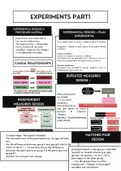
EXPERIMENTS PART1
EXPERIMENTAL DESIGNS &
PROCEDURE MATERIAL EXPERIMENTAL DESIGNS = PLAN
EXPERIMENTAL
Experiments are conducted to
test causal relationships. The VI andVD levels or values = modalités de la VD et de la
The experimenter = manipulates VI
the VI, controls all the other Assignment = location of participants to the experimentale
variables, measures the changes conditions
in the dependent variable Control condition :
Control or comparison group or condition
Participants are not exposed to the influence of the IV. +
Results are compared to the experimental conditions.
CAUSAL RELATIONSHIPS
Random assignment:
Participants are assigned to groups randomly Aims to
avoid bias during the selection.
REPEATED MEASURES
DESIGN :
When participants
are tested
INDEPENDENT in 2 (or more)
conditions,
MEASURES DESIGN their performance
may get better or worse
because of practice
/fatigue...
Solution: Counterbalancing
order effects
Disadvantages: Participant Variables MATCHED PAIR
The characteristics of the participants ex: IQ, age, attitude DESIGN
etc.
Are the differences between group A and group B due to the
▪
effect of the IV ? Or are they due to the differences
between the participants of group A & the participants of Each participant in one group is matched
group B? (paired) on several criteria (e.g. age,
Solution: Pre-test post-test design gender, occupation, I.Q. etc.) with a
participant in the other group.
--> So, the groups have a similar
composition. /Subject or Participant
variables are neutralised.
EXPERIMENTAL DESIGNS &
PROCEDURE MATERIAL EXPERIMENTAL DESIGNS = PLAN
EXPERIMENTAL
Experiments are conducted to
test causal relationships. The VI andVD levels or values = modalités de la VD et de la
The experimenter = manipulates VI
the VI, controls all the other Assignment = location of participants to the experimentale
variables, measures the changes conditions
in the dependent variable Control condition :
Control or comparison group or condition
Participants are not exposed to the influence of the IV. +
Results are compared to the experimental conditions.
CAUSAL RELATIONSHIPS
Random assignment:
Participants are assigned to groups randomly Aims to
avoid bias during the selection.
REPEATED MEASURES
DESIGN :
When participants
are tested
INDEPENDENT in 2 (or more)
conditions,
MEASURES DESIGN their performance
may get better or worse
because of practice
/fatigue...
Solution: Counterbalancing
order effects
Disadvantages: Participant Variables MATCHED PAIR
The characteristics of the participants ex: IQ, age, attitude DESIGN
etc.
Are the differences between group A and group B due to the
▪
effect of the IV ? Or are they due to the differences
between the participants of group A & the participants of Each participant in one group is matched
group B? (paired) on several criteria (e.g. age,
Solution: Pre-test post-test design gender, occupation, I.Q. etc.) with a
participant in the other group.
--> So, the groups have a similar
composition. /Subject or Participant
variables are neutralised.