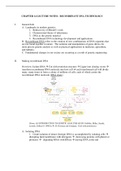
CHAPTER 14 LECTURE NOTES: RECOMBINANT DNA TECHNOLOGY
I. General Info
A. Landmarks in modern genetics
1. Rediscovery of Mendel’s work
2. Chromosomal theory of inheritance
3. DNA as the genetic material
4. Recombinant DNA technology development and applications
B. Recombinant DNA refers to the creation of new combinations of DNA segments that
are not found together in nature. The isolation and manipulation of genes allows for
more precise genetic analysis as well as practical applications in medicine, agriculture,
and industry.
C. Fundamental changes in our society are occurring as a result of genetic engineering.
II. Making recombinant DNA
Overview: Isolate DNA à Cut with restriction enzymes à Ligate into cloning vector à
transform recombinant DNA molecule into host cell à each transformed cell will divide
many, many times to form a colony of millions of cells, each of which carries the
recombinant DNA molecule (DNA clone)
(From: AN INTRODUCTION TO GENETIC ANALYSIS 6/E BY Griffiths, Miller, Suzuki,
Leontin, Gelbart 1996 by W. H. Freeman and Company. Used with permission.)
A. Isolating DNA
1. Crude isolation of donor (foreign) DNA is accomplished by isolating cells à
disrupting lipid membranes with detergents à destroying proteins with phenol or
proteases à degrading RNAs with RNase à leaving DNA at the end
, 2. Crude isolation of plasmid vector DNA is accomplished by an alkaline lysis
procedure or by boiling cells which removes bacterial chromosomal DNA from
plasmid DNA.
3. To get purer DNA from either (1) or (2), crude DNA is
a) Fractionated on a CsCl2 gradient
b) Precipitated with ethanol
c) Poured over a resin column that specifically binds DNA
B. Cutting DNA
1. DNA can be cut into large fragments by mechanical shearing.
2. Restriction enzymes are the scissors of molecular genetics. Restriction
enzymes (RE) are endonucleases that will recognize specific nucleotide sequences
in the DNA and break the DNA chain at those points. A variety of RE have been
isolated and are commercially available. Most cut at specific palindromic sites in
the DNA (sequence that is the same on both antiparallel DNA strands). These
cuts can be a staggered which generate “sticky or overhanging ends” or a blunt
which generate flush ends.
5’--GAATTC--3’ 5’--G AATTC--3’
3’--CTTAAG--5’ 3’--CTTAA G--5’
C. Joining DNA
Once you have isolated and cut the donor and vector DNAs, they must be joined together.
The DNAs are mixed together in a tube. If both have been cut with the same RE, the
ends will match up because they are sticky. DNA ligase is the glue of molecular genetics
that holds the ends of the DNAs together. DNA ligase creates a phosophodiester bond
between two DNA ends.
(From: AN INTRODUCTION TO GENETIC ANALYSIS 6/E BY Griffiths, Miller, Suzuki,
Leontin, Gelbart 1996 by W. H. Freeman and Company. Used with permission.)
, D. Amplifying the recombinant DNA
To recover large amounts of the recombinant DNA molecule, it must be amplified. This
is accomplished by transforming the recombinant DNA into a bacterial host strain. (The
cells are treated with CaCl2 à DNA is added à Cells are heat shocked at 42 C à DNA
goes into cell by a somewhat unknown mechanism.) Once in a cell, the recombinant
DNA will be replicated. When the cell divides, the replicated recombinant molecules go
to both daughter cells which themselves will divide later. Thus, the DNA is amplified.
(From: AN INTRODUCTION TO GENETIC ANALYSIS 6/E BY Griffiths, Miller, Suzuki, Leontin,
Gelbart 1996 by W. H. Freeman and Company. Used with permission.)
DNA clone = A section of DNA that has been inserted into a vector molecule and then
replicated in a host cell to form many copies.
E. Vectors
1. Requirements for a cloning vector
a) Should be capable of replicating in host cell
b) Should have convenient RE sites for inserting DNA of interest
c) Should have a selectable marker to indicate which host cells received
recombinant DNA molecule
d) Should be small and easy to isolate
I. General Info
A. Landmarks in modern genetics
1. Rediscovery of Mendel’s work
2. Chromosomal theory of inheritance
3. DNA as the genetic material
4. Recombinant DNA technology development and applications
B. Recombinant DNA refers to the creation of new combinations of DNA segments that
are not found together in nature. The isolation and manipulation of genes allows for
more precise genetic analysis as well as practical applications in medicine, agriculture,
and industry.
C. Fundamental changes in our society are occurring as a result of genetic engineering.
II. Making recombinant DNA
Overview: Isolate DNA à Cut with restriction enzymes à Ligate into cloning vector à
transform recombinant DNA molecule into host cell à each transformed cell will divide
many, many times to form a colony of millions of cells, each of which carries the
recombinant DNA molecule (DNA clone)
(From: AN INTRODUCTION TO GENETIC ANALYSIS 6/E BY Griffiths, Miller, Suzuki,
Leontin, Gelbart 1996 by W. H. Freeman and Company. Used with permission.)
A. Isolating DNA
1. Crude isolation of donor (foreign) DNA is accomplished by isolating cells à
disrupting lipid membranes with detergents à destroying proteins with phenol or
proteases à degrading RNAs with RNase à leaving DNA at the end
, 2. Crude isolation of plasmid vector DNA is accomplished by an alkaline lysis
procedure or by boiling cells which removes bacterial chromosomal DNA from
plasmid DNA.
3. To get purer DNA from either (1) or (2), crude DNA is
a) Fractionated on a CsCl2 gradient
b) Precipitated with ethanol
c) Poured over a resin column that specifically binds DNA
B. Cutting DNA
1. DNA can be cut into large fragments by mechanical shearing.
2. Restriction enzymes are the scissors of molecular genetics. Restriction
enzymes (RE) are endonucleases that will recognize specific nucleotide sequences
in the DNA and break the DNA chain at those points. A variety of RE have been
isolated and are commercially available. Most cut at specific palindromic sites in
the DNA (sequence that is the same on both antiparallel DNA strands). These
cuts can be a staggered which generate “sticky or overhanging ends” or a blunt
which generate flush ends.
5’--GAATTC--3’ 5’--G AATTC--3’
3’--CTTAAG--5’ 3’--CTTAA G--5’
C. Joining DNA
Once you have isolated and cut the donor and vector DNAs, they must be joined together.
The DNAs are mixed together in a tube. If both have been cut with the same RE, the
ends will match up because they are sticky. DNA ligase is the glue of molecular genetics
that holds the ends of the DNAs together. DNA ligase creates a phosophodiester bond
between two DNA ends.
(From: AN INTRODUCTION TO GENETIC ANALYSIS 6/E BY Griffiths, Miller, Suzuki,
Leontin, Gelbart 1996 by W. H. Freeman and Company. Used with permission.)
, D. Amplifying the recombinant DNA
To recover large amounts of the recombinant DNA molecule, it must be amplified. This
is accomplished by transforming the recombinant DNA into a bacterial host strain. (The
cells are treated with CaCl2 à DNA is added à Cells are heat shocked at 42 C à DNA
goes into cell by a somewhat unknown mechanism.) Once in a cell, the recombinant
DNA will be replicated. When the cell divides, the replicated recombinant molecules go
to both daughter cells which themselves will divide later. Thus, the DNA is amplified.
(From: AN INTRODUCTION TO GENETIC ANALYSIS 6/E BY Griffiths, Miller, Suzuki, Leontin,
Gelbart 1996 by W. H. Freeman and Company. Used with permission.)
DNA clone = A section of DNA that has been inserted into a vector molecule and then
replicated in a host cell to form many copies.
E. Vectors
1. Requirements for a cloning vector
a) Should be capable of replicating in host cell
b) Should have convenient RE sites for inserting DNA of interest
c) Should have a selectable marker to indicate which host cells received
recombinant DNA molecule
d) Should be small and easy to isolate