BUSINESS LAW SUMMARY
Ch. 3
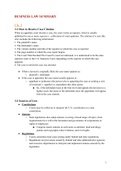
3.1 How to Read a Case Citation
When an appellate court decides a case, the court writes an opinion, which is usually
published in one or more reporters—collections of court opinions. The citation of a case (the
cite) includes the following information:
1. The plaintiff’s name.
2. The defendant’s name.
3. The volume number and title of the reporter in which the case is reported.
4. The page number at which the case report begins.
5. The Court That Decided The Case(if a court not indicated, it is understood to be the state
supreme court or the U.S. Supreme Court, depending on the reporter in which the case
appears).
6. The year in which the case was decided.
● When a lawsuit is originally filed, the case name appears as
○ plaintiff v. defendant.
● If the case is appealed, the case name usually appears as
○ appellant or petitioner (the person who is appealing the case or seeking a writ
of certiorari) v. appellee or respondent (the other party).
■ So, if the defendant loses at the trial level and appeals the decision to a
higher court, the name of the defendant (now the appellant) will appear
first in the case citation.
3.2 Sources of Law
● Constitutions
○ Courts may be called on to interpret the U.S. constitution or a state
constitution.
● Statutes
○ State legislatures also adopt statutes covering a broad range of topics, from
requirements for a will to the formation and governance of corporations to
rights of employers.
■ Congress enacts statutes in such areas as antitrust, food and drugs,
patents and copyrights, labor relations, and civil rights.
● Regulations
○ Courts sometimes hear cases arising under federal and state regulations.
○ Regulations are provisions issued by federal and state administrative agencies
and executive departments to interpret and implement statutes enacted by the
legislature.
1
, ● Common Law and the Doctrine of Stare Decisis
○ Common law is case law—the legal rules made by judges when they decide a
case where no constitution, statute, or regulation exists to resolve the dispute.
○ Common law is developed through the doctrine of stare decisis, which means
“to abide by decided cases.” Once a court resolves a specific issue, other
courts in the same jurisdiction addressing a similar legal problem will gener-
ally follow that court’s decision.
■ persuasive if it reasonably and fairly resolves the dispute.
■ an authoritative decision, by contrast, is one that must be followed,
regardless of its persuasive power.
● Restatements
○ Many rules that originated as common law have been collected into
restatements.
○ There are restatements of various areas of the law, such as torts, contracts,
property, and trusts. The restatements are persuasive rather than authoritative.
Reversing U.S. Supreme Court Precedent
The U.S. The Supreme Court rarely overrules its previous decisions, but it does do so on
occasion.
● 1. Has the prior decision’s central rule proved unworkable?
● 2. Can the rule be changed without serious inequity to those who have relied on it, or
would such a change significantly damage the stability of the society governed by the
rule in question?
● 3. Has the law’s growth in the intervening years left the prior decision’s central rule a
doctrinal anachronism discounted by society?
● 4. Have the prior decision’s premises of fact so greatly changed since the decision was
issued as to render its central holding somehow irrelevant or unjustifiable in dealing
with the issue it addressed?
Courts apply stare decisis more “rigidly” in statutory cases than in constitutional cases.
Splits in the Circuits
Just as one trial court does not have to follow the decision of another trial court, the court of
appeals in one circuit does not have to follow a decision by a court of appeals in another
circuit.
3.3 The U.S. and State Court Systems
Federal and state courts have different subject matter jurisdiction, meaning that they have the
power to hear different kinds of cases.
● Federal courts are courts of limited subject matter jurisdiction, meaning that they can
adjudicate only certain types of cases.
○ The jurisdiction of the federal courts arises from the U.S. Constitution and
statutes enacted by Congress.
2
Ch. 3
3.1 How to Read a Case Citation
When an appellate court decides a case, the court writes an opinion, which is usually
published in one or more reporters—collections of court opinions. The citation of a case (the
cite) includes the following information:
1. The plaintiff’s name.
2. The defendant’s name.
3. The volume number and title of the reporter in which the case is reported.
4. The page number at which the case report begins.
5. The Court That Decided The Case(if a court not indicated, it is understood to be the state
supreme court or the U.S. Supreme Court, depending on the reporter in which the case
appears).
6. The year in which the case was decided.
● When a lawsuit is originally filed, the case name appears as
○ plaintiff v. defendant.
● If the case is appealed, the case name usually appears as
○ appellant or petitioner (the person who is appealing the case or seeking a writ
of certiorari) v. appellee or respondent (the other party).
■ So, if the defendant loses at the trial level and appeals the decision to a
higher court, the name of the defendant (now the appellant) will appear
first in the case citation.
3.2 Sources of Law
● Constitutions
○ Courts may be called on to interpret the U.S. constitution or a state
constitution.
● Statutes
○ State legislatures also adopt statutes covering a broad range of topics, from
requirements for a will to the formation and governance of corporations to
rights of employers.
■ Congress enacts statutes in such areas as antitrust, food and drugs,
patents and copyrights, labor relations, and civil rights.
● Regulations
○ Courts sometimes hear cases arising under federal and state regulations.
○ Regulations are provisions issued by federal and state administrative agencies
and executive departments to interpret and implement statutes enacted by the
legislature.
1
, ● Common Law and the Doctrine of Stare Decisis
○ Common law is case law—the legal rules made by judges when they decide a
case where no constitution, statute, or regulation exists to resolve the dispute.
○ Common law is developed through the doctrine of stare decisis, which means
“to abide by decided cases.” Once a court resolves a specific issue, other
courts in the same jurisdiction addressing a similar legal problem will gener-
ally follow that court’s decision.
■ persuasive if it reasonably and fairly resolves the dispute.
■ an authoritative decision, by contrast, is one that must be followed,
regardless of its persuasive power.
● Restatements
○ Many rules that originated as common law have been collected into
restatements.
○ There are restatements of various areas of the law, such as torts, contracts,
property, and trusts. The restatements are persuasive rather than authoritative.
Reversing U.S. Supreme Court Precedent
The U.S. The Supreme Court rarely overrules its previous decisions, but it does do so on
occasion.
● 1. Has the prior decision’s central rule proved unworkable?
● 2. Can the rule be changed without serious inequity to those who have relied on it, or
would such a change significantly damage the stability of the society governed by the
rule in question?
● 3. Has the law’s growth in the intervening years left the prior decision’s central rule a
doctrinal anachronism discounted by society?
● 4. Have the prior decision’s premises of fact so greatly changed since the decision was
issued as to render its central holding somehow irrelevant or unjustifiable in dealing
with the issue it addressed?
Courts apply stare decisis more “rigidly” in statutory cases than in constitutional cases.
Splits in the Circuits
Just as one trial court does not have to follow the decision of another trial court, the court of
appeals in one circuit does not have to follow a decision by a court of appeals in another
circuit.
3.3 The U.S. and State Court Systems
Federal and state courts have different subject matter jurisdiction, meaning that they have the
power to hear different kinds of cases.
● Federal courts are courts of limited subject matter jurisdiction, meaning that they can
adjudicate only certain types of cases.
○ The jurisdiction of the federal courts arises from the U.S. Constitution and
statutes enacted by Congress.
2