Lecture 1 : organization of the nervous system
Cells of the NS : neurons & glia -> neural circuits (+endoth cells, pericytes)
Neural circuits : primary components of the neural sys, process specific types of info
neural syst :
1) sensory syst
2) motor syst
3) association syst : sens + motor
Genetics and the brain : Human -> 20’000 genes, 14’000 expressed in the developing brain, 8’000 in all cells and
tissue
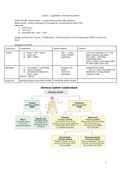
Subdivision of the NS :
Subdivision Components Special features Location
Central 1) Brain (+ CN2 + retina) - Oligo → myelin - Covered by meninges (o->i : dura
2) spinal cord - Axons CANNOT mater, arachnoid, pia mater)
3) Optic n (CN2) regenerate - Gray matter : cell bodies +
unmyelinated fibers
- nuclei : clusters of cell bodies within
the white matter of the CNS
Peripheral 1) Peri ganglia* (+ cell bodies) - Schwann cell -> - outside the dura mater
2) sensory respector myelin - * = Gps of n. cells concentrated into
3) peri portion of spinal cord + - Axons can small knots or clumps located
CN (no CN2) regenerate outside the CNS
Afferent + efferent
Autonomic Selected portions of the CNS and PNS Functionally distinct system
1
, Types of Nervous T cells
1. Neurons : sensory/motor/interneurons/ association neurons
a) Characteristics
1) Excitabiliy
- stimulus
- AP (produce + conduction)
- neurotransmitters (release chemical regulators)
2) long-lived
3) high metabolic rate for high energetic consume
4) amitotic-cannot divide by mitosis
!!! neurons arise 4 mo intrauterine life. !!! Exp : olfactory bulb n. renewed continually by stem cell or neuronal
progenitor cells
b) strc
str Organelles Cytoskeleton plus
Cell body/ soma/ nucleus neurofilaments
perikaryon ER microtubules
Golgi complex thin filaments (dyn
mitochondria features → plasticity)
Dendrites ER Microtubules - limites length
- membrane receptors for neurotransmitters
-dendritic spines: amplify the receiving/ postsynaptic area
Axon axoplasm microtubules - axon hillock : unmyelinated
microfilaments - axon : myelinated
- self reliant in energy metabolism, taking up glucose +
oxygen from their immediate envi to produce ATP
Presynaptic terminals elect signal → chemical signal or other (signal transduction)
c) neuronal compartmentalization
- n. are polarized cells
- Axoplasmic transport of molecules in vesicles is mediated by microtubule-associated proteins
(MAPs) :
1) Kinesin* - Anterograde transport, → axon terminal/ presynaptic seg, (+) end of
microtubules
*energized by ATP
2) Dynein* (MAP-1C) - retrograde transport, → postsynaptic
*splits ATP
2
,d) Classification
1) Axonal projection (long/short)
2) Dendrites geometry/shape (pyramidal/stellate/spiny)
3) Nbr of processes originating from cell body (unipolar/bipolar/multipolar)
4) N. based on their function
- Sensory (afferent) n
● carry impulses from the sensory receptors
● cutaneous sense organs
● proprioceptors - detect stretch or tension
- Motor (efferent) n
● Carry impulses from CNS
- Interneurons (association n)
● found only in the CNS, in neural pathways
● connect sensory + motor
3
, 2. Non-neuronal/neuroglial cells : astrocytes/ microglia/ ependymal cells/ oligodendrocytes/ Schwann cells
- smaller & more numerous
- no axons
- no AP
Astrocytes 1) Helps form the blood-brain barrier
2) regulates IF composition
3) Provides str support + organization to the CNS
4) Assist w neuronal dvp
5) Replicates to occupy space of dying n.
Ependymal Cell 1) lines ventricles of the brain + central canal of spinal cord
2) assists in production + circulation of CSF
Microglial Cell 1) Phagocytic cells, move through the CNS
2) Protects the CNS by engulfing infectious agents + other potential harmful
substances
Oligodendrocyte 1) Myelinates + insulates CNS axons
2) Allows faster action potential propagation along axons in the CNS
Glial Cell function :
- major impact on the compo of the ECF (ECF, major role in blood barrier)
- Glial Fills in almost all the space around neurons: EC space btw neurons and glial cells
- Clear transmitters from synapse, role in ion homeostasis, cell volume control, vol transmission (K+ & H+
uptake- role in maintaining neuronal excitability)
- Myelin synt by oligon (CNS), Schwann cells (PNS)
- Neuron-glia connections assist synchronous firing in the neural net
- Neurovascular unit- cerebral capillary (BBB), pericytes, astrocytes, microglia, neurons : assist
neurovascular coupling (increased n metabolism in active brain areas det vasodilation + increased local
blood perfusion)
4
Cells of the NS : neurons & glia -> neural circuits (+endoth cells, pericytes)
Neural circuits : primary components of the neural sys, process specific types of info
neural syst :
1) sensory syst
2) motor syst
3) association syst : sens + motor
Genetics and the brain : Human -> 20’000 genes, 14’000 expressed in the developing brain, 8’000 in all cells and
tissue
Subdivision of the NS :
Subdivision Components Special features Location
Central 1) Brain (+ CN2 + retina) - Oligo → myelin - Covered by meninges (o->i : dura
2) spinal cord - Axons CANNOT mater, arachnoid, pia mater)
3) Optic n (CN2) regenerate - Gray matter : cell bodies +
unmyelinated fibers
- nuclei : clusters of cell bodies within
the white matter of the CNS
Peripheral 1) Peri ganglia* (+ cell bodies) - Schwann cell -> - outside the dura mater
2) sensory respector myelin - * = Gps of n. cells concentrated into
3) peri portion of spinal cord + - Axons can small knots or clumps located
CN (no CN2) regenerate outside the CNS
Afferent + efferent
Autonomic Selected portions of the CNS and PNS Functionally distinct system
1
, Types of Nervous T cells
1. Neurons : sensory/motor/interneurons/ association neurons
a) Characteristics
1) Excitabiliy
- stimulus
- AP (produce + conduction)
- neurotransmitters (release chemical regulators)
2) long-lived
3) high metabolic rate for high energetic consume
4) amitotic-cannot divide by mitosis
!!! neurons arise 4 mo intrauterine life. !!! Exp : olfactory bulb n. renewed continually by stem cell or neuronal
progenitor cells
b) strc
str Organelles Cytoskeleton plus
Cell body/ soma/ nucleus neurofilaments
perikaryon ER microtubules
Golgi complex thin filaments (dyn
mitochondria features → plasticity)
Dendrites ER Microtubules - limites length
- membrane receptors for neurotransmitters
-dendritic spines: amplify the receiving/ postsynaptic area
Axon axoplasm microtubules - axon hillock : unmyelinated
microfilaments - axon : myelinated
- self reliant in energy metabolism, taking up glucose +
oxygen from their immediate envi to produce ATP
Presynaptic terminals elect signal → chemical signal or other (signal transduction)
c) neuronal compartmentalization
- n. are polarized cells
- Axoplasmic transport of molecules in vesicles is mediated by microtubule-associated proteins
(MAPs) :
1) Kinesin* - Anterograde transport, → axon terminal/ presynaptic seg, (+) end of
microtubules
*energized by ATP
2) Dynein* (MAP-1C) - retrograde transport, → postsynaptic
*splits ATP
2
,d) Classification
1) Axonal projection (long/short)
2) Dendrites geometry/shape (pyramidal/stellate/spiny)
3) Nbr of processes originating from cell body (unipolar/bipolar/multipolar)
4) N. based on their function
- Sensory (afferent) n
● carry impulses from the sensory receptors
● cutaneous sense organs
● proprioceptors - detect stretch or tension
- Motor (efferent) n
● Carry impulses from CNS
- Interneurons (association n)
● found only in the CNS, in neural pathways
● connect sensory + motor
3
, 2. Non-neuronal/neuroglial cells : astrocytes/ microglia/ ependymal cells/ oligodendrocytes/ Schwann cells
- smaller & more numerous
- no axons
- no AP
Astrocytes 1) Helps form the blood-brain barrier
2) regulates IF composition
3) Provides str support + organization to the CNS
4) Assist w neuronal dvp
5) Replicates to occupy space of dying n.
Ependymal Cell 1) lines ventricles of the brain + central canal of spinal cord
2) assists in production + circulation of CSF
Microglial Cell 1) Phagocytic cells, move through the CNS
2) Protects the CNS by engulfing infectious agents + other potential harmful
substances
Oligodendrocyte 1) Myelinates + insulates CNS axons
2) Allows faster action potential propagation along axons in the CNS
Glial Cell function :
- major impact on the compo of the ECF (ECF, major role in blood barrier)
- Glial Fills in almost all the space around neurons: EC space btw neurons and glial cells
- Clear transmitters from synapse, role in ion homeostasis, cell volume control, vol transmission (K+ & H+
uptake- role in maintaining neuronal excitability)
- Myelin synt by oligon (CNS), Schwann cells (PNS)
- Neuron-glia connections assist synchronous firing in the neural net
- Neurovascular unit- cerebral capillary (BBB), pericytes, astrocytes, microglia, neurons : assist
neurovascular coupling (increased n metabolism in active brain areas det vasodilation + increased local
blood perfusion)
4