

E M E R G E N C Y N U R S E S A S S O C I AT I O N
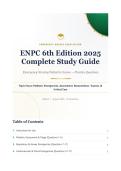
ENPC 6th Edition 2025
Complete Study Guide
Emergency Nursing Pediatric Course — Practice Questions
Topic Focus: Pediatric Emergencies, Assessment, Resuscitation, Trauma, &
Critical Care
Edition 1 · August 2026 · 25 Questions
Table of Contents
1. Instructions for Use 2
2. Pediatric Assessment & Triage (Questions 1–6) 2
3. Respiratory & Airway Emergencies (Questions 7–11) 4
4. Cardiovascular & Shock Emergencies (Questions 12–17) 5
,5. Trauma & Injury (Questions 18–22) 6
6. Special Populations & Psychosocial (Questions 23–25) 7
ENPC 6th Edition 2025 Page 1
, ENPC 6TH EDITION 2025 STUDY GUIDE ASSESSMENT & TRIAGE — Q1–6
How to Use This Guide
Read each stem, choose your answer, then check the rationale directly below it. The correct
option is marked, and each wrong option is explained so you understand why it's wrong — not
just that it is. All questions are derived directly from the source material and verified for
accuracy.
Category: Pediatric Assessment & Triage — Questions 1–6
1 A 5-year-old child presents to the emergency department after being hit by a car.
The patient complains of left upper quadrant pain, and the focused assessment with
sonography for trauma (FAST) exam shows fluid around her spleen. Which of the
following findings would be an early indication of ongoing blood loss?
A Widening pulse pressure
B Bradycardia
C Decreasing diastolic blood pressure
D Weak peripheral pulses
Why D is correct: Early signs of hypovolemic shock include tachycardia and delayed
capillary refill. The nurse may note a strong central pulse but weaker peripheral pulses,
indicating the child is compensating by shunting blood to their core.
A — Widening pulse pressure is a sign of increased intracranial pressure, not shock.
B — Bradycardia is a late sign of shock; tachycardia is early.
C — Decreasing diastolic pressure is not the earliest sign.
ENPC 6th Edition 2025
Complete Study Guide
Emergency Nursing Pediatric Course — Practice Questions
Topic Focus: Pediatric Emergencies, Assessment, Resuscitation, Trauma, &
Critical Care
Edition 1 · August 2026 · 25 Questions
Table of Contents
1. Instructions for Use 2
2. Pediatric Assessment & Triage (Questions 1–6) 2
3. Respiratory & Airway Emergencies (Questions 7–11) 4
4. Cardiovascular & Shock Emergencies (Questions 12–17) 5
,5. Trauma & Injury (Questions 18–22) 6
6. Special Populations & Psychosocial (Questions 23–25) 7
ENPC 6th Edition 2025 Page 1
, ENPC 6TH EDITION 2025 STUDY GUIDE ASSESSMENT & TRIAGE — Q1–6
How to Use This Guide
Read each stem, choose your answer, then check the rationale directly below it. The correct
option is marked, and each wrong option is explained so you understand why it's wrong — not
just that it is. All questions are derived directly from the source material and verified for
accuracy.
Category: Pediatric Assessment & Triage — Questions 1–6
1 A 5-year-old child presents to the emergency department after being hit by a car.
The patient complains of left upper quadrant pain, and the focused assessment with
sonography for trauma (FAST) exam shows fluid around her spleen. Which of the
following findings would be an early indication of ongoing blood loss?
A Widening pulse pressure
B Bradycardia
C Decreasing diastolic blood pressure
D Weak peripheral pulses
Why D is correct: Early signs of hypovolemic shock include tachycardia and delayed
capillary refill. The nurse may note a strong central pulse but weaker peripheral pulses,
indicating the child is compensating by shunting blood to their core.
A — Widening pulse pressure is a sign of increased intracranial pressure, not shock.
B — Bradycardia is a late sign of shock; tachycardia is early.
C — Decreasing diastolic pressure is not the earliest sign.


