Problem 5 2.6
Where is my mind?
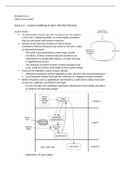
Source 1 – causal modelling of panic disorder theories
Clark’s model
His explanation of panic disorder was based on the subject's
catastrophic misinterpretation of certain bodily sensations
that are associated with anxiety responses
Stimuli can be external (context) or internal (body
sensations). If these stimuli are perceived as a threat, a state
of mild anxiety results.
- This state is accompanied by a wide range of body
sensations. If these anxiety-produced sensations are
interpreted in a catastrophic fashion, a further increase
in apprehension occurs.
- This produces a further increase in body sensations and
so on round in a vicious circle which ends in a panic attack
Focus on the repetitive nature of panic attacks
1. infrequent autonomic events regarded as panic attacks in the normal population
2. recurring panic attacks that typically culminate in a diagnosis of panic disorder
Bodily sensations, such as palpitations and dizziness, could arise in daily events such
as exercise, walking or excitement and anger
- In panic disorder, the individual cognitively misinterprets these bodily sensations
as evidence of impending danger.
- palpitations heart attack
, - dizziness impending loss of control
Internal trigger stimuli- low-level bodily sensations e.g., palpitations
- After the initial trigger, these bodily sensations become part of the vicious circle.
Antecedent cause = learned threat caused by some previously occurring critical
event
- Vicious circle (thick dotted lines) can be started off either by an external trigger
or by an internal trigger: an initial, relatively small variation in bodily sensations
- there must be a threshold level of bodily sensation above which the panic attack
will be triggered
A composite cognitive theory
The patient comes with three antecedent conditions:
1. lower self-efficacy - arising from early attachment problems
2. high anxiety sensitivity – arising from a genetic predisposition or from
attachment problems
3. learned threat - arising from some early critical event
Together, these make the system underlying the vicious circle susceptible to being
triggered
- can happen externally - combination of the external trigger + learned threat
- or internally - have allowed low self-efficacy to lead to an increase in arousal
levels, leading to bodily sensations that trigger the vicious circle. We have also
allowed an option to have the circle operate without catastrophic
misinterpretation
different theories fit together in a way that leads to panic attacks being
overdetermined
several approaches that occur on studying the composite:
, 1. To question whether all the crucial constructs are valid, namely, learned threat,
high AS and low self-efficacy
2. To ask whether certain of these constructs themselves are caused by another.
E.g., if someone acquires a learned threat [in Clark's terms] will they develop
high AS.
3. To ask whether the three constructs correspond to distinct subgroups of PD
patient or could be seen as three dimensions, with each patient having a value
on each
Pure causal model of the composite cognitive theory
Focus on the state of the panic disorder sufferer, indicating the precursors for the
possible developmental relationship between high AS and low self-efficacy are
shown
- These links are missing in the model above since there are no theories that
assume an interaction between these factors in the course of a panic attack
- Here, we include the detail of the operation of the system during a panic attack
- the vicious circle is here referred to simply as a state of the patient, not as a
mechanism
- can also be seen as a description of the patient’s history
Neuroanatomical theories – Gorman
Where is my mind?
Source 1 – causal modelling of panic disorder theories
Clark’s model
His explanation of panic disorder was based on the subject's
catastrophic misinterpretation of certain bodily sensations
that are associated with anxiety responses
Stimuli can be external (context) or internal (body
sensations). If these stimuli are perceived as a threat, a state
of mild anxiety results.
- This state is accompanied by a wide range of body
sensations. If these anxiety-produced sensations are
interpreted in a catastrophic fashion, a further increase
in apprehension occurs.
- This produces a further increase in body sensations and
so on round in a vicious circle which ends in a panic attack
Focus on the repetitive nature of panic attacks
1. infrequent autonomic events regarded as panic attacks in the normal population
2. recurring panic attacks that typically culminate in a diagnosis of panic disorder
Bodily sensations, such as palpitations and dizziness, could arise in daily events such
as exercise, walking or excitement and anger
- In panic disorder, the individual cognitively misinterprets these bodily sensations
as evidence of impending danger.
- palpitations heart attack
, - dizziness impending loss of control
Internal trigger stimuli- low-level bodily sensations e.g., palpitations
- After the initial trigger, these bodily sensations become part of the vicious circle.
Antecedent cause = learned threat caused by some previously occurring critical
event
- Vicious circle (thick dotted lines) can be started off either by an external trigger
or by an internal trigger: an initial, relatively small variation in bodily sensations
- there must be a threshold level of bodily sensation above which the panic attack
will be triggered
A composite cognitive theory
The patient comes with three antecedent conditions:
1. lower self-efficacy - arising from early attachment problems
2. high anxiety sensitivity – arising from a genetic predisposition or from
attachment problems
3. learned threat - arising from some early critical event
Together, these make the system underlying the vicious circle susceptible to being
triggered
- can happen externally - combination of the external trigger + learned threat
- or internally - have allowed low self-efficacy to lead to an increase in arousal
levels, leading to bodily sensations that trigger the vicious circle. We have also
allowed an option to have the circle operate without catastrophic
misinterpretation
different theories fit together in a way that leads to panic attacks being
overdetermined
several approaches that occur on studying the composite:
, 1. To question whether all the crucial constructs are valid, namely, learned threat,
high AS and low self-efficacy
2. To ask whether certain of these constructs themselves are caused by another.
E.g., if someone acquires a learned threat [in Clark's terms] will they develop
high AS.
3. To ask whether the three constructs correspond to distinct subgroups of PD
patient or could be seen as three dimensions, with each patient having a value
on each
Pure causal model of the composite cognitive theory
Focus on the state of the panic disorder sufferer, indicating the precursors for the
possible developmental relationship between high AS and low self-efficacy are
shown
- These links are missing in the model above since there are no theories that
assume an interaction between these factors in the course of a panic attack
- Here, we include the detail of the operation of the system during a panic attack
- the vicious circle is here referred to simply as a state of the patient, not as a
mechanism
- can also be seen as a description of the patient’s history
Neuroanatomical theories – Gorman