Problem 2 2.6
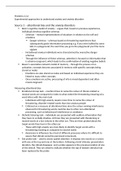
Experimental approaches to understand anxiety and anxiety disorders
Source 1 – attentional bias and the anxiety disorders
Beck’s cognitive model of anxiety – argues that, based on previous experiences,
individuals develop cognitive schemas
- Schemas – mental representations of situations in relation to the self and
emotions
Danger schemas – schemas based on threatening experiences that
subsequently guide information processing e.g. if you were bullied by some
kids in a playground, the next time you go to the playground you’ll be more
vigilant
- He believed anxious individuals were characterised by overactive danger
schemas
- Through the influence of these schemas, attention is focused on information that
is schema-congruent, which leads to the confirmation of existing negative beliefs
Bower’s associative network model of memory – through the process of co-
activation, concepts become associated in memory with specific concepts being
stored as nodes
- Emotions are also stored as nodes and based on individual experience they are
linked to many other concepts
- Once emotions are active, processing of info is mood dependent and often
mood-congruent
Measuring attentional bias
Emotional stroop task – reaction times to name the colour of threat-related vs
neutral words are compared to index to what extent the threatening meaning od a
word infers with the main task
- Individuals with high anxiety require more time to name the colour of
threatening, disorder-related words than low-anxious people
◊ Criticised as a measure of attentional bias since the colour-naming interference
observed for threatening words could be due to other non-attentional
processing, such as behavioural interference or avoidance
Dichotic listening task – individuals are presented with auditory information that
they have to verbally shadow. At times they are presented with threatening or
neutral words at a low volume in the other ear. They are then probed about the
target words they hear in the other ear
- Those with high anxiety are more likely to identify target words with a
threatening meaning as compared to neutral words
◊ Awareness is influences by a host of different processes where it is difficult to
assure that stimuli cannot be perceived consciously
Dot probe task – used to assess spatial attention. It displays two words on a screen
with one at the top and one at the bottom. Following a brief stimulus presentation
duration, the stimuli disappear, and a probe appears in the previous location of one
of the stimuli. They are asked to indicate whether the top of bottom stimulus had
been replaced by the probe
, - Attentional biases are inferred from different response times to probes that
replace threatening stimuli compared to probes that replace neutral stimuli
- If one’s attention is systematically drawn to the threat stimulus, response times
will be shorter for probes that replace threatening stimuli
Visual search task – assesses spatial attention allocation. Ppt detect a target stimulus
that is embedded in a matrix of distracting stimuli e.g., the word spider may be
displayed in a matrix of neutral distractor words OR a neutral target word may be
embedded in a matrix of spider-related words
- Attention biases are inferred from faster response times to detect a threatening
stimulus in a matrix of neutral stimuli i.e., the individual’s attention is drawn to
the threat stimuli
- Attentional biases can also be inferred from slower response times to detect
neutral stimuli in a matrix of threatening stimuli i.e., the individual’s attention is
captured by the threat stimulus
- Many stimuli presented simultaneously, which requires an active search process
of ppt
- The speed of target search in relation to the number of distracting stimuli allows
examination whether threatening information “pops out” with search slopes
being unaffected or very minimally affected by the number of distractors
Spatial cueing task – assesses spatial attention allocation. Ppt focus on a fixation
point located between two rectangles and a cue is presented (typically an emotional
word or picture), followed by the appearance of a target in one of the two
rectangles. Ppt indicate the rectangle in which the target is located.
- Some are valid cues i.e., cue draws attention to the rectangle in which the target
is located, and some are invalid i.e., it draws attention away from the rectangle
- Facilitated attentional engagement with threat is indicated by faster responses
on valid threat-cued trials
- Impaired attentional disengagement from threat is indicated by slower responses
on invalidly threat-cued trials
◊ Debate over the validity of distinguishing between these two components of
attentional bias using the spatial cueing task
Eye tracking- ecologically valid measure of spatial attention as there is a close
relation between covert and overt shifts of attention. Often combined with spatial
attention paradigms. Visual info is gathered by measuring saccades
Main research findings
There is evidence for an attentional bias across the different anxiety disorders
Attentional bias is observed in individuals with high trait anxiety scores
- Suggests attentional bias is not a mere correlate of clinical anxiety but may also
be involved in the development of anxiety disorders
Nature of attentional bias
Automaticity of attentional bias
Early theories suggested that attentional bias is an automatic process that is based
on a very fast evaluation mechanism that operates at a preconscious level
Experimental approaches to understand anxiety and anxiety disorders
Source 1 – attentional bias and the anxiety disorders
Beck’s cognitive model of anxiety – argues that, based on previous experiences,
individuals develop cognitive schemas
- Schemas – mental representations of situations in relation to the self and
emotions
Danger schemas – schemas based on threatening experiences that
subsequently guide information processing e.g. if you were bullied by some
kids in a playground, the next time you go to the playground you’ll be more
vigilant
- He believed anxious individuals were characterised by overactive danger
schemas
- Through the influence of these schemas, attention is focused on information that
is schema-congruent, which leads to the confirmation of existing negative beliefs
Bower’s associative network model of memory – through the process of co-
activation, concepts become associated in memory with specific concepts being
stored as nodes
- Emotions are also stored as nodes and based on individual experience they are
linked to many other concepts
- Once emotions are active, processing of info is mood dependent and often
mood-congruent
Measuring attentional bias
Emotional stroop task – reaction times to name the colour of threat-related vs
neutral words are compared to index to what extent the threatening meaning od a
word infers with the main task
- Individuals with high anxiety require more time to name the colour of
threatening, disorder-related words than low-anxious people
◊ Criticised as a measure of attentional bias since the colour-naming interference
observed for threatening words could be due to other non-attentional
processing, such as behavioural interference or avoidance
Dichotic listening task – individuals are presented with auditory information that
they have to verbally shadow. At times they are presented with threatening or
neutral words at a low volume in the other ear. They are then probed about the
target words they hear in the other ear
- Those with high anxiety are more likely to identify target words with a
threatening meaning as compared to neutral words
◊ Awareness is influences by a host of different processes where it is difficult to
assure that stimuli cannot be perceived consciously
Dot probe task – used to assess spatial attention. It displays two words on a screen
with one at the top and one at the bottom. Following a brief stimulus presentation
duration, the stimuli disappear, and a probe appears in the previous location of one
of the stimuli. They are asked to indicate whether the top of bottom stimulus had
been replaced by the probe
, - Attentional biases are inferred from different response times to probes that
replace threatening stimuli compared to probes that replace neutral stimuli
- If one’s attention is systematically drawn to the threat stimulus, response times
will be shorter for probes that replace threatening stimuli
Visual search task – assesses spatial attention allocation. Ppt detect a target stimulus
that is embedded in a matrix of distracting stimuli e.g., the word spider may be
displayed in a matrix of neutral distractor words OR a neutral target word may be
embedded in a matrix of spider-related words
- Attention biases are inferred from faster response times to detect a threatening
stimulus in a matrix of neutral stimuli i.e., the individual’s attention is drawn to
the threat stimuli
- Attentional biases can also be inferred from slower response times to detect
neutral stimuli in a matrix of threatening stimuli i.e., the individual’s attention is
captured by the threat stimulus
- Many stimuli presented simultaneously, which requires an active search process
of ppt
- The speed of target search in relation to the number of distracting stimuli allows
examination whether threatening information “pops out” with search slopes
being unaffected or very minimally affected by the number of distractors
Spatial cueing task – assesses spatial attention allocation. Ppt focus on a fixation
point located between two rectangles and a cue is presented (typically an emotional
word or picture), followed by the appearance of a target in one of the two
rectangles. Ppt indicate the rectangle in which the target is located.
- Some are valid cues i.e., cue draws attention to the rectangle in which the target
is located, and some are invalid i.e., it draws attention away from the rectangle
- Facilitated attentional engagement with threat is indicated by faster responses
on valid threat-cued trials
- Impaired attentional disengagement from threat is indicated by slower responses
on invalidly threat-cued trials
◊ Debate over the validity of distinguishing between these two components of
attentional bias using the spatial cueing task
Eye tracking- ecologically valid measure of spatial attention as there is a close
relation between covert and overt shifts of attention. Often combined with spatial
attention paradigms. Visual info is gathered by measuring saccades
Main research findings
There is evidence for an attentional bias across the different anxiety disorders
Attentional bias is observed in individuals with high trait anxiety scores
- Suggests attentional bias is not a mere correlate of clinical anxiety but may also
be involved in the development of anxiety disorders
Nature of attentional bias
Automaticity of attentional bias
Early theories suggested that attentional bias is an automatic process that is based
on a very fast evaluation mechanism that operates at a preconscious level