PROBLEM 1. BULLYING 1
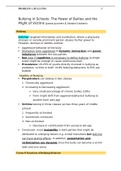
Bullying in Schools: The Power of Bullies and the
Plight of Victims (Jaana Juvonen & Sandra Graham)
Bullying
Bullying: targeted intimidation and humiliation; where a physically
stronger or socially prominent person abuses his/her power to
threaten, demean or belittle another.
Aggressive behavior of the bully
Distinction from aggression Dynamic interaction and power
imbalance between the two parties
Not clear if repetition is necessary to define bullying (a single
event might be enough to cause continuous fear)
Prevalence: 20-25% of youths directly involved in bullying as
predators, victims or both. (4-9% bullying behaviors, 9-25% are
bullied)
Stability of Bullying
Perpetrators can belong in two classes:
1. Chronically aggressive
2. Increasing & Decreasing aggression
Very small percentage of chronic bullies (10%)
Form might shift from aggressive/physical bullying to
another form with age
Victims belong in three classes (across three years of middle
school)
1. Frequently victimized
2. Sometimes victimized
3. Non-victimized
Decrease in victimization from young to old age
Conclusion: more instability in both parties that might be
attributed to changing factors e.g. school transitions but bullying
can have lasting effects. In addition, perpetration and
victimization are dynamic since the bully can become a victim
later and vice versa.
Forms & Functions of Bullying Behavior
, PROBLEM 1. BULLYING 2
Direct confrontation: physical aggression, threats, name-calling
usually in front of an audience.
Indirect tactics: relational manipulation spreading rumors,
backstabbing, exclusion from the group, designed to damage the
reputation & social status of target and hide predators identity
o Age differences not found; maybe due to lack of studies
on covert tactics, or because of behavioral heterogeneity
Only physical reduces with age
o Gender differences found;
Boys more likely to engage in physical aggression (in
every age group, ethnicity, social class and nationality).
Relational aggression was thought to be the domain of
females, which was supported by the valence of
relationships and from an evolutionary perspective.
→ Not strong differences in relational aggression
(2 meta-analyses), boys are just as likely to embrace
exclusion tactics especially by middle adolescence
where physical aggression becomes less acceptable.
Conclusions: developmental & gender difference only for
physical aggression that decreases with age and is more
prevalent for boys. Not robust differences for indirect tactics
even though girls are more likely to use them.
Social Dominance
Why do youths engage in bullying behaviors?
Lack of social skills & antisocial personality Criticism:
indirect aggression requires sophisticated social skills and bullying
behaviors are short-lived.
Bullying as instrumental behavior: cold, calculating bullies
lacking empathy and using coercive strategies to dominate and
control their peers’ behavior.
High social status motives (gain & maintain position in social
hierarchy) more prominent in transitional phases
Inflated Self-Views and Social-Cognitive Biases of Bullies
Maintain Inflated/ Positive self-views
1. Information processing bias
2. Hostile attribution bias: where they perceive ambiguous situations
as hostile and that is the reason why they lack distress.
Blaming others and avoiding responsibility
3. More positive than negative social feedback: rare challenge of bullies
by intervention. The bystanders reinforce the bullies by
smiling and laughing (IPB). Peers that do not like the bullies
Bullying in Schools: The Power of Bullies and the
Plight of Victims (Jaana Juvonen & Sandra Graham)
Bullying
Bullying: targeted intimidation and humiliation; where a physically
stronger or socially prominent person abuses his/her power to
threaten, demean or belittle another.
Aggressive behavior of the bully
Distinction from aggression Dynamic interaction and power
imbalance between the two parties
Not clear if repetition is necessary to define bullying (a single
event might be enough to cause continuous fear)
Prevalence: 20-25% of youths directly involved in bullying as
predators, victims or both. (4-9% bullying behaviors, 9-25% are
bullied)
Stability of Bullying
Perpetrators can belong in two classes:
1. Chronically aggressive
2. Increasing & Decreasing aggression
Very small percentage of chronic bullies (10%)
Form might shift from aggressive/physical bullying to
another form with age
Victims belong in three classes (across three years of middle
school)
1. Frequently victimized
2. Sometimes victimized
3. Non-victimized
Decrease in victimization from young to old age
Conclusion: more instability in both parties that might be
attributed to changing factors e.g. school transitions but bullying
can have lasting effects. In addition, perpetration and
victimization are dynamic since the bully can become a victim
later and vice versa.
Forms & Functions of Bullying Behavior
, PROBLEM 1. BULLYING 2
Direct confrontation: physical aggression, threats, name-calling
usually in front of an audience.
Indirect tactics: relational manipulation spreading rumors,
backstabbing, exclusion from the group, designed to damage the
reputation & social status of target and hide predators identity
o Age differences not found; maybe due to lack of studies
on covert tactics, or because of behavioral heterogeneity
Only physical reduces with age
o Gender differences found;
Boys more likely to engage in physical aggression (in
every age group, ethnicity, social class and nationality).
Relational aggression was thought to be the domain of
females, which was supported by the valence of
relationships and from an evolutionary perspective.
→ Not strong differences in relational aggression
(2 meta-analyses), boys are just as likely to embrace
exclusion tactics especially by middle adolescence
where physical aggression becomes less acceptable.
Conclusions: developmental & gender difference only for
physical aggression that decreases with age and is more
prevalent for boys. Not robust differences for indirect tactics
even though girls are more likely to use them.
Social Dominance
Why do youths engage in bullying behaviors?
Lack of social skills & antisocial personality Criticism:
indirect aggression requires sophisticated social skills and bullying
behaviors are short-lived.
Bullying as instrumental behavior: cold, calculating bullies
lacking empathy and using coercive strategies to dominate and
control their peers’ behavior.
High social status motives (gain & maintain position in social
hierarchy) more prominent in transitional phases
Inflated Self-Views and Social-Cognitive Biases of Bullies
Maintain Inflated/ Positive self-views
1. Information processing bias
2. Hostile attribution bias: where they perceive ambiguous situations
as hostile and that is the reason why they lack distress.
Blaming others and avoiding responsibility
3. More positive than negative social feedback: rare challenge of bullies
by intervention. The bystanders reinforce the bullies by
smiling and laughing (IPB). Peers that do not like the bullies