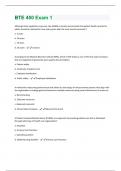
Week 5: Sherpath: Implementation and
Evaluation of Interventions Related to Electrolyte
Balance Questions and Verified Answers
The nurse is caring for a patient with known hyponatremia. Which are appropriate
nursing interventions for the nurse to implement for this patient?
Select all that apply.
A. Administer potassium supplements.
B. Increase oral fluid intake.
C. Instruct the patient to avoid sports drinks and drink mostly plain water.
D. Assist the patient to adhere to fluid restriction requirements.
E. Monitor intake and output. Correct Answer: D and E
Assist the patient to adhere to fluid restriction requirements.
-Patients with hyponatremia should be encouraged to restrict oral fluid intake.
Monitor intake and output.
-The nurse should monitor intake and output volumes to ensure that excess fluid is
not being excreted, adding to the existing hyponatremia.
What nursing action is appropriate for a patient experiencing continued
hypokalemia despite a week of treatment?
,A. The patient's diuretic should not be taken until potassium levels are normal.
B. Instruct the patient to avoid salt substitutes.
C. Report laboratory values to the primary healthcare provider (PCP).
D. The patient should be instructed to take potassium supplements with water only.
Correct Answer: C. Report laboratory values to the primary healthcare provider
(PCP).
The PCP needs to be aware of the continued hypokalemia. To combat this, a change
in dosage of potassium may be required.
Match the administration of potassium supplement with the appropriate nursing
action.
1. Administer with juice
2. Teach the use of salt-substitutes
3. Never administer by push or bolus.
A. Dietary
B. Oral
C. Intravenous Correct Answer: 1. B
, 2. A
3. C
Which patients would benefit from treatment involving the administration of
calcium supplement?
Select all that apply.
A. A 20-year-old young adult with no health problems
B. A 55-year-old woman who has been through menopause
C. A 79-year-old male patient who resides in a nursing home
D. A marathon runner
E. A 72-year-old female patient who does not take any supplements. Correct
Answer: B, C and E
A 55-year-old woman who has been through menopause
-A post-menopausal woman has increased calcium needs, due to potential bone loss.
A 79-year-old male patient who resides in a nursing home
-Patients over the age of 70 have increased calcium requirements due to the risk of
bone loss.
Evaluation of Interventions Related to Electrolyte
Balance Questions and Verified Answers
The nurse is caring for a patient with known hyponatremia. Which are appropriate
nursing interventions for the nurse to implement for this patient?
Select all that apply.
A. Administer potassium supplements.
B. Increase oral fluid intake.
C. Instruct the patient to avoid sports drinks and drink mostly plain water.
D. Assist the patient to adhere to fluid restriction requirements.
E. Monitor intake and output. Correct Answer: D and E
Assist the patient to adhere to fluid restriction requirements.
-Patients with hyponatremia should be encouraged to restrict oral fluid intake.
Monitor intake and output.
-The nurse should monitor intake and output volumes to ensure that excess fluid is
not being excreted, adding to the existing hyponatremia.
What nursing action is appropriate for a patient experiencing continued
hypokalemia despite a week of treatment?
,A. The patient's diuretic should not be taken until potassium levels are normal.
B. Instruct the patient to avoid salt substitutes.
C. Report laboratory values to the primary healthcare provider (PCP).
D. The patient should be instructed to take potassium supplements with water only.
Correct Answer: C. Report laboratory values to the primary healthcare provider
(PCP).
The PCP needs to be aware of the continued hypokalemia. To combat this, a change
in dosage of potassium may be required.
Match the administration of potassium supplement with the appropriate nursing
action.
1. Administer with juice
2. Teach the use of salt-substitutes
3. Never administer by push or bolus.
A. Dietary
B. Oral
C. Intravenous Correct Answer: 1. B
, 2. A
3. C
Which patients would benefit from treatment involving the administration of
calcium supplement?
Select all that apply.
A. A 20-year-old young adult with no health problems
B. A 55-year-old woman who has been through menopause
C. A 79-year-old male patient who resides in a nursing home
D. A marathon runner
E. A 72-year-old female patient who does not take any supplements. Correct
Answer: B, C and E
A 55-year-old woman who has been through menopause
-A post-menopausal woman has increased calcium needs, due to potential bone loss.
A 79-year-old male patient who resides in a nursing home
-Patients over the age of 70 have increased calcium requirements due to the risk of
bone loss.