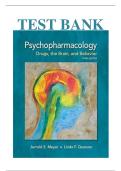
PSYCHOPHARMACOLOGY DRUGS THE BRAIN
AND BEHAVIOR FINAL PAPER 2026 SOLVED
ITEMS ACCURATE MARKING
◉ What are psychoactive drugs? Answer: Substances that alter
mood, thought, or behavior, used to manage neuropsychological
illness.
◉ What are the common routes of drug administration? Answer:
Oral, inhaled, rectal, patches, injection into the bloodstream, muscle,
or brain.
◉ What is the blood-brain barrier? Answer: A barrier that restricts
the movement of substances from the bloodstream into the brain.
◉ What is an agonist in the context of drug action? Answer: A
substance that enhances the function of a synapse.
◉ What is an antagonist in the context of drug action? Answer: A
substance that blocks or decreases the function of a synapse.
, ◉ What is metabolic tolerance? Answer: An increase in the number
of enzymes in the liver, blood, or brain used to break down a
substance.
◉ What is cellular tolerance? Answer: When brain cell activities
adjust to minimize the effects of a substance.
◉ What is learned tolerance? Answer: When individuals learn to
cope with being intoxicated.
◉ What happens to neurotransmitters during synaptic
transmission? Answer: They are synthesized, packaged, released,
and interact with receptors before being inactivated by reuptake or
enzymatic degradation.
◉ What is sensitization in drug use? Answer: An increased
responsiveness to a drug that can develop with intermittent use.
◉ How does the body eliminate drugs? Answer: Drugs are broken
down in the kidneys, liver, and intestines, and excreted in urine,
feces, sweat, breast milk, and exhaled air.
◉ What is the role of the pituitary gland in drug action? Answer: It is
a target for many blood-borne hormones.
AND BEHAVIOR FINAL PAPER 2026 SOLVED
ITEMS ACCURATE MARKING
◉ What are psychoactive drugs? Answer: Substances that alter
mood, thought, or behavior, used to manage neuropsychological
illness.
◉ What are the common routes of drug administration? Answer:
Oral, inhaled, rectal, patches, injection into the bloodstream, muscle,
or brain.
◉ What is the blood-brain barrier? Answer: A barrier that restricts
the movement of substances from the bloodstream into the brain.
◉ What is an agonist in the context of drug action? Answer: A
substance that enhances the function of a synapse.
◉ What is an antagonist in the context of drug action? Answer: A
substance that blocks or decreases the function of a synapse.
, ◉ What is metabolic tolerance? Answer: An increase in the number
of enzymes in the liver, blood, or brain used to break down a
substance.
◉ What is cellular tolerance? Answer: When brain cell activities
adjust to minimize the effects of a substance.
◉ What is learned tolerance? Answer: When individuals learn to
cope with being intoxicated.
◉ What happens to neurotransmitters during synaptic
transmission? Answer: They are synthesized, packaged, released,
and interact with receptors before being inactivated by reuptake or
enzymatic degradation.
◉ What is sensitization in drug use? Answer: An increased
responsiveness to a drug that can develop with intermittent use.
◉ How does the body eliminate drugs? Answer: Drugs are broken
down in the kidneys, liver, and intestines, and excreted in urine,
feces, sweat, breast milk, and exhaled air.
◉ What is the role of the pituitary gland in drug action? Answer: It is
a target for many blood-borne hormones.