chapter 1: Marketing principles and and practice
1.1 What is marketing?
goal = to understand and meet customer needs to create value
definition: Marketing is a social and managerial process by which individuals and groups
obtain what they need and want through creating and exchanging products and value with
others.
→ In business context: To build and maintain profitable relationships with stakeholders
What does marketing apply to?:
- Physical products
- Services
- Retail
- Experiences
- Events
- Film, music, and theater
- Places
- Ideas
- Charity and non-profit
- People
=> anywhere “buyers” have a choice
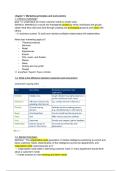
1.2. What is the difference between customers and consumers?
consumers’ buying roles
1.3. Market Orientation
Definition: “The organization-wide generation of market intelligence pertaining to current and
future customer needs, dissemination of the intelligence across the departments, and
organization-wide responsiveness to it”
→ Organization-wide belief in delivering customer value (= every department should think
about a customer's need)
→ Create products to meet existing and latent needs
, the 3 components of marketing orientation:
- Customer orientation = focus on customers.
- Competitor orientation = watch the competition.
- Interfunctional coordination = teamwork across the company.
Customer centricity:
Not trying to please all customers
Fulfilling needs in a profitable way
1.5. Differences between sales and marketing
Sales: Product push, short-term focus on satisfaction of customer needs
≠
Marketing: Product pull, long-term focus on satisfaction of customer needs, high focus on
stimulation of demand
marketing sales
long term satisfaction of customer needs short term satisfaction of customer needs
co-creation lesser input into customer design of offering
high focus on stimulation of demand more focused on meeting existing demand
acquisition vs. retention
obtaining a good relationship vs. maintaining it
Tip of the iceberg → What consumers see is only a fraction of companies’
overall business strategies
Selling = the tip of the iceberg
1.1 What is marketing?
goal = to understand and meet customer needs to create value
definition: Marketing is a social and managerial process by which individuals and groups
obtain what they need and want through creating and exchanging products and value with
others.
→ In business context: To build and maintain profitable relationships with stakeholders
What does marketing apply to?:
- Physical products
- Services
- Retail
- Experiences
- Events
- Film, music, and theater
- Places
- Ideas
- Charity and non-profit
- People
=> anywhere “buyers” have a choice
1.2. What is the difference between customers and consumers?
consumers’ buying roles
1.3. Market Orientation
Definition: “The organization-wide generation of market intelligence pertaining to current and
future customer needs, dissemination of the intelligence across the departments, and
organization-wide responsiveness to it”
→ Organization-wide belief in delivering customer value (= every department should think
about a customer's need)
→ Create products to meet existing and latent needs
, the 3 components of marketing orientation:
- Customer orientation = focus on customers.
- Competitor orientation = watch the competition.
- Interfunctional coordination = teamwork across the company.
Customer centricity:
Not trying to please all customers
Fulfilling needs in a profitable way
1.5. Differences between sales and marketing
Sales: Product push, short-term focus on satisfaction of customer needs
≠
Marketing: Product pull, long-term focus on satisfaction of customer needs, high focus on
stimulation of demand
marketing sales
long term satisfaction of customer needs short term satisfaction of customer needs
co-creation lesser input into customer design of offering
high focus on stimulation of demand more focused on meeting existing demand
acquisition vs. retention
obtaining a good relationship vs. maintaining it
Tip of the iceberg → What consumers see is only a fraction of companies’
overall business strategies
Selling = the tip of the iceberg