English: Grammar (unit 1 - 12)
Countable and uncountable nouns
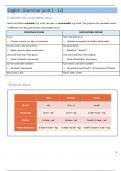
Nouns are either countable, e.g. a job, two jobs, or uncountable, e.g. work. The grammar for countable nouns
is different from the grammar for uncountable nouns.
COUNTABLE NOUNS UNCOUNTABLE NOUNS
A/ an Not used with a/ an
o A book, a pencil, an idea, a conclusion o I believe in equality. He dislikes philosophy.
Can be used in the plural form No plural forms
o Books, pencils, ideas, conclusions o Weathers*, breads*
Use some and any in the plural Use some and any in the singular
o Some customers, any emails o Some information, any money
Can be used with numbers Can not be used with numbers
o Six books, two pencils o He ordered two breads*. → Two loaves of bread
Many, few, a few Much, little, a little
The tenses: basics
1
,The present/past tenses
Present simple: use
• General time
o When we talk about permanent situations, or about things that happen regularly, repeatedly or all the
time (not just around now), we usually use the simple present.
• My parents live near Dover. • I go to London about three times
• What do lions eat? (Compare: a week.
what are lions eating?) • I play tennis every Wednesday.
• Water freezes at 0° Celsius. • It always rains in November.
• Not used for things happening just around the present
o We do not usually use the simple present to talk about temporary situations or actions that are going
on around the present. Compare:
• Water boils at 100° Celsius.
• The kettle’s boiling – shall I make tea? (NOT *The kettle boils…)
• Sometimes it snows in April.
2
, • Look – it’s snowing! (NOT *Look – it snows!)
• I play tennis every Wednesday.
• Where’s Andy? – He’s playing tennis. (NOT *…He plays tennis.)
• Non-progressive verbs
o The simple present is used for this ‘around the present’ meaning with verbs that do not have progressive
forms.
• I like this wine very much. (NOT *I’m liking this wine very much)
• I believe you. (NOT *I’m believing you.)
• I feel Jack has something to say about it as well (NOT *I’m feeling…)
• The baby weighs almost 8 lbs. (NOT *The baby is weighing…)
• The soup smells delicious. (NOT *The soup is smelling delicious.)
• Talking about the future
o We do not normally use the simple present to talk about the future. However, the simple present is used
for ‘timetabled’ future events.
• His train arrives at 11:47. (NOT *His train will arrive at 11:47.)
• I start my new job tomorrow. (NOT *I will start my new job tomorrow.)
o The simple present is often used instead of will… in subordinate clauses that refer to the future.
• I’ll phone you when I get home. (NOT *…when I’ll get home.)
• I’ll kill anybody who touches my possessions. (NOT *…who’ll touch…)
o The simple present is also used in suggestions with Why don’t you…?
• Why don’t you take a day off tomorrow?
• Series of events
o When we talk about series of completed actions and events, we often use the simple present. This
happens, for example, in demonstrations, commentaries, instructions and present-tense stories.
• First I take a bowl and break two eggs into it. Next I whisk them together… (NOT *First I’m
taking a bowl and breaking two eggs into it.)
• De Bruyne passes to Lukaku. Lukaku shoots – and he scores!
• How do I get to the station? ~ You go straight on to the traffic lights, then you turn left…
• So I go into the office, and I see this man, and he says to me…
3
Countable and uncountable nouns
Nouns are either countable, e.g. a job, two jobs, or uncountable, e.g. work. The grammar for countable nouns
is different from the grammar for uncountable nouns.
COUNTABLE NOUNS UNCOUNTABLE NOUNS
A/ an Not used with a/ an
o A book, a pencil, an idea, a conclusion o I believe in equality. He dislikes philosophy.
Can be used in the plural form No plural forms
o Books, pencils, ideas, conclusions o Weathers*, breads*
Use some and any in the plural Use some and any in the singular
o Some customers, any emails o Some information, any money
Can be used with numbers Can not be used with numbers
o Six books, two pencils o He ordered two breads*. → Two loaves of bread
Many, few, a few Much, little, a little
The tenses: basics
1
,The present/past tenses
Present simple: use
• General time
o When we talk about permanent situations, or about things that happen regularly, repeatedly or all the
time (not just around now), we usually use the simple present.
• My parents live near Dover. • I go to London about three times
• What do lions eat? (Compare: a week.
what are lions eating?) • I play tennis every Wednesday.
• Water freezes at 0° Celsius. • It always rains in November.
• Not used for things happening just around the present
o We do not usually use the simple present to talk about temporary situations or actions that are going
on around the present. Compare:
• Water boils at 100° Celsius.
• The kettle’s boiling – shall I make tea? (NOT *The kettle boils…)
• Sometimes it snows in April.
2
, • Look – it’s snowing! (NOT *Look – it snows!)
• I play tennis every Wednesday.
• Where’s Andy? – He’s playing tennis. (NOT *…He plays tennis.)
• Non-progressive verbs
o The simple present is used for this ‘around the present’ meaning with verbs that do not have progressive
forms.
• I like this wine very much. (NOT *I’m liking this wine very much)
• I believe you. (NOT *I’m believing you.)
• I feel Jack has something to say about it as well (NOT *I’m feeling…)
• The baby weighs almost 8 lbs. (NOT *The baby is weighing…)
• The soup smells delicious. (NOT *The soup is smelling delicious.)
• Talking about the future
o We do not normally use the simple present to talk about the future. However, the simple present is used
for ‘timetabled’ future events.
• His train arrives at 11:47. (NOT *His train will arrive at 11:47.)
• I start my new job tomorrow. (NOT *I will start my new job tomorrow.)
o The simple present is often used instead of will… in subordinate clauses that refer to the future.
• I’ll phone you when I get home. (NOT *…when I’ll get home.)
• I’ll kill anybody who touches my possessions. (NOT *…who’ll touch…)
o The simple present is also used in suggestions with Why don’t you…?
• Why don’t you take a day off tomorrow?
• Series of events
o When we talk about series of completed actions and events, we often use the simple present. This
happens, for example, in demonstrations, commentaries, instructions and present-tense stories.
• First I take a bowl and break two eggs into it. Next I whisk them together… (NOT *First I’m
taking a bowl and breaking two eggs into it.)
• De Bruyne passes to Lukaku. Lukaku shoots – and he scores!
• How do I get to the station? ~ You go straight on to the traffic lights, then you turn left…
• So I go into the office, and I see this man, and he says to me…
3