
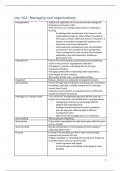
Les 1&2: Managing and organizations
Managerialism Justifies the application of its one-dimensional managerial
techniques to all areas of life.
Thinks that you can manage people based on rationalism.
Framing
- An ideology that management is the answer to all
organizational problems, often without considering
the unique context of different sectors or situations. It
tends to universalize management practices even
when they may not be appropriate.
- Overemphasizes management tools and principles,
sometimes to the exclusion of other perspectives.
- Treats management as the one-size-fits-all solution,
applicable in any field (education, healthcare,
government, etc.).
Management Process of communicating, coordinating and accomplishing
action in the pursuit of organizational objectives.
Managing as a practice, something that we do, goal-
orientated collectives.
Managing collaborative relationships with stakeholders,
technologies an other artefacts.
Not neutral activity, also a social-political activity.
Organized Being an element in a systematic arrangement of parts.
Sensemaking Process through which individuals and groups give meaning to
something, especially to explain unexpected or confusing
events. (expl. Covid).
Meaning is constructed in an ongoing process in which past
experience informs the present.
Managing in a complex world ‘one size fits all” management approach will not work. No
longer rely on hierarchy and nominal roles to manage people.
- Managing has become an increasingly difficult,
political and challenging task.
- Managers should understand human complexity
- Not one approach, different skills & different
management styles
- New trend: self managing teams, less hierarchy
Sense making What’s going on, explaining.
Sense giving Frame other’s perceptions to make them agree with the sense
you are making.
Sense breaking Disrupt existing flows of sensemaking and sense giving to
make alternative sense.
Framing Framing & sensemaking go hand in hand, made through
language and concepts you use.
Putting a spotlight on something and leaving other things out.
It defines what is relevant (and what not).
- Frame argument and repeat!
- Occurs through sensemaking, sense giving & sense
breaking
1
,Managerial rationality Rational approach
- About making logical and efficient decisions within a
specific context, using reasoning and data to find the
best solution
- Focuses on optimizing resources, processes, and
outcomes
- Seeks to achieve efficiency, consistency, and
predictability
Rationality is bounded, always contextually & cognitively
limited
Digital age Digital technologies and a growing international division of
labor btwn economies make the world economy increasingly
globalized.
4th industrial revolution: algorithmic innovation, gig economy,
working from home,…
Digitalization Use of technologies and data to manage organizational
processes
Tacit knowledge Implicit
Managing technological change Flexible, timely approach to customer requirements.
- Different generations and digital capabilities.
- Form hard to soft power relations.
- Increase in knowledge-intensive work
- Brains not brawn, mental rather than manual work
Global shifts Changing organizational cultures and social relations at work.
- Digitalization changing experiences of time and space
for employees
- Importance of EDI (Equality, Diversity, Inclusion)
Economic context of contemporary management
- NPM
- Demise of bureaucracies
- Neo-liberalism
- AI
Division of labor; associated asymmetry of power relations
changing social systems.
Effects of global shift - Local effects on wages & production
- International division of labor
- Shifts in production
- Changes in social relations (China as an important
leader, Western less and less)
- International demand of labor
- Knowledge work!
Conclusion - Sensemaking = important and part of managerial skill
set
- Sensemaking & framing go hand in hand, can’t make
sense without framing
- Crucial to reflect upon sensemaking
- The pure rational manager doesn’t exist
- Technological development & global shift have an
impact on managerialism and sensemaking
Digital bubbles Electronic media support leads to like-minded networks
2
, - Shared sense of emotionally rather than a shared
rational
Organizational culture and social Diversity is increasingly seen as an asset for organizations:
relations at work improvement for productivity, need of global mindset &
expertise (not easy!).
- Must understand the specificities of the local market,
cultural sensitivity
Challenges: work is more accountable and transparent as
others can be online anytime, anywhere.
Global shifts : economic context - New technologies
of contemporary management - Rise op NPM
- Demise of bureaucracy
- Economic neo-liberalism
- Tax cuts & trickle down effect
- Political economy after covid
- Growth of AI
- Global division of labor: associated asymmetry of
power relations changing social systems
- New center of manufacturing employment tilting
towards Asia, China
- Major capital investments no longer in the Western
Effects of global shifts (being - Local effects on wages & production
critical) - International division of labor
- Shift in production (mental vs manual)
- Changes social relations (smart teams-> located
everywhere-> different to understand)
- International demand of labor
- Growth of knowledge work
Sensibility Being sensible, to understand, see different opinions.
Conclusion - Digitalization (use of digital technology& data)
changed organizations
- Knowledge intensive work means that organizations
employ & manage different kinds of employees
- Social media changes brand loyalty
- Social media is powerful and needs to be managed
Les 3: Managing power, politics and decision-making
Underlying aspects of Understanding office & organ politics is
organizational politics important skill for managers.
- Politics shape the structure of organ life
- Organ relations can be conflictual and
market by power relations
- Organ aren’t rational entities
- Bounded rationality of managers
Organizational politics Refer to the networks btwn people in and
around organ that entail power relations.
Power relations Defined with formal rules, relations & politics
AND informal signs that go beyond formal
authority.
Bureaucracy (Weber) A system of formal rules, draws line btwn
3
Managerialism Justifies the application of its one-dimensional managerial
techniques to all areas of life.
Thinks that you can manage people based on rationalism.
Framing
- An ideology that management is the answer to all
organizational problems, often without considering
the unique context of different sectors or situations. It
tends to universalize management practices even
when they may not be appropriate.
- Overemphasizes management tools and principles,
sometimes to the exclusion of other perspectives.
- Treats management as the one-size-fits-all solution,
applicable in any field (education, healthcare,
government, etc.).
Management Process of communicating, coordinating and accomplishing
action in the pursuit of organizational objectives.
Managing as a practice, something that we do, goal-
orientated collectives.
Managing collaborative relationships with stakeholders,
technologies an other artefacts.
Not neutral activity, also a social-political activity.
Organized Being an element in a systematic arrangement of parts.
Sensemaking Process through which individuals and groups give meaning to
something, especially to explain unexpected or confusing
events. (expl. Covid).
Meaning is constructed in an ongoing process in which past
experience informs the present.
Managing in a complex world ‘one size fits all” management approach will not work. No
longer rely on hierarchy and nominal roles to manage people.
- Managing has become an increasingly difficult,
political and challenging task.
- Managers should understand human complexity
- Not one approach, different skills & different
management styles
- New trend: self managing teams, less hierarchy
Sense making What’s going on, explaining.
Sense giving Frame other’s perceptions to make them agree with the sense
you are making.
Sense breaking Disrupt existing flows of sensemaking and sense giving to
make alternative sense.
Framing Framing & sensemaking go hand in hand, made through
language and concepts you use.
Putting a spotlight on something and leaving other things out.
It defines what is relevant (and what not).
- Frame argument and repeat!
- Occurs through sensemaking, sense giving & sense
breaking
1
,Managerial rationality Rational approach
- About making logical and efficient decisions within a
specific context, using reasoning and data to find the
best solution
- Focuses on optimizing resources, processes, and
outcomes
- Seeks to achieve efficiency, consistency, and
predictability
Rationality is bounded, always contextually & cognitively
limited
Digital age Digital technologies and a growing international division of
labor btwn economies make the world economy increasingly
globalized.
4th industrial revolution: algorithmic innovation, gig economy,
working from home,…
Digitalization Use of technologies and data to manage organizational
processes
Tacit knowledge Implicit
Managing technological change Flexible, timely approach to customer requirements.
- Different generations and digital capabilities.
- Form hard to soft power relations.
- Increase in knowledge-intensive work
- Brains not brawn, mental rather than manual work
Global shifts Changing organizational cultures and social relations at work.
- Digitalization changing experiences of time and space
for employees
- Importance of EDI (Equality, Diversity, Inclusion)
Economic context of contemporary management
- NPM
- Demise of bureaucracies
- Neo-liberalism
- AI
Division of labor; associated asymmetry of power relations
changing social systems.
Effects of global shift - Local effects on wages & production
- International division of labor
- Shifts in production
- Changes in social relations (China as an important
leader, Western less and less)
- International demand of labor
- Knowledge work!
Conclusion - Sensemaking = important and part of managerial skill
set
- Sensemaking & framing go hand in hand, can’t make
sense without framing
- Crucial to reflect upon sensemaking
- The pure rational manager doesn’t exist
- Technological development & global shift have an
impact on managerialism and sensemaking
Digital bubbles Electronic media support leads to like-minded networks
2
, - Shared sense of emotionally rather than a shared
rational
Organizational culture and social Diversity is increasingly seen as an asset for organizations:
relations at work improvement for productivity, need of global mindset &
expertise (not easy!).
- Must understand the specificities of the local market,
cultural sensitivity
Challenges: work is more accountable and transparent as
others can be online anytime, anywhere.
Global shifts : economic context - New technologies
of contemporary management - Rise op NPM
- Demise of bureaucracy
- Economic neo-liberalism
- Tax cuts & trickle down effect
- Political economy after covid
- Growth of AI
- Global division of labor: associated asymmetry of
power relations changing social systems
- New center of manufacturing employment tilting
towards Asia, China
- Major capital investments no longer in the Western
Effects of global shifts (being - Local effects on wages & production
critical) - International division of labor
- Shift in production (mental vs manual)
- Changes social relations (smart teams-> located
everywhere-> different to understand)
- International demand of labor
- Growth of knowledge work
Sensibility Being sensible, to understand, see different opinions.
Conclusion - Digitalization (use of digital technology& data)
changed organizations
- Knowledge intensive work means that organizations
employ & manage different kinds of employees
- Social media changes brand loyalty
- Social media is powerful and needs to be managed
Les 3: Managing power, politics and decision-making
Underlying aspects of Understanding office & organ politics is
organizational politics important skill for managers.
- Politics shape the structure of organ life
- Organ relations can be conflictual and
market by power relations
- Organ aren’t rational entities
- Bounded rationality of managers
Organizational politics Refer to the networks btwn people in and
around organ that entail power relations.
Power relations Defined with formal rules, relations & politics
AND informal signs that go beyond formal
authority.
Bureaucracy (Weber) A system of formal rules, draws line btwn
3

