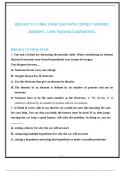
BIOLOGY 117 FINAL EXAM 2024 WITH CORRECT VERIFIED
ANSWERS. 100% PASSING GUARANTEED.
BIOLOGY 117 FINAL EXAM
1. You and a friend are discussing the periodic table. When considering an element
that has 8 neutrons your friend immediately says it must be oxygen.
You disagree because....
a. Neutrons do not carry any charge.
b. Oxygen always has 10 neutrons.
c. It is the electrons that give an element its identity.
d. The identity of an element is defined by its number of protons and not its
neutrons.
e. Neutrons have to be the same number as the electrons.: d. The identity of an
element is defined by its number of protons and not its neutrons.
2. A friend of yours calls to say that his car would not start this morning. He asks
for your help. You say that you think the battery must be dead. If so, then jump-
starting the car from a good battery will solve the problem. In doing so, you are
________.
a. testing a theory for why the car will not start
b. comparing multiple hypotheses for why the car will not start
c. stating a hypothesis and using that hypothesis to make a testable prediction
,d. making observations to inspire a theory for why the car will not start: c. stating a
hypothesis and using that hypothesis to make a testable prediction 3. Individual
water molecules are made up of hydrogen and oxygen atoms bonded covalently.
We describe these covalent bonds as polar because a. the oxygen atom donates an
electron to each of the hydrogen atoms
b. the oxygen atom forms hybrid orbitals that distribute electrons unequally
around the oxygen nucleus
c. the electrons shared between the oxygen and hydrogen atoms spend more
time around the oxygen atom nucleus than around the hydrogen atom nucleus d.
one of the hydrogen atoms donates an electron to the oxygen atom
e. the oxygen atom has two pairs of electrons in its valence shell that are not
neutralized by hydrogen atoms: c. the electrons shared between the oxygen and
hydrogen atoms spend more time around the oxygen atom nucleus than around the
hydrogen atom nucleus
4. When carrying out a controlled experiment, it is important to:
a. All of these choices are correct.
b. change only one variable at a time.
c. change multiple variables at once to see the full effect of the variables.
d. subject different groups to different conditions.: b. change only one variable at a
time.
5. The first cells were most similar to:
a. multicellular forms.
b. eukaryotes.
c. viruses.
d. None of these choices are correct.
, e. prokaryotes.: e. prokaryotes.
6. Consider the two elements sodium (Na) and magnesium (Mg), which occupy the
same row in the periodic table of elements. Sodium and magnesium atoms have:
a. the same atomic number.
b. the same atomic masses.
c. None of the choices is correct
d. different atomic masses and the same number of electrons in their outer-most
orbitals.: c. None of the choices is correct
7. Covalent bonds involve two atoms sharing electrons between them whereas
noncovalent bonds involves one atom "stealing" the electrons from another atom.
This characteristic of noncovalent bonds makes them important to life because
a. They are weak in a cellular environment, so they can be made, broken, and
reformed easily.
b. They are strong in a cellular environment that holds atoms together tightly.
c. None of the other answer options is correct.
d. They can only occur in: a. They are weak in a cellular environment, so they can be
made, broken, and reformed easily.
8. Imagine walking through a tropical rainforest. You notice that there are
different types of trees, birds, insects, and a plethora of other living things. A few
weeks later you are taking a walk through the desert and notice that the trees,
birds, insects, and many other living things are different than those you saw in the
rainforest. Which of the statements best explains the differences between each of
these ecological systems?
ANSWERS. 100% PASSING GUARANTEED.
BIOLOGY 117 FINAL EXAM
1. You and a friend are discussing the periodic table. When considering an element
that has 8 neutrons your friend immediately says it must be oxygen.
You disagree because....
a. Neutrons do not carry any charge.
b. Oxygen always has 10 neutrons.
c. It is the electrons that give an element its identity.
d. The identity of an element is defined by its number of protons and not its
neutrons.
e. Neutrons have to be the same number as the electrons.: d. The identity of an
element is defined by its number of protons and not its neutrons.
2. A friend of yours calls to say that his car would not start this morning. He asks
for your help. You say that you think the battery must be dead. If so, then jump-
starting the car from a good battery will solve the problem. In doing so, you are
________.
a. testing a theory for why the car will not start
b. comparing multiple hypotheses for why the car will not start
c. stating a hypothesis and using that hypothesis to make a testable prediction
,d. making observations to inspire a theory for why the car will not start: c. stating a
hypothesis and using that hypothesis to make a testable prediction 3. Individual
water molecules are made up of hydrogen and oxygen atoms bonded covalently.
We describe these covalent bonds as polar because a. the oxygen atom donates an
electron to each of the hydrogen atoms
b. the oxygen atom forms hybrid orbitals that distribute electrons unequally
around the oxygen nucleus
c. the electrons shared between the oxygen and hydrogen atoms spend more
time around the oxygen atom nucleus than around the hydrogen atom nucleus d.
one of the hydrogen atoms donates an electron to the oxygen atom
e. the oxygen atom has two pairs of electrons in its valence shell that are not
neutralized by hydrogen atoms: c. the electrons shared between the oxygen and
hydrogen atoms spend more time around the oxygen atom nucleus than around the
hydrogen atom nucleus
4. When carrying out a controlled experiment, it is important to:
a. All of these choices are correct.
b. change only one variable at a time.
c. change multiple variables at once to see the full effect of the variables.
d. subject different groups to different conditions.: b. change only one variable at a
time.
5. The first cells were most similar to:
a. multicellular forms.
b. eukaryotes.
c. viruses.
d. None of these choices are correct.
, e. prokaryotes.: e. prokaryotes.
6. Consider the two elements sodium (Na) and magnesium (Mg), which occupy the
same row in the periodic table of elements. Sodium and magnesium atoms have:
a. the same atomic number.
b. the same atomic masses.
c. None of the choices is correct
d. different atomic masses and the same number of electrons in their outer-most
orbitals.: c. None of the choices is correct
7. Covalent bonds involve two atoms sharing electrons between them whereas
noncovalent bonds involves one atom "stealing" the electrons from another atom.
This characteristic of noncovalent bonds makes them important to life because
a. They are weak in a cellular environment, so they can be made, broken, and
reformed easily.
b. They are strong in a cellular environment that holds atoms together tightly.
c. None of the other answer options is correct.
d. They can only occur in: a. They are weak in a cellular environment, so they can be
made, broken, and reformed easily.
8. Imagine walking through a tropical rainforest. You notice that there are
different types of trees, birds, insects, and a plethora of other living things. A few
weeks later you are taking a walk through the desert and notice that the trees,
birds, insects, and many other living things are different than those you saw in the
rainforest. Which of the statements best explains the differences between each of
these ecological systems?