2019-2020 – Anna Gagiano – Uantwerpen – Text and Communication 2
Analysing & researching texts
Medium Message
How the message is being communicated What message is being communicated
Affects the message, e.g. the headquarters of the UN “Changes need to be made”: powerful message
stands for human civilisation
Can make the message more powerful
Critical terms are e.g. target audience, register, formal, informal, tone
1) Researching texts
a. Develop research & study skills that are fundamental to the academic work of text analysis
b. How to undertake detailed, language-focused, contextually sensitive analysis
2) Analysing text structure
a. Focus on the major internal aspects of text analysis (signs & sounds, lexis & semantics, grammar)
b. Language structure & use
3) Texts & contexts
a. Focus on external aspects of texts
b. Explores the role played by context in the production & interpretation of texts
c. Wide range of texts: spoken, written, multimodal
d. How texts operate in sociocultural contexts
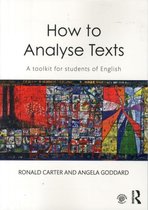
Cover of the book
- Authors from UK: analyse with an <s> is the British spelling
- “Toolkit”: verbal metaphor: you will not need a literal toolkit, but a set of resources (figurative
use of language)
- Artwork: graffiti on a wall, written in Russian, colours, shapes, big and small images
o A text on the cover the readers probably cannot understand: visual metaphor, similarities
with analysing a text: both involve decoding the message
Back cover of the book
- Routledge: academical publisher
- Blurb: a short description of a book, film, or other product written for promotional purposes
o Written by sb who loves the book
o TA: written for potential bias
o Aim: to make you buy or sell the book
o Positive adjectives stand out: consistent use of positive adj. makes the reviews effective
o The essential one…; the most practical… Definite articles; “this is the only one and there is
no doubt about it” Adaptations change the impact of the blurb
- Reviews
o We know who the book is for (TA): undergraduate (beginning) & advanced students
o We know what the book is like
o Positive adjectives stand out
1. Categorisation
- Is it a text, an image or a mixture of the two?
- What kind of text/image is it?
2. Interpretation
- What is the text saying?
- How does this particular text produce meaning?
3. Analysis as a two-step process
- Identify a noteworthy element (the what is it-question) Be specific & analytical
- Explain its effect/significance (the and what does it do-question) How does this element affect
the way the text produces meaning?
1
, 2019-2020 – Anna Gagiano – Uantwerpen – Text and Communication 2
Texts are…
- Ubiquitous: they are everywhere
- Diverse: all sorts of different kinds of texts
- Complex
Analysis
- Starts with noticing things: sustained perception
- Not always straightforward, but usually enriching
- Goes beyond understanding the contents of the text to understanding how the text produces
meaning Decoding
- It seems as if…; It could be… or it could just be…; How can you tell? Evidence for interpretation
- When you analyse, you need to step back completely and even state the obvious
- Show that you understand the text’s core message and the tone of the text
- Demonstrate awareness of genre/mode/context; linguistic awareness; ability to apply relevant
critical vocabulary; (inter)cultural awareness; awareness of literary history; insight and acquired
knowledge
Introduction: Ideology, language and linguistics
- Ideology remains one of the most important concepts in the social sciences
- Theoretical difficulties in delineating the concept & methodological difficulties in
making it visible via analysis of concrete expressions of ideology
- Ideology remains essential to the many disciplines interested in understanding
the process by which ‘the outside becomes the inside, and… the inside reveals
itself and shapes the outside’
- The sign as the ideological phenomenon ‘par excellence’: a view of ideology as sth entirely
pervasive, arguing that everything that is ideological has semiotic value and that without signs
‘there is no ideology’
How to Analyse Texts – A toolkit for students of English
- Think about language patterns, both in terms of how texts work internally and how they
construct & reveal the wider culture that produces them
o Text-internal perspective: structural aspects of language
o Text-external perspective: contextual aspects of interpretation
- Corpus (corpora): digital, searchable collections of millions of words
- Real skills are only developed in practical applications & activities
o HTAT = toolkit for active enquiry into language patterns
- Visual elements integral to many messages, but central concern of HTAT is with language in the
verbal sense
- Different parts prioritise different aspects of analysis, but overall approach is to see…
o Language as a creative resource for human communication
o Texts not isolated artefacts, part of social texture of any community
o Texts of all kinds are complex pieces of communication so worth analysing
Text discourse
- Subtle differences: terms have different origins, histories, and scales of reference
- ‘Text’ traditionally written communication, a single artefact, used more in arts & humanities
- ‘Discourse’: spoken language, more extensive communication, whole patterns of thinking,
knowing & behaving, < social sciences Discourse-analytic theoretical approach
Spoken written texts
2
, 2019-2020 – Anna Gagiano – Uantwerpen – Text and Communication 2
- Speech (or sound) and writing (or symbol) used to be considered different, discrete systems
- Modern communication (digital + multimodal) has created broader focus Inter-connectedness
of speech and writing recognised
Part I: Foundations - Researching texts
Your materials
- A spirit of enquiry (attitude): stand back from what is known and what you encounter (be it
known or unknown) and see it afresh; allow yourself to be intrigued by language
o Standing back from language is never easy; we are not used to critically reflecting on
language because it seems “natural” to us
- Personal language inventory: you and your direct environment are a resource for ongoing text
analysis: your younger self, family & friends, you now, your attitudes, your linguistic pet hates…
- Individuals are said to have their own ‘idiolect’: a set of linguistic fingerprints that are uniquely
their own, e.g. your unique language habits or expressions, accent, dialect
Gathering more materials
- Step 1: collect/record collect new sources of language use by constantly looking around
o Intertextuality: when one text refers to another text in some way (known > new)
o Advertisers often encourage readers to interact with a text to draw attention to their
message
o Academic research ethics warn us against doing anything which causes harm to (vulnerable)
individuals during the process of research: remember to anonymise & ask permission
observer’s paradox
o Intercultural awareness
- Step 2: archive
o Variety of text types: how to store texts of different types = how to capture language and fix
it for study
o Organise your collection: searchable & logical system, e.g. particular text types together, or
particular themes together
o Websites may change: creating a screen grab and storing it is the safest solution. URLs do
not show how the website used to look like.
Sizing up the job: questions, scope and focus
What?
- What happens in a text is always of interest
- Pointing to a text’s features is an important part of the way you structure an analysis forms
evidence for your interpretation
- From ‘what’ to other WH-questions = moving from describing contents to considering which
factors determine particular language choices
Who?
- For speech (or other real-time interaction): Who are the participants and what are their
relationships to each other? Affects e.g. formality
- Written texts might contain characters, but do they have participants? Rather “implied
communicators”
- Writers (sub)consciously create a narrative voice to address their audience. This voice makes
assumptions about who reader is: many ‘WHOs’
A real writer An imaginary narrator (the constructed persona that appears to be addressing us from the text)
A real reader An implied reader
3
Analysing & researching texts
Medium Message
How the message is being communicated What message is being communicated
Affects the message, e.g. the headquarters of the UN “Changes need to be made”: powerful message
stands for human civilisation
Can make the message more powerful
Critical terms are e.g. target audience, register, formal, informal, tone
1) Researching texts
a. Develop research & study skills that are fundamental to the academic work of text analysis
b. How to undertake detailed, language-focused, contextually sensitive analysis
2) Analysing text structure
a. Focus on the major internal aspects of text analysis (signs & sounds, lexis & semantics, grammar)
b. Language structure & use
3) Texts & contexts
a. Focus on external aspects of texts
b. Explores the role played by context in the production & interpretation of texts
c. Wide range of texts: spoken, written, multimodal
d. How texts operate in sociocultural contexts
Cover of the book
- Authors from UK: analyse with an <s> is the British spelling
- “Toolkit”: verbal metaphor: you will not need a literal toolkit, but a set of resources (figurative
use of language)
- Artwork: graffiti on a wall, written in Russian, colours, shapes, big and small images
o A text on the cover the readers probably cannot understand: visual metaphor, similarities
with analysing a text: both involve decoding the message
Back cover of the book
- Routledge: academical publisher
- Blurb: a short description of a book, film, or other product written for promotional purposes
o Written by sb who loves the book
o TA: written for potential bias
o Aim: to make you buy or sell the book
o Positive adjectives stand out: consistent use of positive adj. makes the reviews effective
o The essential one…; the most practical… Definite articles; “this is the only one and there is
no doubt about it” Adaptations change the impact of the blurb
- Reviews
o We know who the book is for (TA): undergraduate (beginning) & advanced students
o We know what the book is like
o Positive adjectives stand out
1. Categorisation
- Is it a text, an image or a mixture of the two?
- What kind of text/image is it?
2. Interpretation
- What is the text saying?
- How does this particular text produce meaning?
3. Analysis as a two-step process
- Identify a noteworthy element (the what is it-question) Be specific & analytical
- Explain its effect/significance (the and what does it do-question) How does this element affect
the way the text produces meaning?
1
, 2019-2020 – Anna Gagiano – Uantwerpen – Text and Communication 2
Texts are…
- Ubiquitous: they are everywhere
- Diverse: all sorts of different kinds of texts
- Complex
Analysis
- Starts with noticing things: sustained perception
- Not always straightforward, but usually enriching
- Goes beyond understanding the contents of the text to understanding how the text produces
meaning Decoding
- It seems as if…; It could be… or it could just be…; How can you tell? Evidence for interpretation
- When you analyse, you need to step back completely and even state the obvious
- Show that you understand the text’s core message and the tone of the text
- Demonstrate awareness of genre/mode/context; linguistic awareness; ability to apply relevant
critical vocabulary; (inter)cultural awareness; awareness of literary history; insight and acquired
knowledge
Introduction: Ideology, language and linguistics
- Ideology remains one of the most important concepts in the social sciences
- Theoretical difficulties in delineating the concept & methodological difficulties in
making it visible via analysis of concrete expressions of ideology
- Ideology remains essential to the many disciplines interested in understanding
the process by which ‘the outside becomes the inside, and… the inside reveals
itself and shapes the outside’
- The sign as the ideological phenomenon ‘par excellence’: a view of ideology as sth entirely
pervasive, arguing that everything that is ideological has semiotic value and that without signs
‘there is no ideology’
How to Analyse Texts – A toolkit for students of English
- Think about language patterns, both in terms of how texts work internally and how they
construct & reveal the wider culture that produces them
o Text-internal perspective: structural aspects of language
o Text-external perspective: contextual aspects of interpretation
- Corpus (corpora): digital, searchable collections of millions of words
- Real skills are only developed in practical applications & activities
o HTAT = toolkit for active enquiry into language patterns
- Visual elements integral to many messages, but central concern of HTAT is with language in the
verbal sense
- Different parts prioritise different aspects of analysis, but overall approach is to see…
o Language as a creative resource for human communication
o Texts not isolated artefacts, part of social texture of any community
o Texts of all kinds are complex pieces of communication so worth analysing
Text discourse
- Subtle differences: terms have different origins, histories, and scales of reference
- ‘Text’ traditionally written communication, a single artefact, used more in arts & humanities
- ‘Discourse’: spoken language, more extensive communication, whole patterns of thinking,
knowing & behaving, < social sciences Discourse-analytic theoretical approach
Spoken written texts
2
, 2019-2020 – Anna Gagiano – Uantwerpen – Text and Communication 2
- Speech (or sound) and writing (or symbol) used to be considered different, discrete systems
- Modern communication (digital + multimodal) has created broader focus Inter-connectedness
of speech and writing recognised
Part I: Foundations - Researching texts
Your materials
- A spirit of enquiry (attitude): stand back from what is known and what you encounter (be it
known or unknown) and see it afresh; allow yourself to be intrigued by language
o Standing back from language is never easy; we are not used to critically reflecting on
language because it seems “natural” to us
- Personal language inventory: you and your direct environment are a resource for ongoing text
analysis: your younger self, family & friends, you now, your attitudes, your linguistic pet hates…
- Individuals are said to have their own ‘idiolect’: a set of linguistic fingerprints that are uniquely
their own, e.g. your unique language habits or expressions, accent, dialect
Gathering more materials
- Step 1: collect/record collect new sources of language use by constantly looking around
o Intertextuality: when one text refers to another text in some way (known > new)
o Advertisers often encourage readers to interact with a text to draw attention to their
message
o Academic research ethics warn us against doing anything which causes harm to (vulnerable)
individuals during the process of research: remember to anonymise & ask permission
observer’s paradox
o Intercultural awareness
- Step 2: archive
o Variety of text types: how to store texts of different types = how to capture language and fix
it for study
o Organise your collection: searchable & logical system, e.g. particular text types together, or
particular themes together
o Websites may change: creating a screen grab and storing it is the safest solution. URLs do
not show how the website used to look like.
Sizing up the job: questions, scope and focus
What?
- What happens in a text is always of interest
- Pointing to a text’s features is an important part of the way you structure an analysis forms
evidence for your interpretation
- From ‘what’ to other WH-questions = moving from describing contents to considering which
factors determine particular language choices
Who?
- For speech (or other real-time interaction): Who are the participants and what are their
relationships to each other? Affects e.g. formality
- Written texts might contain characters, but do they have participants? Rather “implied
communicators”
- Writers (sub)consciously create a narrative voice to address their audience. This voice makes
assumptions about who reader is: many ‘WHOs’
A real writer An imaginary narrator (the constructed persona that appears to be addressing us from the text)
A real reader An implied reader
3