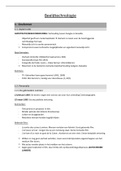
This is a summary of the obligatory literature used in the course “Medical Neuroscience
and Neuroanatomy”. Those parts of the chapters that need to be studied are summarised
in this document.
,Content
A. An overview of the brain....................................................................................................................3
B. How to control movement.................................................................................................................8
C. Somatosensory perception...............................................................................................................11
D. Blood supply.....................................................................................................................................14
E. Cranial nerves...................................................................................................................................15
, A. An overview of the brain
The nervous system
The nervous system can be divided into two parts. The first part is the central nervous
system (CNS) which includes the brain and the spinal cord, while the peripheral
nervous system includes the rest. The CNS is formed during embryological by the
folding of a sheet of ectodermal cells. After folding, this sheet is called the neural tube.
Afterwards, this neural tube will develop itself into the brain and the spinal cord. In the
brain, cavities are formed, which are called ventricles. These ventricles are filled with a
liquid called the cerebrospinal fluid (CSF).
A (developing) brain can be divided into three parts, the procencephalon, the
mesencephalon, and the rhombencephalin, or the forebrain, the midbrain, and the
hindbrain. The forebrain is the largest structure and can be divided into the
telencephalon and the diencephalon. The diencephalon consists of, among others, the
thalamus and the hypothalamus, which the telencephalon consists of the basal ganglia
and white matter, among other structures. The midbrain connects the forebrain to the
hindbrain and is small. The hindbrain consist of the pons and the medulla
(myelencephalon) and the cerebellum (metencephalon). The midbrain, pons and
medulla together form the brainstem.
The CSF is formed by the choroid plexus and circulates through the ventricles, starting in
the lateral ventricles, the third ventricle, the forth ventricle and through the brain and
spinal cord. The CNS is protected by different protective layers, which are called
meninges. These meninges are called, from inside to outside, the Dura, Arachnoid, and
the Pia.
Orientation
Body parts and brain structures are always said to be orientated in a certain position to
the nervous system. Ventral (or inferior) means towards the belly or under the nervous
system, where it enters the brain and dorsal (or superior) means towards the back or
above the nervous system. Next, rostral (or anterior) means towards the front (so, the
head) and dorsal (or posterior) means towards the end (so, the back). These terms can
be quite confusing, so it is important to always imagine how the spinal cord is orientated.
Next, the brain can be viewed from different positions, usually during a radiological scan.
It is said to be cut in different planes. One of these planes is the coronal plane. The
coronal plane is a plane that cuts the brain vertically, from top to bottom and shows both
hemispheres shown from above. The saggital plane shows another vertical cut form the
brain, but then from anterior to posterior in the brain. If the saggital plane passes the
border of two hemispheres, it is called a midsaggital cut, if it is just off the midline, it is
called a parasagittal cut. It only shows one hemisphere. The last plane is the
horizontal plane, which cuts the brain horizontally.
Cells
Two different cells are found in the nervous system. First, the glial cells, are cells which
provide support. Next, the nerve cells or the neurons are responsible for communication
in input from stimuli to the brain and signals from the brain to the body. A neuron
consists of a cell body, in which the nucleus is located, and the part receiving input to
the neuron, a short branch called the dendrite, and a longer branch responsible for
output, the axon. Most cells consist of multiple dendrites and axons, therefore being
multipolar. Usually, different axons branch of one main axon. A neuron is bipolar if it
has a single dendrite and a single axon. Most bipolar cells are sensorial neurons.
and Neuroanatomy”. Those parts of the chapters that need to be studied are summarised
in this document.
,Content
A. An overview of the brain....................................................................................................................3
B. How to control movement.................................................................................................................8
C. Somatosensory perception...............................................................................................................11
D. Blood supply.....................................................................................................................................14
E. Cranial nerves...................................................................................................................................15
, A. An overview of the brain
The nervous system
The nervous system can be divided into two parts. The first part is the central nervous
system (CNS) which includes the brain and the spinal cord, while the peripheral
nervous system includes the rest. The CNS is formed during embryological by the
folding of a sheet of ectodermal cells. After folding, this sheet is called the neural tube.
Afterwards, this neural tube will develop itself into the brain and the spinal cord. In the
brain, cavities are formed, which are called ventricles. These ventricles are filled with a
liquid called the cerebrospinal fluid (CSF).
A (developing) brain can be divided into three parts, the procencephalon, the
mesencephalon, and the rhombencephalin, or the forebrain, the midbrain, and the
hindbrain. The forebrain is the largest structure and can be divided into the
telencephalon and the diencephalon. The diencephalon consists of, among others, the
thalamus and the hypothalamus, which the telencephalon consists of the basal ganglia
and white matter, among other structures. The midbrain connects the forebrain to the
hindbrain and is small. The hindbrain consist of the pons and the medulla
(myelencephalon) and the cerebellum (metencephalon). The midbrain, pons and
medulla together form the brainstem.
The CSF is formed by the choroid plexus and circulates through the ventricles, starting in
the lateral ventricles, the third ventricle, the forth ventricle and through the brain and
spinal cord. The CNS is protected by different protective layers, which are called
meninges. These meninges are called, from inside to outside, the Dura, Arachnoid, and
the Pia.
Orientation
Body parts and brain structures are always said to be orientated in a certain position to
the nervous system. Ventral (or inferior) means towards the belly or under the nervous
system, where it enters the brain and dorsal (or superior) means towards the back or
above the nervous system. Next, rostral (or anterior) means towards the front (so, the
head) and dorsal (or posterior) means towards the end (so, the back). These terms can
be quite confusing, so it is important to always imagine how the spinal cord is orientated.
Next, the brain can be viewed from different positions, usually during a radiological scan.
It is said to be cut in different planes. One of these planes is the coronal plane. The
coronal plane is a plane that cuts the brain vertically, from top to bottom and shows both
hemispheres shown from above. The saggital plane shows another vertical cut form the
brain, but then from anterior to posterior in the brain. If the saggital plane passes the
border of two hemispheres, it is called a midsaggital cut, if it is just off the midline, it is
called a parasagittal cut. It only shows one hemisphere. The last plane is the
horizontal plane, which cuts the brain horizontally.
Cells
Two different cells are found in the nervous system. First, the glial cells, are cells which
provide support. Next, the nerve cells or the neurons are responsible for communication
in input from stimuli to the brain and signals from the brain to the body. A neuron
consists of a cell body, in which the nucleus is located, and the part receiving input to
the neuron, a short branch called the dendrite, and a longer branch responsible for
output, the axon. Most cells consist of multiple dendrites and axons, therefore being
multipolar. Usually, different axons branch of one main axon. A neuron is bipolar if it
has a single dendrite and a single axon. Most bipolar cells are sensorial neurons.