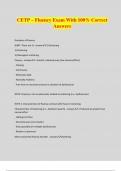
CETP – Fluency Exam With 100% Correct Answers
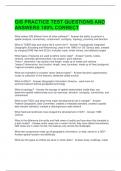
CETP – Fluency Exam With 100% Correct Answers Disorders of Fluency (HINT: There are 3) - answer1) Stuttering 2) Cluttering 3) Neurogenic stuttering Fluency - answer- Smooth, relatively easy (low tension/effort) - Flowing - Continuous - Relatively rapid - Normally rhythmic - Free from an excessive amount or duration of dysfluencies NOTE: Fluency is not as extensively studied as stuttering (i.e., dysfluencies) NOTE 2: Characteristics of fluency contrast with those of stuttering Characteristics of Stuttering (i.e., dysfluent speech) - answer- Produced w/ greater than normal effort - Halting (no flow) - Discontinuous (not smooth) - Slow (possibly d/t multiple dysfluencies) - Rhythm is abnormal Most researched fluency disorder - answerStuttering Also defined as a disorder of rhythm Primary speech characteristics of stuttering - answer1) Sound/part-word/syllable repetitions (e.g., S-s-s-s-saturday or Sa-sa-sa-saturday) 2) Prolongations (e.g., Sssssssaturday) 3) Blocks (i.e., Silent prolongations) Defining stuttering w/ nonspeech behaviours - answer- An anticipatory, apprehensive, and hypertonic AVOIDANCE reaction (Johnson et al., 1959) - Stuttering is not the same thing as dysfluency; Dx is made based on consistent avoidance of speaking situations - Stuttering begins when a child learns to avoid speech, speaking situations, and certain audiences (listeners or CPs) - Consists of: 1) anticipating trouble in speaking situations, 2) becoming apprehensive about the prospect of speaking, 3) experiencing tension, and 4) avoiding the situation - Avoidance results from parental disapproval/punishment of normal nonfluencies in typical speech - Stuttering can also be defined as what a person does to avoid stuttering (e.g., avoid speech situations in order to avoid negative consequences of normal nonfluencies) - Finally, it can also be defined as a social role conflict (Sheehan, 1970); the PWS cannot play their social roles normally - E.g., PWS may speak more fluently when talking to pets or kids, or when acting; difficulties arise when they have to speak with their boss or strangers. Thus, trouble playing different social roles Defining stuttering w/ unspecified behaviours - answer- Some definitions of stuttering don't specify behaviours (speech or nonspeech); instead refer to stuttering molar or global terms - Central notion to these definitions is an expert judgment; an expert's judgment that stuttering has occurred is the definition of stuttering (i.e., stuttering is what the expert says it is) - Stuttering may be defined as a MOMENT (moment of stuttering observed by an expert during some time duration); note, this does not specify WHAT the behaviour was - Stuttering may also be seen as an EVENT, as recognized by an expert - While the terms MOMENT and EVENT are used, they don't help us measure the beahviours objectively Definitions of stuttering limited to certain types of dysfluencies - answer- Many types of dysfluencies exist, and this is one reason why stuttering has so many definitions and varied diagnostic criteria - Certain definitions include only certain dysfluencies; from their POV, some dysfliencies are clinically significant, others are part of normal speech - Classic definitions include only part-word repetitions and speech-sound prolongations - Dysfluencies like word repetitions, interjections, and pauses are considered normal from this POV Van Riper: "Stuttering occurs when the forward flow of speech is interrupted by a motorically disrupted sound, syllable, or word or by the speaker's reaction thereto" - answer- This definition restricts stuttering to sound, syllable, or word repetitions or sound prolongations - Emphasizes speaker reactions, which many other definitions do not. Reactions are typically negative Definition of stuttering based on psychopathology (neurosis) - answer- View held by psychoanalysts and some psychologists (those who adopt Freudian POV) - Stuttering is d/t some psychopathology or a neurotic reaction (i.e., exhibiting neurosis) - Neurosis = drastic/irrational reactions; anxiety, phobias, frustrations - Psychological reactions like anxiety, frustration in self-expression, and apprehension about speaking situations/specific words are self-reported by many adults who stutter - Freudian psychoanalysts: fixation at an earlier stage of psychosexual development (i.e., oral or anal), frustration later in life, regression to the fixated stage of development, and subsequent symptom formation (i.e., conversion of fixation to relatively socially acceptable behaviours) explains stutttering - Not all psychologists who believe that stuttering is a form of neurosis believe in Freud's fixation-regression-symptom formation model; some just believe stuttering = a formed of learned neurotic reaction - Few SLPs believe that stuttering is d/t psychopathology - However, psychological reactions of PWS are considered significant and worth assessing Definition of stuttering based on all types of dysfluencies - answer- Many experts describe stuttering in terms of FREQUENCY and DURATION of dysfluencies - Include all types of dysfluencies in their d
École, étude et sujet
- Établissement
- CETP
- Cours
- CETP
Infos sur le Document
- Publié le
- 3 mars 2024
- Nombre de pages
- 34
- Écrit en
- 2023/2024
- Type
- Examen
- Contient
- Questions et réponses
Sujets
-
cetp fluency exam with 100 correct answers

Document également disponible en groupe