Language and communication
Week 2
Language allows us to express, observations, thoughts, feelings and needs
It’s listening, speaking, writing, and reading.
All the languages in the world
Worldwide, 6909 languages
Europe, 230 languages
Asia, 2197 languages
Language communicates a meaning.
Human language consists of a finite number of ‘signs’ (sounds, letters) that can be combined
to create an infinite number of meaningful units.
Every language has its own set of discrete units (phonemes, morphemes, words, phases
etc.)
Language is a modular system.
Modules:
- phonetics/phonology
- morphology
- syntax
- lexicon/semantics
- pragmatics
- discourse organization
Gestures are used by non-human (primates), for communication. These gestures can be
learned over time.
Human communication is more complex.
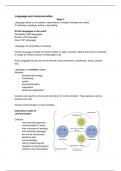
Interaction model of
communication.
Criticism
- very technical approach
- communication is more
than a process of sending
and receiving messages
- we cannot consciously
decide to stop
communicating
- role of context beyond
physical and psychological
context is not represented
,Basic function of verbal communication
- helps define reality
- helps to organize complex ideas and experiences (categorisation)
- helps to think
- helps to shape attitudes about the world
Principles of verbal communication
- it is a rule-governed system of symbols to share meaning
- has been agreed upon
- symbols are abstract and ambiguous
- rules that determine our use of symbols are, phonology, semantics, syntax,
pragmatics
Forms of communication are, intrapersonal, interpersonal, group, public and mass
communication.
Summary
Human language has many different functions, it differs from that of non-humans. It has
several distinct characteristics. Human communication also differs from that of non-humans.
Human communication is also too complex to represent in a model.
Language plays a ‘minor’, but important role in communication, there are also different levels
of communication.
Week 3, phonetics & phonology
Phonetics is
- the sounds of speech
- the production of speech sounds
- combination of speech sounds
- description of speech sounds
- representation of speeches sounds by written symbols
Phonology is
- the distribution of sounds in a language
- the patterning of speech sounds in a language
- (tacit) rules that govern pronunciation of sounds in a language
Letters can represent different sounds.
How do humans make speech sounds?
- the reed moved(vibration) by stream of air = source
- vibration can be manipulated using different keys in vocal tract = filter
- instrument is resonance box
The vocal tract, how humans make speech sounds.
,The use of articulation
- air stream mechanism, usually moving air from the lungs
- vocal folds (vibration = voiced sounds; aspiration
- velum (open = nasal sounds, closed = oral sounds)
Manner of articulation = the way in which airstream is released.
1. stops: air flow is cut off completely, examples /p/, /t/, /k/ as in stop, let, cat
2. fricatives: air flow is not blocked, but restricted, the air stream becomes noisy,
examples /s/, /z/, /f/, /v/ as in sin, zip, fight, vintage
3. affricates: a stop + fricative in one sound, examples, /ʤ/ or /ʧ/ as in gin or chat
4. nasals: air flow via the nose, examples /m/, /n/ as in my, night or wing
5. trill: two articulators involved, the passive articulator is in place, the active
articulator raps against passive articular, example /r/ as in spanish perro
6. tap/flap, in a single short movement of one articulator tapping against another
articulate, example /r/ as in matter
7. approximant; restriction of air flow without friction or fricative
a. glides or semi-vowel: almost produced like a vowel, but tongue closer to
roof of mouth, examples /w/, /j/ as in win and yen
, b. liquids: air flow through opening around tongue
- laterals: air flows over the sides of tongue, example /l/ as in lip
- rhotics: r-sounds with a lot of variation across languages
Obstruents: oral stops, fricatives and affricates
- restriction of air flow results in a hissing sounds
Sonorants: nasal stops, approximants and vowels
- sounds are made via the vibration of the vocal folds, they are always voiced
Voiceless, the vocal folds are open when the air steam passes the vocal folds
Voiced, the vocal folds are vibrating when the air stream passes the vocal folds.
-
Place of articulation = place to which the active articulator moves
watch
- bilabial, /p/ pan (voiceless), /b/ ban, /m/ man
- labiodental, /f/ fish (voiceless), /v/, van
- dental, /θ/ thin (voiceless), /ð/ this
- alveolar, /t/ town (voiceless), /d/ dog, /n/ nail, /l/ laugh, /s/ sun (voiceless), /z/ zoo
- postalveolar, /ʃ/ shine (voiceless), /ʒ/ vision, /ʧ/ church (voiceless), / ʤ/ judge
- palatal, /j/ yes
- velar, /k/ king (voiceless), /g/ garden, /ŋ/ sing
- glottal, /h/ home, /ʔ/ uh-oh
- retroflex, /ʈ/, /ɖ/
- uvular, /r/
- pharyngeal, /ħ/
- epi-glottal, /ʡ/
Places of articulation (passive & active):
1. Exo-labial, 2. Endo-labial, 3. Dental, 4. Alveolar, 5. Post-alveolar, 6. Pre-
palatal, 7. Palatal, 8. Velar, 9. Uvular, 10. Pharyngeal, 11. Glottal, 12.
Epiglottal, 13. Radical, 14. Postero-dorsal, 15. Antero-dorsal, 16. Laminal, 17.
Apical, 18. Sub-apical