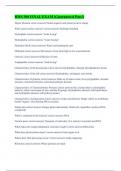
BMS 300 FINAL EXAM (Guaranteed Pass!)
Dipole Moment correct answers Partial negative and partial positive charge What causes surface tension? correct answers Hydrogen bonding Hydrophilic correct answers "water loving" Hydrophobic correct answers "water fearing" Hydration Shell correct answers Water surrounding the ions Diffusion correct answers Movement of ions from high to low concentrations Osmosis correct answers Diffusion of water Amphipathic correct answers "both loving" Characteristics of the head group correct answers Hydrophilic, charged, phosphodiestor bonds Characteristics of the tail correct answers Hydrophobic, uncharged, ester bonds. Characteristics of proteins correct answers Made up of amino acids, have polypeptides, includes enzymes, structural elements, and transmembrane proteins Characteristics of Transmembrane Proteins correct answers Has a lumen that is a hydrophilic pathway, allows movement of ions, and has R-groups. Hydrophobic interacts with lipid bilayer and hydrophilic interacts with pathway/lumen Characteristics of prokaryotes correct answers Archea and bacteria. Single celled, no membrane bound "organs", free floating DNA (circular) Eukaryotes correct answers Fungus plants and animals. Multi-cell, organelles, nucleus (DNA compacted) What is contained in the nucleus? correct answers DNA Nuclear pores correct answers Transport of molecules. It is selective to protein and RNA What makes the rough endoplasmic reticulum rough? correct answers Ribosomes What does glycosylation mean? correct answers It has sugars on it Where does final processing occur? correct answers Golgi Apparatus Ribosome correct answers Where proteins are made
École, étude et sujet
- Établissement
- BMS 300
- Cours
- BMS 300
Infos sur le Document
- Publié le
- 4 janvier 2024
- Nombre de pages
- 11
- Écrit en
- 2023/2024
- Type
- Examen
- Contient
- Questions et réponses
Sujets
-
dipole moment

Document également disponible en groupe