

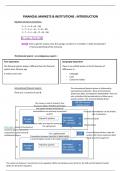
FINANCIAL MARKETS & INSTITUTIONS : INTRODUCTION
Equation of macro economics :
Y = C + I + G + (X – M)
Y – T = C + I + G – T + (X – M)
Y – T – C = I + (G – T) + (X – M)
S = I + (G – T) + (X – M)
How to get the surplus, thus the savings, to where it is needed ( = debts and equity) ?
= Financial plumbing of the economy
The financial system = an endogenous system :
Time dependent Geography dependent
The financial system today is different then the financial There is no unified system in the EU because of
system from 20 years ago differences in :
It evolves over time - Language
- Laws
- Consumer habits
International financial system : The international financial system is influenced by
supranational authorities : Bank of International
There are 2 countries A and B : Settlements (BIS), self regulation (ISDA/ESMA). There are
also institutions that provide advice or follow up on
specific markets : BIS, Financial Stability Board
The money is used to transact, thus
buying or selling. Therefore exchanges
and capital markets and financial
intermediaries are necessary as payment Financial intermediaries can be divided
systems into 2 subclasses :
Commercial banks
These make sure that the money goes to
Shadow banks
the right person
Start point : money in the hands of
economic agents (consumers,
corporations, governments & Central Clearing Parties, make the
institutional players. system safer. Every investment bank
Transactions between countries or banks within
a country happen mostly in the capital markets needs to work through CCP.
This system (in between 1 country) has to be regulated. Within the banking union of the EU, the ECB and the National Central
Banks are the prime regulators.
,The Belgian Financial System :
Conclusions :
- The banking system is much more important then the capital markets
- Professional parties do use capital markets much: mainly for derivates and bonds
- There is a limited use of the capital market to raise funding
- New trend : digital systems
, CHAPTER 1: MONEY AND THE CREATION OF MONEY
Origin and characteristics
Money = a product that is generally accepted in exchange for goods & services, a means of exchange.
Based on convention : we have trust and confidence that the people that we offer the
money to will accept it, it represents general purchasing power.
It is an explicit or implicit agreement :
Explicit agreement Implicit agreement
An agreement by law. The law can An agreement based on whatever the
enforce to use a given good as money economic agents agree to use as a
means of change
BUT if the public has no trust in this
good as a means of exchange then
even legal obligations cannot enforce
the use the use of the legal tender
outside the officially controlled circuit.
For all free transactions other means
of payment will be used.
ATTENTION : money does not equal coins issued by a central authority.
all legal tender issued by central banks do not automatically act as money.
Functions of money :
Means of exchange Investment Unit of account Standard for future payments
People use money in order Money represents a general, People express value in Time value of money.
to pay for goods and services stable purchasing power. terms of money.
Because of this money will Comparison of value do
This is a necessary condition be considered as a savings happen in money terms.
for the economy to thrive instrument next to other
stores of value.
Characteristics of money :
Throughout time the functions of money pointed to characteristics that an ideal means of payment
needs to possess.
valuable in comparison to its weight
We prefer a bank note to a bar of gold because the bar is to heavy, you cannot make transactions
with it because it is not practical.
durable
The good needs to last and be hard to destroy. Example : you can put a bank note of 5 euro in the washing
machine and it will still be whole.
, divisible
You can split it up in different smaller pieces. This makes the good practical
standardised quality
All euro notes have the same value. Diamonds for example do not, some of them are small, others
more shiny etc.
easily recognisable
stable purchasing power
If a person buys something today for 5 euros he should be able to do it again in x number of years.
Evolution of money :
means of payment:
commodities used as
barter trade precious metals coins (minted) or paper
"money"
money
There was no money at Examples : Gold and silver Each lord had his own
this time. People gave money with his stamp on
one good in exchange for Salt, tea, shells, it.
another. alcohol, silk, …
legal tender (fiat e-money -
fiduciary money
money) cryptocurrencies
Fiat money = what a government Fiduciary money = takes value Electronic money (e-
determines as money. The government thanks to the confidence of the money) = an electronic
declares fiat money to be legal public that it will be generally store of monetary value
tender, which requires all people and accepted as a medium of on a technical device that
firms within the country to accept it as a exchange, that it has purchasing may be widely used for
means of payment. power. making payments to
entities other than the e-
BUT this does not mean that the fiat The issuer of fiduciary money
money issuer.
money needs to be accepted by a promises to exchange it back for a
merchant. There is always a freedom of commodity or fiat money if The device acts as a
contract. For instance does a merchant requested by the bearer. The value prepaid bearer
have to accept cash? Cash is legal of the money token > the physical instrument which does
tender, but the merchant can decide to value of the money token (e.g. a 50 not necessarily involve
accept only electronic payments. In this euro banknote) bank accounts in
case he accepts commercial bank transactions.
money.
Equation of macro economics :
Y = C + I + G + (X – M)
Y – T = C + I + G – T + (X – M)
Y – T – C = I + (G – T) + (X – M)
S = I + (G – T) + (X – M)
How to get the surplus, thus the savings, to where it is needed ( = debts and equity) ?
= Financial plumbing of the economy
The financial system = an endogenous system :
Time dependent Geography dependent
The financial system today is different then the financial There is no unified system in the EU because of
system from 20 years ago differences in :
It evolves over time - Language
- Laws
- Consumer habits
International financial system : The international financial system is influenced by
supranational authorities : Bank of International
There are 2 countries A and B : Settlements (BIS), self regulation (ISDA/ESMA). There are
also institutions that provide advice or follow up on
specific markets : BIS, Financial Stability Board
The money is used to transact, thus
buying or selling. Therefore exchanges
and capital markets and financial
intermediaries are necessary as payment Financial intermediaries can be divided
systems into 2 subclasses :
Commercial banks
These make sure that the money goes to
Shadow banks
the right person
Start point : money in the hands of
economic agents (consumers,
corporations, governments & Central Clearing Parties, make the
institutional players. system safer. Every investment bank
Transactions between countries or banks within
a country happen mostly in the capital markets needs to work through CCP.
This system (in between 1 country) has to be regulated. Within the banking union of the EU, the ECB and the National Central
Banks are the prime regulators.
,The Belgian Financial System :
Conclusions :
- The banking system is much more important then the capital markets
- Professional parties do use capital markets much: mainly for derivates and bonds
- There is a limited use of the capital market to raise funding
- New trend : digital systems
, CHAPTER 1: MONEY AND THE CREATION OF MONEY
Origin and characteristics
Money = a product that is generally accepted in exchange for goods & services, a means of exchange.
Based on convention : we have trust and confidence that the people that we offer the
money to will accept it, it represents general purchasing power.
It is an explicit or implicit agreement :
Explicit agreement Implicit agreement
An agreement by law. The law can An agreement based on whatever the
enforce to use a given good as money economic agents agree to use as a
means of change
BUT if the public has no trust in this
good as a means of exchange then
even legal obligations cannot enforce
the use the use of the legal tender
outside the officially controlled circuit.
For all free transactions other means
of payment will be used.
ATTENTION : money does not equal coins issued by a central authority.
all legal tender issued by central banks do not automatically act as money.
Functions of money :
Means of exchange Investment Unit of account Standard for future payments
People use money in order Money represents a general, People express value in Time value of money.
to pay for goods and services stable purchasing power. terms of money.
Because of this money will Comparison of value do
This is a necessary condition be considered as a savings happen in money terms.
for the economy to thrive instrument next to other
stores of value.
Characteristics of money :
Throughout time the functions of money pointed to characteristics that an ideal means of payment
needs to possess.
valuable in comparison to its weight
We prefer a bank note to a bar of gold because the bar is to heavy, you cannot make transactions
with it because it is not practical.
durable
The good needs to last and be hard to destroy. Example : you can put a bank note of 5 euro in the washing
machine and it will still be whole.
, divisible
You can split it up in different smaller pieces. This makes the good practical
standardised quality
All euro notes have the same value. Diamonds for example do not, some of them are small, others
more shiny etc.
easily recognisable
stable purchasing power
If a person buys something today for 5 euros he should be able to do it again in x number of years.
Evolution of money :
means of payment:
commodities used as
barter trade precious metals coins (minted) or paper
"money"
money
There was no money at Examples : Gold and silver Each lord had his own
this time. People gave money with his stamp on
one good in exchange for Salt, tea, shells, it.
another. alcohol, silk, …
legal tender (fiat e-money -
fiduciary money
money) cryptocurrencies
Fiat money = what a government Fiduciary money = takes value Electronic money (e-
determines as money. The government thanks to the confidence of the money) = an electronic
declares fiat money to be legal public that it will be generally store of monetary value
tender, which requires all people and accepted as a medium of on a technical device that
firms within the country to accept it as a exchange, that it has purchasing may be widely used for
means of payment. power. making payments to
entities other than the e-
BUT this does not mean that the fiat The issuer of fiduciary money
money issuer.
money needs to be accepted by a promises to exchange it back for a
merchant. There is always a freedom of commodity or fiat money if The device acts as a
contract. For instance does a merchant requested by the bearer. The value prepaid bearer
have to accept cash? Cash is legal of the money token > the physical instrument which does
tender, but the merchant can decide to value of the money token (e.g. a 50 not necessarily involve
accept only electronic payments. In this euro banknote) bank accounts in
case he accepts commercial bank transactions.
money.


