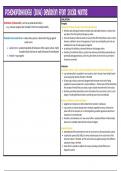
EVALUATION:
Definitions of Abnormality = aim to say what abnormality is Strengths:
→ e.g. how we recognise the mentally ill from the mentally healthy Distinguishes Between Desirable and Undesirable Behaviour
• definition does distinguish between desirable and undesirable behaviour, a feature that
was absent from the statistical infrequency model
Deviation from Social Norms = states that a person is abnormal if they go against ------ • the social deviancy model also takes into account the effect that behaviour has on others,
------------------------------------------social norms deviance is defined in terms of transgression of social rules and (ideally) social rules are
established in order to help people live together
→ social norms = accepted standards of behaviour within a given culture, might • according to this definition, abnormal behaviour that damages others
------------------- be explicit (built into law) or implicit (frowned if not followed) • therefore, this definition offers a practical and useful way of identifying undesirable and
→ deviate = to go against potentially damaging behaviour, which may alert others to the need to secure help for
the person concerned
Limitations:
Susceptible to Abuse - what is socially acceptable now may not have been 50 years ago
• e.g. homosexuality is acceptable in most countries, but in the past it was included under
sexual and gender identity disorders in the DSM
• 50 years ago in Russia, anyone who disagreed with the state ran the risk of being
regarded as insane and placed in a mental institutions – Thomas Szasz (1974) claimed that
the concept of mental illness was simply a way to exclude nonconformists from society
• therefore, we define abnormality in terms of deviation from social norms, there is a real
danger of creating definitions based on prevailing social morals and attitudes
Deviance is Related to Context and Degree
• judgements on deviance are often related to the context of a behaviour
• e.g. a person on a beach wearing next to nothing is regarded as normal, whereas the
same outfit in the classroom or at a formal gathering could be regarded as abnormal or
indication of a mental disorder
• therefore, social deviance on its own cannot offer a complete definition of abnormality,
because it is inevitably related to both context and degree
Cultural Relativism
• attempting to define abnormality in terms of social norms is obviously bound by culture
• classification systems (the DSM), are almost entirely based on the social norms of the
dominant culture in the West, yet the same criteria are applied to people from different
subcultures living in the West
• shows that it is possible to address this issue by including cultural differences in
diagnostic systems
, EVALUATION:
Definitions of Abnormality = aim to say what abnormality is Strengths:
→ e.g. how we recognise the mentally ill from the mentally healthy Statistical Infrequency is Sometimes Appropriate for Defining Abnormality
• e.g. intellectual disability is defined in terms of the normal distribution using the
concept of standard deviation to establish a cut-off point for abnormality, any
Statistical Infrequency = abnormality is defined as behaviours that are extremely rare individual whose IQ is more than two standard deviations below the mean is
→ e.g. any behaviour that is found in very few people is regarded as abnormal judges as having a mental disorder – however, such a diagnosis is only made in
conjunction with failure to function adequately
• behaviours/traits that are rare are abnormal • this suggests that statistical infrequency is only one of a number of tools
→ abnormality is defined as more than two standard deviations from the mean
• many behaviours, when plotted, form a normal distribution curve Limitations:
→ the mid-point is the mean, each bar represents one standard deviation Some Abnormal Behaviours are Desirable
• main issue is that there are many abnormal behaviours that are quite desirable
• e.g. very few people have an IQ over 150 but this abnormality is desirable, there
are some ‘normal/common behaviours’ such as depression that are undesirable
• therefore, using statistical frequency to define abnormality means that we are
unable to distinguish between desirable and undesirable behaviours
The Cut-Off Point is Subjective
• if abnormality is defined in terms of statistical infrequency, we need to decide
where to separate normality from abnormality
• e.g. one symptom of depression is ‘difficulty sleeping’, some people may think
abnormal sleep is less than 6 hours a night on average, others may think cut-off
should be 5 hours
• such disagreements mean it is difficult to define abnormality in terms of
statistical infrequency
Cultural Relativism
• behaviours that are statistically infrequent in ne culture may be statistically more
frequent in another
• e.g. one of the symptoms of schizophrenia is claiming to hear voices, however,
this is an experience that is common in some cultures
Definitions of Abnormality = aim to say what abnormality is Strengths:
→ e.g. how we recognise the mentally ill from the mentally healthy Distinguishes Between Desirable and Undesirable Behaviour
• definition does distinguish between desirable and undesirable behaviour, a feature that
was absent from the statistical infrequency model
Deviation from Social Norms = states that a person is abnormal if they go against ------ • the social deviancy model also takes into account the effect that behaviour has on others,
------------------------------------------social norms deviance is defined in terms of transgression of social rules and (ideally) social rules are
established in order to help people live together
→ social norms = accepted standards of behaviour within a given culture, might • according to this definition, abnormal behaviour that damages others
------------------- be explicit (built into law) or implicit (frowned if not followed) • therefore, this definition offers a practical and useful way of identifying undesirable and
→ deviate = to go against potentially damaging behaviour, which may alert others to the need to secure help for
the person concerned
Limitations:
Susceptible to Abuse - what is socially acceptable now may not have been 50 years ago
• e.g. homosexuality is acceptable in most countries, but in the past it was included under
sexual and gender identity disorders in the DSM
• 50 years ago in Russia, anyone who disagreed with the state ran the risk of being
regarded as insane and placed in a mental institutions – Thomas Szasz (1974) claimed that
the concept of mental illness was simply a way to exclude nonconformists from society
• therefore, we define abnormality in terms of deviation from social norms, there is a real
danger of creating definitions based on prevailing social morals and attitudes
Deviance is Related to Context and Degree
• judgements on deviance are often related to the context of a behaviour
• e.g. a person on a beach wearing next to nothing is regarded as normal, whereas the
same outfit in the classroom or at a formal gathering could be regarded as abnormal or
indication of a mental disorder
• therefore, social deviance on its own cannot offer a complete definition of abnormality,
because it is inevitably related to both context and degree
Cultural Relativism
• attempting to define abnormality in terms of social norms is obviously bound by culture
• classification systems (the DSM), are almost entirely based on the social norms of the
dominant culture in the West, yet the same criteria are applied to people from different
subcultures living in the West
• shows that it is possible to address this issue by including cultural differences in
diagnostic systems
, EVALUATION:
Definitions of Abnormality = aim to say what abnormality is Strengths:
→ e.g. how we recognise the mentally ill from the mentally healthy Statistical Infrequency is Sometimes Appropriate for Defining Abnormality
• e.g. intellectual disability is defined in terms of the normal distribution using the
concept of standard deviation to establish a cut-off point for abnormality, any
Statistical Infrequency = abnormality is defined as behaviours that are extremely rare individual whose IQ is more than two standard deviations below the mean is
→ e.g. any behaviour that is found in very few people is regarded as abnormal judges as having a mental disorder – however, such a diagnosis is only made in
conjunction with failure to function adequately
• behaviours/traits that are rare are abnormal • this suggests that statistical infrequency is only one of a number of tools
→ abnormality is defined as more than two standard deviations from the mean
• many behaviours, when plotted, form a normal distribution curve Limitations:
→ the mid-point is the mean, each bar represents one standard deviation Some Abnormal Behaviours are Desirable
• main issue is that there are many abnormal behaviours that are quite desirable
• e.g. very few people have an IQ over 150 but this abnormality is desirable, there
are some ‘normal/common behaviours’ such as depression that are undesirable
• therefore, using statistical frequency to define abnormality means that we are
unable to distinguish between desirable and undesirable behaviours
The Cut-Off Point is Subjective
• if abnormality is defined in terms of statistical infrequency, we need to decide
where to separate normality from abnormality
• e.g. one symptom of depression is ‘difficulty sleeping’, some people may think
abnormal sleep is less than 6 hours a night on average, others may think cut-off
should be 5 hours
• such disagreements mean it is difficult to define abnormality in terms of
statistical infrequency
Cultural Relativism
• behaviours that are statistically infrequent in ne culture may be statistically more
frequent in another
• e.g. one of the symptoms of schizophrenia is claiming to hear voices, however,
this is an experience that is common in some cultures