Week 2 :
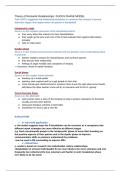
Preparation: Chap 3: National Income: Where It Comes
from and Where It Goes.
GDP measures both a nation’s total output of goods and services and its total
income.
Public saving: any excess of tax revenue over government spending. It can be
positive (a budget surplus)
or negative (a budget deficit).
GDP depends on the quantity of inputs, called the factors of production, and its
ability to turn inputs
into outputs.
Factors of production: inputs used to produce goods and services. 2
most important: Capital (set of
tools used by workers) and the Labor (the time people spend on
working).
Production function: Y = F(K, L)
The available production technology determines how much
outputs is produced from given amounts of capital and
labour.
Many production functions have a constant return to scale, if
zY = F (zK, zL)
19th century idea: The demand for each factor of production
depends on the marginal productivity of that factor =>
neoclassical theory of distribution.
The distribution of national income is determined by factor
prices – amounts paid to the factors of production. With Labor
and Capital: workers’ wages and the rent the owners of
capital collect.
Assumptions:
A typical firm is competitive, i.e. small relative to the markets in which it trades,
so little influence on market prices. A firm sells its output at a price P, hires
workers at a wage W, rents capital at a rate R.
The goal of a firmq is to maximize profit – Revenue minus Costs; i.e: Revenue =
P x Y, Costs = costs of labor + costs of capital = W x L + R x K
π= PY – WL – RK
π = PF (K, L) – WL – RK Because Y = F (K, L)
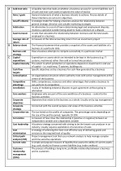
The Marginal Product of Labor (MPL): more labor = more output.
MPL = F (K, L+1) – F (K, L)
Most production function have the property of diminishing marginal product.
If the economy is a closed economy – i.e. not trading with other countries – then
Net Export = 0, and National Income Accounts Identity (Y) = C + I + G
, Government taxes households an amount T, so income after payment of all
taxes (namely Disposable Income) = Y – T
C = C (Y – T)
Relationship between consumption and disposable income is consumption
function.
The marginal Propensity to consume (MPC): the amount by which consumption
changes when disposable income increases by one dollar.
The quantity of investment goods depends on the interest rate,
measuring the cost of the funds used to finance investment.
The nominal interest rate is the interest rate as usually reported: the
one payed by investors to borrow money.
The real interest rate is the nominal interest rate corrected with the effects of
inflation.
I = I (r)
If government purchases equal taxes minus transfers, then G = T
and the government has a balanced
budget. If G>T, budget deficit -> Gov. debt.
If G<T, budget surplus -> repayment of
debt.
Y – C – G (The output that remains after the demands of consumers)= I
National saving or saving (S)
S= (Y – T – C)Private saving + (T – G)Public saving = I
Y – C ( Y – T ) – G = I (r)
At the equilibrium interest
rate, households’ desire to
save balance firms’ desire to invest, and the quantity of loanable fuds supplied
equals the quantity demanded.
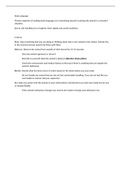
Government purchases crowd out investment.
Chap 6: The Open
Economy
Cd = Consumption of domestic goods and services
Id = Investment in domestic gods and services
Gd = Government purchases of domestic goods and services
X = exports of domestic goods and services (foreign spending)
(C = Cd + Cf and so on)
So Y = (C – Cf ) + (I – If) + (G – Gf) + X
So Y = C + I + G + X – (Cf + If + Gf ) and IM (expenditures on imports) = (C f + If
+ Gf )
So Y = C + I + G + X – IM and because NX = X – IM
So Y = C + I + G + NX
Preparation: Chap 3: National Income: Where It Comes
from and Where It Goes.
GDP measures both a nation’s total output of goods and services and its total
income.
Public saving: any excess of tax revenue over government spending. It can be
positive (a budget surplus)
or negative (a budget deficit).
GDP depends on the quantity of inputs, called the factors of production, and its
ability to turn inputs
into outputs.
Factors of production: inputs used to produce goods and services. 2
most important: Capital (set of
tools used by workers) and the Labor (the time people spend on
working).
Production function: Y = F(K, L)
The available production technology determines how much
outputs is produced from given amounts of capital and
labour.
Many production functions have a constant return to scale, if
zY = F (zK, zL)
19th century idea: The demand for each factor of production
depends on the marginal productivity of that factor =>
neoclassical theory of distribution.
The distribution of national income is determined by factor
prices – amounts paid to the factors of production. With Labor
and Capital: workers’ wages and the rent the owners of
capital collect.
Assumptions:
A typical firm is competitive, i.e. small relative to the markets in which it trades,
so little influence on market prices. A firm sells its output at a price P, hires
workers at a wage W, rents capital at a rate R.
The goal of a firmq is to maximize profit – Revenue minus Costs; i.e: Revenue =
P x Y, Costs = costs of labor + costs of capital = W x L + R x K
π= PY – WL – RK
π = PF (K, L) – WL – RK Because Y = F (K, L)
The Marginal Product of Labor (MPL): more labor = more output.
MPL = F (K, L+1) – F (K, L)
Most production function have the property of diminishing marginal product.
If the economy is a closed economy – i.e. not trading with other countries – then
Net Export = 0, and National Income Accounts Identity (Y) = C + I + G
, Government taxes households an amount T, so income after payment of all
taxes (namely Disposable Income) = Y – T
C = C (Y – T)
Relationship between consumption and disposable income is consumption
function.
The marginal Propensity to consume (MPC): the amount by which consumption
changes when disposable income increases by one dollar.
The quantity of investment goods depends on the interest rate,
measuring the cost of the funds used to finance investment.
The nominal interest rate is the interest rate as usually reported: the
one payed by investors to borrow money.
The real interest rate is the nominal interest rate corrected with the effects of
inflation.
I = I (r)
If government purchases equal taxes minus transfers, then G = T
and the government has a balanced
budget. If G>T, budget deficit -> Gov. debt.
If G<T, budget surplus -> repayment of
debt.
Y – C – G (The output that remains after the demands of consumers)= I
National saving or saving (S)
S= (Y – T – C)Private saving + (T – G)Public saving = I
Y – C ( Y – T ) – G = I (r)
At the equilibrium interest
rate, households’ desire to
save balance firms’ desire to invest, and the quantity of loanable fuds supplied
equals the quantity demanded.
Government purchases crowd out investment.
Chap 6: The Open
Economy
Cd = Consumption of domestic goods and services
Id = Investment in domestic gods and services
Gd = Government purchases of domestic goods and services
X = exports of domestic goods and services (foreign spending)
(C = Cd + Cf and so on)
So Y = (C – Cf ) + (I – If) + (G – Gf) + X
So Y = C + I + G + X – (Cf + If + Gf ) and IM (expenditures on imports) = (C f + If
+ Gf )
So Y = C + I + G + X – IM and because NX = X – IM
So Y = C + I + G + NX