Laura van den End
Introduction
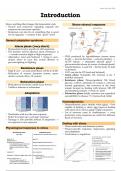
Stress: anything that changes the homeostatic state Neuro-adrenal responses
- Neural and endocrine signaling regulate the
response (not necessary specific)
- Responses can also be on something that is good
for an organism → eustress is the “good” stress
General adaptation syndrome
Alarm phase (very short)
- Homeostatic level is specific for diff organisms
- The baseline will be affected: shock (resistance ↓)
→ counter-reaction (fight to flight response)
- Alternative: tend and befriend = trying to accu- - CRH: produced by hypothalamus (senses stress
mulate stress in your life, switch lifestyle to levels) → local in the brain → activate pituitary →
prevent fighting or flighting ACTH release → stimulates adrenal gland →
glucocorticoids release (in cortex of adrenal gland)
- Catecholamines: A and NA -. Set the body in state
Resistance phase
- High E cost → at some point there will be no E left of alertness
- Relocation of sources (immune system, repro- - AVP: can also be OT (tend and befriend)
- Alarm phase: Sympathic NS; Cortisol, A etc ↑;
ductive system/drive, GI system)
mobilize resources
- Resistance phase: Parasympathetic NS; blood
Exhaustion phase glucose, cortisol, adrenalin etc remain ↑; outward
- Relocation of recourses cannot occur forever normal appearance, but resources of the body
- Visible is sickness or exhaustion remain focused on dealing with stressor; HR, BP
and breathing remain↑ ⇒ body on ‘alert’
Adaptation - Exhaustion phase: bodily resources are expended;
susceptibility to disease ↑↑; if unresolved: lethal
Homeodynamics
- Homeodynamic space shrinks when aging → less
capable of dealing w stress. also improve dealing
with stress slows down aging = tight connection
- Lot of stressors come in combinations → cross
- Deal better with it in the next exposure protection: some responses are useful for different
- Entire level goes up vs stronger response kinds of stressors
- Damage is also possible instead of adaptation →
no response in next exposure
Dealing with stress
- Neuro-endocrino and immune systems
Physiological responses to stress - Stressor-specific responses: chaperones, signaling
and adaptation
- Conformers vs regulators:
1 bold dashed line (almost straight)
2 curvy dotted line
3 Dashed and dotted
4 is light dashed line (straight)
5 bold dashed line that stops (top)
6 continuous line
Adaptive and stress physiology
, Laura van den End
Temperature
- Different species heave different temperature Blubber and fur
requirements - 2 ways (autonomous NS)
- How an animal deals with stress also limits the nr 1. Insulation layer on the inside of the skin =
of environments it can migrate into (and the other blubber
way around) - Insulating value regulated by blood vessel
- Earths range: -89ºC - 350ºC; prokaryotes are shunting
everywhere 2. Insulation layer on top of the skin: fur
- Animal life is more restricted: in order to cool - Insulating value regulated by pilomotor
down, endothermic animals need to produce control
heat - Hair traps air → flattened fur has less
- Ectotherms are capable to live in colder insulating value than fur that stands straight
environments but not in hotter - Short term: orientation → volume of trapped air
changes
Metabolism - Long term: seasonal changes
- Metabolism generates heat (protons slipping out, - Migrating (local or long term)
instead of being used in the ATPases)
- The higher the difference, the higher the transfer Biochemistry
- K - thermal conductivity → Ek is passed on
between molecules Enzyme kinetics
- The closer together, the faster the transfer - Enzymes lower Eact, do not affect reaction speeds
- Conductivity of water is bigger than air: water is
but ΔG, T affects reaction speed
more dense → more molecules to exchange heat - At eq: fwd and rev speeds = no major effects
- Convection: helping conduction by replacing
expected over non-denaturing range, but biolo-
molecules
gical interactions: often fwd favored (and P often
- Radiation: electromagnetic, no direct contact
titrated away)
required. Using radiation from the sun to warm - Deadly if:
up (also loss of heat) - Reaction too slow to sustain life
- Evaporation: get rid of the heat (e.g sweating) - Misaligned reaction speeds between multiple
- Animal’s body temperature reflects stored heat →
enzymes
depends on surface to volume (T gradient and - Denaturing of enzymes
specific heat conductance) - Some enzymes have T-dependent allelic
expressions
Heat transfer: general mechanisms - Occurrence of alleles according to geological
location
Blood ow
- Redirection: more easily lose or gain heat Membrane uidity and remodeling
- Also countercurrent exchangers: eg feet of birds: - Membranes need to be fluid so proteins can move
feet are not endothermic but have T of environ- around → not too fluid bc then an organism can’t
ment → heat exchange between arteries and veins regulate the moving around of proteins
→ increase T in feet - Measure: DPH → intercalated into the membrane
- Tuna: most fish have blood vessels in the center, → apolar
but tuna has under their skin - Measure anisotropy → shine polarized light
- Blood cools down when traveling pastils → into membrane → DPH will return polarized
you don’t want the cool blood to travel to the light. If membrane becomes more fluid →
central parts of your body DPH can move around more → less polarized
- Counter Curren: cool blood (O2 rich( coming light will be returned
from rolls gets heated up by the warmer - The higher the anisotropy, the more rigid the
blood membrane → doesn’t matter which animal
you take, they will always try to keep their
membrane fluidity in a certain range
Adaptive and stress physiology
fl fl
, Laura van den End
Physiological classi cation
Homeothermic vs poikilothermic
- Poliko: Tb fluctuate with the changing of Tenv →
can’t maintain Tb of narrow range (cold blooded,
fish, amphibians and reptiles)
- Homeo: Tb do not fluctuate with the change of Tenv
→ can maintain Tb of narrow range (warm
blooded, bird and mammals)
Endotherm vs exotherm
- All animals produce heat (metabolism) →
ectotherms don’t use this heat (endotherms do)
- Move membrane to colder T (1 → 2) → membrane - Endotherm: generates internal heat to regulate its
becomes more rigid → after a while, membrane body temperature (not necessarily constant)
fluidity drops (2 → 3) = membrane acclimated - Ectotherm: environment determines the body
- Move membrane to higher T again (3 → 4) fluidity temperature (not necessarily variable)
will drop even further but will evt go back up (4 - Real life is between the extremes: ectothermic and
→ 1) = homeoviscous membrane adaptation homeothermic live in thermal stable environments
- Regulation towards low fluidity when T drops
- Regulation towards high fluidity when T increases Regional and temporal heterothermy
Temporal heterothermia → hummingbird
- FA chain length → shorter = fewer interactions - Needs to eat all of the time to keep
with neighboring molecules → higher fluidity metabolism going and thus regulate Tb
- Saturation: unsaturated bonds: next FA will be - What at night when they need to sleep?
pushed further away → higher fluidity → Tb drops to conserve energy
- Phospholipid class: PC (phosphatidyl choline) =
acc to warmer; PE (phosphatidyl ethalomine) = acc Regional heterothermia → bumblebees
to colder - TA = ambient temperature (outside)
- Cholesterol content: keeps long side-chains from - TB = body temperature
interacting with each other at lower T → rigid - Tb split over thorax and abdomen
membrane becomes more fluid bc FA chains can’t - Thorax = endothermic → bc thorax
interact with each other + restricts movement in is kept warmer than the env when Ta
membrane when T↑ → more rigid drops
- Abdomen = ectothermic → bc Tb follows Ta
- Cells do this via de novo synthesis, but also in situ ⇒ only regulation of thorax T by the animal
replacement
- In situ relies on FA from diet Flying insect + pre-flight thermogenesis
- De novo FA synthesis in ER: endo- and - Warmup time ~ Tenvironment
exocytic cycles: continuous replacement - flight muscles put in anta-
gonistic movement (same as
Chaperones shivering in humans) →
- Small molecules e.g. trehalose increase of thorax T makes it
- Proteins: heat shock proteins possible to fly (wings attached
to thorax) → other animals
can’t do this at lower T but
this organism can
Heterothermic fish: typically
species that swim continuously
- Animal has rete mirabile, red
muscle ⇒ heterothermic
- Major vessels towards outside
of body → doesn’t regulate T
⇒ ectothermic
Adaptive and stress physiology
fi
Introduction
Stress: anything that changes the homeostatic state Neuro-adrenal responses
- Neural and endocrine signaling regulate the
response (not necessary specific)
- Responses can also be on something that is good
for an organism → eustress is the “good” stress
General adaptation syndrome
Alarm phase (very short)
- Homeostatic level is specific for diff organisms
- The baseline will be affected: shock (resistance ↓)
→ counter-reaction (fight to flight response)
- Alternative: tend and befriend = trying to accu- - CRH: produced by hypothalamus (senses stress
mulate stress in your life, switch lifestyle to levels) → local in the brain → activate pituitary →
prevent fighting or flighting ACTH release → stimulates adrenal gland →
glucocorticoids release (in cortex of adrenal gland)
- Catecholamines: A and NA -. Set the body in state
Resistance phase
- High E cost → at some point there will be no E left of alertness
- Relocation of sources (immune system, repro- - AVP: can also be OT (tend and befriend)
- Alarm phase: Sympathic NS; Cortisol, A etc ↑;
ductive system/drive, GI system)
mobilize resources
- Resistance phase: Parasympathetic NS; blood
Exhaustion phase glucose, cortisol, adrenalin etc remain ↑; outward
- Relocation of recourses cannot occur forever normal appearance, but resources of the body
- Visible is sickness or exhaustion remain focused on dealing with stressor; HR, BP
and breathing remain↑ ⇒ body on ‘alert’
Adaptation - Exhaustion phase: bodily resources are expended;
susceptibility to disease ↑↑; if unresolved: lethal
Homeodynamics
- Homeodynamic space shrinks when aging → less
capable of dealing w stress. also improve dealing
with stress slows down aging = tight connection
- Lot of stressors come in combinations → cross
- Deal better with it in the next exposure protection: some responses are useful for different
- Entire level goes up vs stronger response kinds of stressors
- Damage is also possible instead of adaptation →
no response in next exposure
Dealing with stress
- Neuro-endocrino and immune systems
Physiological responses to stress - Stressor-specific responses: chaperones, signaling
and adaptation
- Conformers vs regulators:
1 bold dashed line (almost straight)
2 curvy dotted line
3 Dashed and dotted
4 is light dashed line (straight)
5 bold dashed line that stops (top)
6 continuous line
Adaptive and stress physiology
, Laura van den End
Temperature
- Different species heave different temperature Blubber and fur
requirements - 2 ways (autonomous NS)
- How an animal deals with stress also limits the nr 1. Insulation layer on the inside of the skin =
of environments it can migrate into (and the other blubber
way around) - Insulating value regulated by blood vessel
- Earths range: -89ºC - 350ºC; prokaryotes are shunting
everywhere 2. Insulation layer on top of the skin: fur
- Animal life is more restricted: in order to cool - Insulating value regulated by pilomotor
down, endothermic animals need to produce control
heat - Hair traps air → flattened fur has less
- Ectotherms are capable to live in colder insulating value than fur that stands straight
environments but not in hotter - Short term: orientation → volume of trapped air
changes
Metabolism - Long term: seasonal changes
- Metabolism generates heat (protons slipping out, - Migrating (local or long term)
instead of being used in the ATPases)
- The higher the difference, the higher the transfer Biochemistry
- K - thermal conductivity → Ek is passed on
between molecules Enzyme kinetics
- The closer together, the faster the transfer - Enzymes lower Eact, do not affect reaction speeds
- Conductivity of water is bigger than air: water is
but ΔG, T affects reaction speed
more dense → more molecules to exchange heat - At eq: fwd and rev speeds = no major effects
- Convection: helping conduction by replacing
expected over non-denaturing range, but biolo-
molecules
gical interactions: often fwd favored (and P often
- Radiation: electromagnetic, no direct contact
titrated away)
required. Using radiation from the sun to warm - Deadly if:
up (also loss of heat) - Reaction too slow to sustain life
- Evaporation: get rid of the heat (e.g sweating) - Misaligned reaction speeds between multiple
- Animal’s body temperature reflects stored heat →
enzymes
depends on surface to volume (T gradient and - Denaturing of enzymes
specific heat conductance) - Some enzymes have T-dependent allelic
expressions
Heat transfer: general mechanisms - Occurrence of alleles according to geological
location
Blood ow
- Redirection: more easily lose or gain heat Membrane uidity and remodeling
- Also countercurrent exchangers: eg feet of birds: - Membranes need to be fluid so proteins can move
feet are not endothermic but have T of environ- around → not too fluid bc then an organism can’t
ment → heat exchange between arteries and veins regulate the moving around of proteins
→ increase T in feet - Measure: DPH → intercalated into the membrane
- Tuna: most fish have blood vessels in the center, → apolar
but tuna has under their skin - Measure anisotropy → shine polarized light
- Blood cools down when traveling pastils → into membrane → DPH will return polarized
you don’t want the cool blood to travel to the light. If membrane becomes more fluid →
central parts of your body DPH can move around more → less polarized
- Counter Curren: cool blood (O2 rich( coming light will be returned
from rolls gets heated up by the warmer - The higher the anisotropy, the more rigid the
blood membrane → doesn’t matter which animal
you take, they will always try to keep their
membrane fluidity in a certain range
Adaptive and stress physiology
fl fl
, Laura van den End
Physiological classi cation
Homeothermic vs poikilothermic
- Poliko: Tb fluctuate with the changing of Tenv →
can’t maintain Tb of narrow range (cold blooded,
fish, amphibians and reptiles)
- Homeo: Tb do not fluctuate with the change of Tenv
→ can maintain Tb of narrow range (warm
blooded, bird and mammals)
Endotherm vs exotherm
- All animals produce heat (metabolism) →
ectotherms don’t use this heat (endotherms do)
- Move membrane to colder T (1 → 2) → membrane - Endotherm: generates internal heat to regulate its
becomes more rigid → after a while, membrane body temperature (not necessarily constant)
fluidity drops (2 → 3) = membrane acclimated - Ectotherm: environment determines the body
- Move membrane to higher T again (3 → 4) fluidity temperature (not necessarily variable)
will drop even further but will evt go back up (4 - Real life is between the extremes: ectothermic and
→ 1) = homeoviscous membrane adaptation homeothermic live in thermal stable environments
- Regulation towards low fluidity when T drops
- Regulation towards high fluidity when T increases Regional and temporal heterothermy
Temporal heterothermia → hummingbird
- FA chain length → shorter = fewer interactions - Needs to eat all of the time to keep
with neighboring molecules → higher fluidity metabolism going and thus regulate Tb
- Saturation: unsaturated bonds: next FA will be - What at night when they need to sleep?
pushed further away → higher fluidity → Tb drops to conserve energy
- Phospholipid class: PC (phosphatidyl choline) =
acc to warmer; PE (phosphatidyl ethalomine) = acc Regional heterothermia → bumblebees
to colder - TA = ambient temperature (outside)
- Cholesterol content: keeps long side-chains from - TB = body temperature
interacting with each other at lower T → rigid - Tb split over thorax and abdomen
membrane becomes more fluid bc FA chains can’t - Thorax = endothermic → bc thorax
interact with each other + restricts movement in is kept warmer than the env when Ta
membrane when T↑ → more rigid drops
- Abdomen = ectothermic → bc Tb follows Ta
- Cells do this via de novo synthesis, but also in situ ⇒ only regulation of thorax T by the animal
replacement
- In situ relies on FA from diet Flying insect + pre-flight thermogenesis
- De novo FA synthesis in ER: endo- and - Warmup time ~ Tenvironment
exocytic cycles: continuous replacement - flight muscles put in anta-
gonistic movement (same as
Chaperones shivering in humans) →
- Small molecules e.g. trehalose increase of thorax T makes it
- Proteins: heat shock proteins possible to fly (wings attached
to thorax) → other animals
can’t do this at lower T but
this organism can
Heterothermic fish: typically
species that swim continuously
- Animal has rete mirabile, red
muscle ⇒ heterothermic
- Major vessels towards outside
of body → doesn’t regulate T
⇒ ectothermic
Adaptive and stress physiology
fi