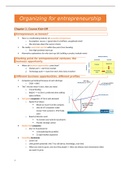
Organizing for entrepreneurship
Chapter 1: Course Kick-Off
Entrepreneurs as heroes?
There is a mythmaking industry of successful entrepreneurs
o Assumption: success = (great idea & a brilliant, exceptional mind)
o We only hear about the success stories
The reality: most start-ups fail within few years from founding
o Even high-potential start-ups
Alternative explanations for why start-ups fail: building a product nobody wants
Starting point for entrepreneurial ventures: the
business opportunity
Where do business opportunities come from?
1. Market pull => start from market
2. Technology push => start from tech, then look at market
Different business opportunities, different profiles
Companies go bankrupt because of cash shortage
o CASH = KING
“the” investor doesn’t exist, there are many
o Crowd funding
o BA&VC => VC firm is preferred when talking
about millions
Tech push companies: VC firms who demand:
o Equity/% of shares
Retain as much % of the company
How do VC-companies make
money? Exit scenario’s: IPO/Trade
sales
o Board of director seats
To monitor and control investments
Provide strategic advice
Market Pull companies
o Also VC investment for
1) broadening the portfolio
2) rapid market expansion
Consulting businesses
o Lower risk
o Little growth potential: why? You sell advice, knowledge, your time
o When you want to grow, you must hire people => there are always more investments when
you want to grow
1
, o Through working with the clients you see what problems are emerging => jump to market pull
company
What is a business model & why is it so important?
A business model = the architecture of the firm’s value creation, delivery and capturing mechanisms
o Value creation = problem - solution fit (value proposition)
o Value capture = bundle of resources, activities, and processes that you have to bring to place
o Value delivery = how you plan to make money
=> building blocks BM
E.g.: Evernote
o Value creation = notes on hand whenever, wherever
o Value capture = any type of device
o Value delivery = freemium
=> BM has to answer these questions
BM is the business in a nutshell explained in <50 words
BM often work great in theory, but fail in the real life, why?
o ASSUMPTIONS: E.g.: Genappeal
Assumptions Genappeal
Who is the customer? Singles
What is the market size? 45 mio
BM? Offers DNA marketing software
Problems:
“the” single doesn’t exist => market segmentation
They don’t engage in the market, look at competition
o ENVIRONMENTAL CHANGE: E.g.: Automatic conversion of online content
KLM: able to raise 5 mio from VC firms to scale up the
business to operate in the Benelux + expand to the US
Replicate BM to other areas => shock from Apple:
iPhone apps => large web agencies want apps => this
company didn’t have any customers => change BM
from high end to low end customers
They change their BM in 15 months => company failed
because ran out of money + VC’s invested in BM1 so pulled their investments
2
,Chapter 2: the lean start-up method
Case study: BOO.com
Background:
o Founded in ‘99
o Ended in ’00 because of bankruptcy
o Investment: 185 million => liquidation
Question 1: Attraction to investors, why is BOO.com online strategy different from more conventional
retail web shops?
o Founders have experience in entrepreneurship (online bookstore)
o They sold the online bookstore: realization of exit => VC companies only get money when
company is sold/stock market
o Full retail price: 5,5% margin
o Shopping experience was fundamentally different => big advantage against competitors
o They promised to be profitable in < 2 years
Question 2: Problems Boo.com
o Push back launch date: technical problems
o Worldwide launch date => 18 countries
≠ tax systems
≠ languages
≠ currencies
o Budget control?
o Lack of managing oversight
o High speed internet access needed (only 11% has this)
No MAC
Question 3: What could Boo.com have done differently?
o Different approach is needed
o Minimal viable product (= strip down to the bare minimum) => limited features/functionalities
Present to clients => collect feedback => improve
=> LEAN START-UP METHOD (LSM): ITERATIVE PROCESS
E.g.: - Netscape navigator 3.0 (slides)
- Prototyping journey of Myo (slides) => wristband to communicate with any
Device
From prototyping to the LSM
LSM: 3 key principles
o On day 1 => series of hypotheses/assumptions
o MVP to test these hypotheses => what
learning do you seek?
o Approach based on BML-cycles
stealth mode of entrepreneurs
3
, State your hypotheses & seek evidence
o HOW? Providing evidence: any info that can confirm/reject your hypotheses
Analogs/antilogs: evidence
of something that has
worked/failed elsewhere,
transposed to another
context
Interviews
Ask open-ended questions
Separate problem & solution interviews
Interview 1 person, based on personas
LISTEN and try not to SELL
Entrepreneurs prefer surveys => PROBLEM
Ask wrong questions
Address the wrong audience
Set up experiments
Test “Minimum viable product” with “early adopters”: a prototype that
contains the minimum features of the real value proposition
Plan your experiments and track what you learn: Test ≠ versions of a
product with customers
o HOW? The use of prototyping techniques
Paper and pencil
Rough sketch of concept
Fastest and cheapest
What type of factors would ppl like to see?
Mock-up
Scaled prototype, 3D illustration
Cheap material
3D printing
Ask feedback to ppl
=> in case of failure you PIVOT: you correct course based on feedback received
Lean start-up approach: from technology to solution
In the beginning you sell a vision (early market), you sell tech gadgets => you have to engage with the
early adopters
Build, measure, learn
In the beginning market adoption goes extremely slow, after
a while it takes off, and then levels off
In many markets there is a chasm: a gap between the early
market and the mainstream market. A lot of new product
and services get stuck here from going from an early to
mainstream market. In the beginning you are selling a
vision, in an early market you are selling this vision basically
4
Chapter 1: Course Kick-Off
Entrepreneurs as heroes?
There is a mythmaking industry of successful entrepreneurs
o Assumption: success = (great idea & a brilliant, exceptional mind)
o We only hear about the success stories
The reality: most start-ups fail within few years from founding
o Even high-potential start-ups
Alternative explanations for why start-ups fail: building a product nobody wants
Starting point for entrepreneurial ventures: the
business opportunity
Where do business opportunities come from?
1. Market pull => start from market
2. Technology push => start from tech, then look at market
Different business opportunities, different profiles
Companies go bankrupt because of cash shortage
o CASH = KING
“the” investor doesn’t exist, there are many
o Crowd funding
o BA&VC => VC firm is preferred when talking
about millions
Tech push companies: VC firms who demand:
o Equity/% of shares
Retain as much % of the company
How do VC-companies make
money? Exit scenario’s: IPO/Trade
sales
o Board of director seats
To monitor and control investments
Provide strategic advice
Market Pull companies
o Also VC investment for
1) broadening the portfolio
2) rapid market expansion
Consulting businesses
o Lower risk
o Little growth potential: why? You sell advice, knowledge, your time
o When you want to grow, you must hire people => there are always more investments when
you want to grow
1
, o Through working with the clients you see what problems are emerging => jump to market pull
company
What is a business model & why is it so important?
A business model = the architecture of the firm’s value creation, delivery and capturing mechanisms
o Value creation = problem - solution fit (value proposition)
o Value capture = bundle of resources, activities, and processes that you have to bring to place
o Value delivery = how you plan to make money
=> building blocks BM
E.g.: Evernote
o Value creation = notes on hand whenever, wherever
o Value capture = any type of device
o Value delivery = freemium
=> BM has to answer these questions
BM is the business in a nutshell explained in <50 words
BM often work great in theory, but fail in the real life, why?
o ASSUMPTIONS: E.g.: Genappeal
Assumptions Genappeal
Who is the customer? Singles
What is the market size? 45 mio
BM? Offers DNA marketing software
Problems:
“the” single doesn’t exist => market segmentation
They don’t engage in the market, look at competition
o ENVIRONMENTAL CHANGE: E.g.: Automatic conversion of online content
KLM: able to raise 5 mio from VC firms to scale up the
business to operate in the Benelux + expand to the US
Replicate BM to other areas => shock from Apple:
iPhone apps => large web agencies want apps => this
company didn’t have any customers => change BM
from high end to low end customers
They change their BM in 15 months => company failed
because ran out of money + VC’s invested in BM1 so pulled their investments
2
,Chapter 2: the lean start-up method
Case study: BOO.com
Background:
o Founded in ‘99
o Ended in ’00 because of bankruptcy
o Investment: 185 million => liquidation
Question 1: Attraction to investors, why is BOO.com online strategy different from more conventional
retail web shops?
o Founders have experience in entrepreneurship (online bookstore)
o They sold the online bookstore: realization of exit => VC companies only get money when
company is sold/stock market
o Full retail price: 5,5% margin
o Shopping experience was fundamentally different => big advantage against competitors
o They promised to be profitable in < 2 years
Question 2: Problems Boo.com
o Push back launch date: technical problems
o Worldwide launch date => 18 countries
≠ tax systems
≠ languages
≠ currencies
o Budget control?
o Lack of managing oversight
o High speed internet access needed (only 11% has this)
No MAC
Question 3: What could Boo.com have done differently?
o Different approach is needed
o Minimal viable product (= strip down to the bare minimum) => limited features/functionalities
Present to clients => collect feedback => improve
=> LEAN START-UP METHOD (LSM): ITERATIVE PROCESS
E.g.: - Netscape navigator 3.0 (slides)
- Prototyping journey of Myo (slides) => wristband to communicate with any
Device
From prototyping to the LSM
LSM: 3 key principles
o On day 1 => series of hypotheses/assumptions
o MVP to test these hypotheses => what
learning do you seek?
o Approach based on BML-cycles
stealth mode of entrepreneurs
3
, State your hypotheses & seek evidence
o HOW? Providing evidence: any info that can confirm/reject your hypotheses
Analogs/antilogs: evidence
of something that has
worked/failed elsewhere,
transposed to another
context
Interviews
Ask open-ended questions
Separate problem & solution interviews
Interview 1 person, based on personas
LISTEN and try not to SELL
Entrepreneurs prefer surveys => PROBLEM
Ask wrong questions
Address the wrong audience
Set up experiments
Test “Minimum viable product” with “early adopters”: a prototype that
contains the minimum features of the real value proposition
Plan your experiments and track what you learn: Test ≠ versions of a
product with customers
o HOW? The use of prototyping techniques
Paper and pencil
Rough sketch of concept
Fastest and cheapest
What type of factors would ppl like to see?
Mock-up
Scaled prototype, 3D illustration
Cheap material
3D printing
Ask feedback to ppl
=> in case of failure you PIVOT: you correct course based on feedback received
Lean start-up approach: from technology to solution
In the beginning you sell a vision (early market), you sell tech gadgets => you have to engage with the
early adopters
Build, measure, learn
In the beginning market adoption goes extremely slow, after
a while it takes off, and then levels off
In many markets there is a chasm: a gap between the early
market and the mainstream market. A lot of new product
and services get stuck here from going from an early to
mainstream market. In the beginning you are selling a
vision, in an early market you are selling this vision basically
4