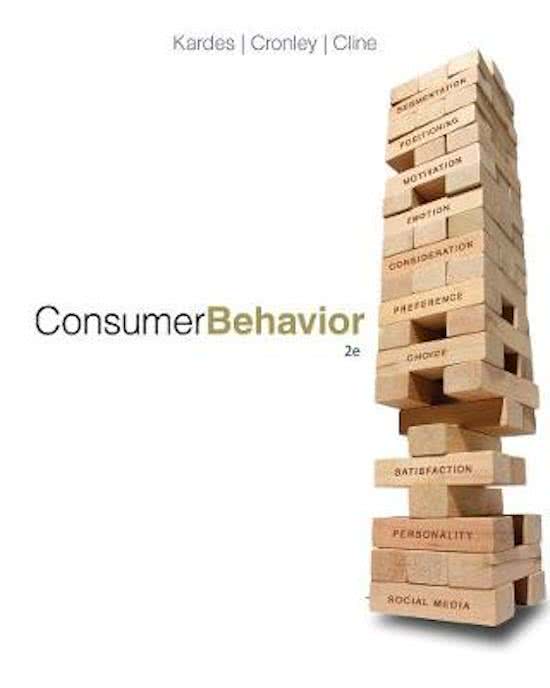
Kardes Book Chapters
Chapter 1: understanding consumer behavior and customer research
Consumer behavior entails all consumer activities associated with the purchase, use, and
disposal of goods and services, including the consumer’s emotional, mental, and behavioral
responses that precede, determine or follow these activities.
The term consumer can describe either individual or organizational consumers. Individual
consumers purchase goods and services to satisfy their own personal needs and wants.
Organizational consumers purchase goods and services in order to:
- Produce other goods or services
- Resell them to other organizations or to individual consumers
- Help manage and run their organization
Consumer behavior is broken down into purchase, use, and disposal activities. Purchase
activities are those through which consumers acquire goods and services, and everything done
leading up to the purchase. Use activities describe where, when, and how consumption takes
place. Disposal activities are the ways consumers get rid of products and/or packaging after
consumption.
Emotional responses (also called affective responses) reflect a consumer’s emotions, feelings,
and moods. Mental responses (also called cognitive responses) include a consumer’s thought
processes, opinions, beliefs, attitudes, and intentions about products and services. Behavioral
responses include a consumer’s overt decisions and actions during the purchase, use, and
disposal activities identified earlier.
Marketers who understand their customers can create better products and services, promote
their products and services more effectively, and develop marketing plans and strategies that
foster sustainable competitive advantages.
Public policy is the establishment of laws and regulations that govern business practice in
order to protect consumers.
Why study consumer behaviour?
- To improve business performance
- To influence public policy
- To educate and help consumers make better decisions
The marketing concept: the idea that firms should discover and satisfy customer needs and
wants in an efficient and profitable manner, while benefiting the long-term interests of
society.
, Customer perceived value: the consumer’s overall assessment of the utility of a product
based on perceptions of what is received and what is given.
Customer delight: customer benefits that not only meet, but also exceed expectations in
unanticipated ways.
How researchers study consumer behavior has also evolved over the past several decades.
Three prominent approaches are examined here: motivation research, behavioral
science, and Interpretivism.
Motivational research: One of the earliest approaches to studying consumer
behavior, motivation research applied psychoanalytic therapy concepts from clinical
psychology to consumer behavior research. The method was developed by Ernest Dichter,
a Freudian psychoanalyst, shortly after World War II. He used in-depth interviewing
techniques to uncover a person’s hidden or unconscious motivations. Motivation research fell
out of fashion in the 1960s. Critics of the approach pointed out methodological limitations,
such as the subjective nature of interview interpretations, as well as the strategic and practical
limitations of applying sexual explanations to most consumer actions. However, motivation
research left two important legacies to the field of consumer research: (1) a focus on
consumer motivations, i.e., trying to answer the question of why people behave as they do,
and (2) the technique of in-depth interviewing.
Behavioral science applies the scientific method, relying on systematic, rigorous procedures
to explain, control, and predict consumer behavior. Thus, behavioral scientists study people
and their behaviors in the same way that natural scientists study physical phenomena. Because
behavioral scientists study people, however, research findings are more difficult to interpret.
The primary methods of behavioral science include the experimental approach—conducting
controlled experiments—and the marketing science approach—employing computer-based
simulations and mathematical models to explain and predict consumer behavior.
An alternative research approach to behavioral science that relies less on scientific and
technological methodology is called Interpretivism (or Postmodernism). Researchers
working from this perspective view consumers as non-rational beings and their reality as
highly subjective. These researchers’ goal is to collect data to describe and interpret this
reality. Interpretivist consumer researchers are often especially interested in the consumption
experience and stress understanding consumers from a broader societal perspective.
Marketing research is a systematic process of planning, collecting, analyzing, and
interpreting data and information relevant to marketing problems and consumer behavior.
Marketing research also enables businesses to better understand the market(s) in which they
compete and the broader environment in order to identify opportunities and threats. Finally,
consumer researchers use marketing research to analyze the effectiveness of marketing
strategies, programs, and tactics.
Consumer research is divided into two broad categories based on the goals of the research:
basic research and applied research. Basic research looks for general relationships between
variables, regardless of the specific situation. The key benefit of basic research is that
conclusions drawn from it generally apply across a variety of situations, and researchers can
use these generalizations to guide strategic planning.
Chapter 1: understanding consumer behavior and customer research
Consumer behavior entails all consumer activities associated with the purchase, use, and
disposal of goods and services, including the consumer’s emotional, mental, and behavioral
responses that precede, determine or follow these activities.
The term consumer can describe either individual or organizational consumers. Individual
consumers purchase goods and services to satisfy their own personal needs and wants.
Organizational consumers purchase goods and services in order to:
- Produce other goods or services
- Resell them to other organizations or to individual consumers
- Help manage and run their organization
Consumer behavior is broken down into purchase, use, and disposal activities. Purchase
activities are those through which consumers acquire goods and services, and everything done
leading up to the purchase. Use activities describe where, when, and how consumption takes
place. Disposal activities are the ways consumers get rid of products and/or packaging after
consumption.
Emotional responses (also called affective responses) reflect a consumer’s emotions, feelings,
and moods. Mental responses (also called cognitive responses) include a consumer’s thought
processes, opinions, beliefs, attitudes, and intentions about products and services. Behavioral
responses include a consumer’s overt decisions and actions during the purchase, use, and
disposal activities identified earlier.
Marketers who understand their customers can create better products and services, promote
their products and services more effectively, and develop marketing plans and strategies that
foster sustainable competitive advantages.
Public policy is the establishment of laws and regulations that govern business practice in
order to protect consumers.
Why study consumer behaviour?
- To improve business performance
- To influence public policy
- To educate and help consumers make better decisions
The marketing concept: the idea that firms should discover and satisfy customer needs and
wants in an efficient and profitable manner, while benefiting the long-term interests of
society.
, Customer perceived value: the consumer’s overall assessment of the utility of a product
based on perceptions of what is received and what is given.
Customer delight: customer benefits that not only meet, but also exceed expectations in
unanticipated ways.
How researchers study consumer behavior has also evolved over the past several decades.
Three prominent approaches are examined here: motivation research, behavioral
science, and Interpretivism.
Motivational research: One of the earliest approaches to studying consumer
behavior, motivation research applied psychoanalytic therapy concepts from clinical
psychology to consumer behavior research. The method was developed by Ernest Dichter,
a Freudian psychoanalyst, shortly after World War II. He used in-depth interviewing
techniques to uncover a person’s hidden or unconscious motivations. Motivation research fell
out of fashion in the 1960s. Critics of the approach pointed out methodological limitations,
such as the subjective nature of interview interpretations, as well as the strategic and practical
limitations of applying sexual explanations to most consumer actions. However, motivation
research left two important legacies to the field of consumer research: (1) a focus on
consumer motivations, i.e., trying to answer the question of why people behave as they do,
and (2) the technique of in-depth interviewing.
Behavioral science applies the scientific method, relying on systematic, rigorous procedures
to explain, control, and predict consumer behavior. Thus, behavioral scientists study people
and their behaviors in the same way that natural scientists study physical phenomena. Because
behavioral scientists study people, however, research findings are more difficult to interpret.
The primary methods of behavioral science include the experimental approach—conducting
controlled experiments—and the marketing science approach—employing computer-based
simulations and mathematical models to explain and predict consumer behavior.
An alternative research approach to behavioral science that relies less on scientific and
technological methodology is called Interpretivism (or Postmodernism). Researchers
working from this perspective view consumers as non-rational beings and their reality as
highly subjective. These researchers’ goal is to collect data to describe and interpret this
reality. Interpretivist consumer researchers are often especially interested in the consumption
experience and stress understanding consumers from a broader societal perspective.
Marketing research is a systematic process of planning, collecting, analyzing, and
interpreting data and information relevant to marketing problems and consumer behavior.
Marketing research also enables businesses to better understand the market(s) in which they
compete and the broader environment in order to identify opportunities and threats. Finally,
consumer researchers use marketing research to analyze the effectiveness of marketing
strategies, programs, and tactics.
Consumer research is divided into two broad categories based on the goals of the research:
basic research and applied research. Basic research looks for general relationships between
variables, regardless of the specific situation. The key benefit of basic research is that
conclusions drawn from it generally apply across a variety of situations, and researchers can
use these generalizations to guide strategic planning.