NURS-6550N Week 6 -Midterm exam
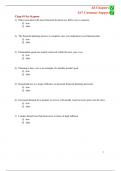
User Brandon Olinger Course NURS-6550N-2/NURS-6550F-2-Adv Prac Care in Acute Set I2016 Winter Qtr 11/28-02/19-PT27 Test Week 6 - Exam Started 1/8/17 8:41 AM Submitted 1/8/17 11:10 AM Due Date 1/9/17 1:59 AM Status Completed Attempt Score 50 out of 100 points Time Elapsed 2 hours, 29 minutes out of 2 hours and 30 minutes Results Displayed Feedback Question 1 1 out of 1 points The AGACNP is caring for a patient who is quite ill and has developed, among other things, a large right sided pleural effusion. Thoracentesis is sent for pleural fluid analysis. While evaluating the fluid analysis, the AGACNP knows that a fluid identified as a(n) __________ is the least worrisome type. Response Feedback : “A” is the correct answer. A transudate is essentially just water and can occur as a consequence of increased hydrostatic pressure in the pulmonary vessels. It typically implies that the some condition has produced an imbalance in colloid-hydrostatic pressures, such as CHF or hypoalbuminemia. While it can represent a serious problem, it may also represent a transient imbalance. Conversely, “B” is not correct as an exudate has more protein in it and implies a condition characterized by protein leaking from vessels, such as a malignancy or some serious systemic stressor. “C” is not correct—a chyliform effusion is characterized by fat and indicates a pathology causing massive triglyceride degradation. “D” is not correct as a hemorrhagic effusion is blood and typically means traumatic injury. Question 2 0 out of 1 points Mrs. Miller is transported to the emergency department by paramedics. She is having profound, unremitting chest pain, is diaphoretic and pale. She has jugular venous distention and a widened pulse pressure. Suspecting ascending aortic aneurysm, the AGACNP order which test to confirm the diagnosis? Response Feedback : “D” is the correct answer. It is the most widely used diagnostic tool as it rapidly and precisely can outline the thoracic and abdominal aorta. “A” is not the correct answer—there are radiographic findings that suggest thoracic aneurysm, but they need confirmation by CT. “B” is not the correct answer as ultrasound is not nearly as precise as a CT scan. “C” is not correct—MRI is only indicated when the patient cannot have a contrast CT. Question 3 1 out of 1 points Certain subgroups of the elderly population are at an increased risk for rapid deterioration and long-term care placement. Which of the following is not considered a high risk factor for long term care placement? Response Feedback: “A” is the correct answer; men are at higher risk for long-term care placement than women. In addition to male gender, other risk factors include age over 80, living alone, bowel or bladder incontinence, history of falls, dysfunctional coping, and intellectual impairment. Question 4 0 out of 1 points A patient with anterior epistaxis has been treated with 20 minutes of direct pressure to the cartilaginous portion of the nose. Following pressure the patient is instructed to gently blow the nose. Expected findings in the patient who has been successfully treated include all of the following except a: Response Feedback : “C” is the correct answer. If bleeding is successfully stopped with 20 minutes of directed pressure, there will be residual blood and clot formation. This is evacuated either by gentle suction or having the patient gently blow. Residual blood and formed clot may present as a sudden gush of dark blood or discharge with or without a clot—these are all typical expected findings. However, if bleeding is not stopped, it will continue as a bright red steady trickle. When this occurs, more invasive measures are indicated. Question 5 0 out of 1 points Kevin is a 14-year-old male who presents for evaluation of a fever of 102.5° F and significant right ear pain. He appears quite ill and says he feels nauseous. Otoscopic evaluation reveals pain to palpation, a very erythematous and bulging tympanic membrane with bullous myringitis. The AGACNP knows that antibiotic therapy must be selected to cover: Response Feedback : “D” is the correct answer. Streptococcus pneumoniae is the most common bacteria that infects the head and neck in immunocompetent persons, and is the primary treatment target when treating otitis media, bacterial sinusitis, and bacterial pharyngitis. “A” is not correct—while likely on broken skin and soft tissue, it is not common in the ear, nose, or throat unless specific risk factors exist. “B” is not correct—this is much more likely in an immunocompromised patient or a patient on mechanical ventilation. “C” is not correct—it is the second most common organism, but strep is the primary treatment target. Question 6 1 out of 1 points P.M. is a 71-year-old gay male patient who presents as an outpatient for evaluation of increasing shortness of breath. The diagnostic evaluation ultimately supports a diagnosis of community acquired pneumonia. The AGACNP appreciates right middle lobe consolidation on chest radiography. Pending sputum cultures, empiric antibiotic therapy must be initiated to cover which organism? Response Feedback : “D” is the correct answer. This patient presents from the outpatient population where the most common cause of pneumonia is Streptococcus pneumoniae, and is the primary treatment target for any patient being treated empirically. “A” is not correct—while the patient’s sexual orientation is offered in the provided history, there is no indication that he has HIV/AIDS or any other condition characterized by immunosuppression that would increase his risk for this organism. “B” is not correct, as this organism is not typically seen in the outpatient population without specific risk, e.g. immunosuppression or chronic ventilator therapy. “C” is not the correct answer as this organism is not likely absent specific risk such as instrumentation or known colonization. Question 7 0 out of 1 points Which of the following is the greatest risk factor for vascular dementia? Response Feedback : “B” is the correct answer. Vascular dementia is a consequence of vascular disease, and is more likely to occur in patients with risk factors for target organ damage, such as hypertension, dyslipidemia, and diabetes. “A” is not a distinct risk factor for vascular dementia; it is a risk for Alzheimer’s dementia. “C” likewise increases risk for Parkinson’s dementia, but does not present a risk for vascular dementia. “D” is not a risk factor for vascular dementia. Although there may be some familial risk for certain vascular diseases that may lead to vascular dementia, there is no clear familial tendency for this type of dementia. Question 8 1 out of 1 points J.R. is a 55-year-old male who presents for a commercial driver’s license physical examination with a blood pressure of 170/102 mm Hg. He has no medical history and is without complaint. Which of the following findings constitutes hypertensive urgency? Response Feedback : “A” is the correct answer. According to the Joint National Committee (JNC) report, hypertensive urgency is described as hypertension in the setting of progressive target organ damage, such as renal involvement with protein leaking, left ventricular hypertrophy, or retinal changes. “A” is not correct— the headache may or may not be relevant, but because there are many non-hypertension causes, a headache alone does not constitute target organ damage. “C” is not correct—it may indicate carotid plaque, but this is not a consequence of hypertension. “D” is not correct as a 1+ palpable pulse may be a normal finding--it must be taken in the context of the rest of the examination. Question 9 0 out of 1 points Because of the commonly recognized adverse effects of atypical antipsychotics, annual laboratory assessment for patients taking these medications should include a: Response “C” is the correct answer. The atypical antipsychotics such as olanzapine Feedback : (Zyprexa), clozapine (Clozaril), and quetiapine (Seroquel) are classically associated with dyslipidemia and annual lipid panels should be performed in patients of all ages who take these medications. “A” is incorrect—this is the appropriate annual screening tool for patients on lithium due to lithium-related iodine suppression of the thyroid gland. There are no specific indications for “B” and “D” unique to patients taking atypical antipsychotics. Those laboratory assessments should only be ordered as indicated by any other significant patient history. Question 10 1 out of 1 points K.R. presents for an evaluation of eye discomfort. He works in a fabricating shop for a custom automobile restoration company and while working he felt like something flew into his eye. He was wearing eye protection at the time but still has the sensation that something is there. Physical examination is significant for some tearing and he reports a persistent sense of something in his eye. Which of the following is not indicated in the diagnostic evaluation? Response Feedback : “B” is the correct answer. The patient’s history is consistent with a metal injury and so an MRI should be avoided. “A” may or not be indicated as the history progresses, but there is no contraindication to it should the examiner determine the need to rule out an abrasion. “C” and “D” are both mechanisms to visualize behind the cornea which may be necessary if a penetration injury (which may occur with a high-velocity injury) is suspected.
École, étude et sujet
- Établissement
- Walden University
- Cours
- NURS 6550
Infos sur le Document
- Publié le
- 10 janvier 2023
- Nombre de pages
- 35
- Écrit en
- 2022/2023
- Type
- Examen
- Contient
- Questions et réponses
Sujets
-
nurs 6550n week 6 midterm exam