2019 – 2020 English T&C
English: Text & Communication
Lecture 1
How to Analyse Texts: A toolkit for students of English
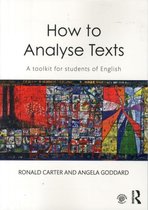
Front cover
• Verbal metaphor: “toolkit”
• Visual metaphor
o Text is written in unknown language
o We have to analyze the text in its context
Back cover
• Blurb1: short description of a book, film or other product written for promotional purpose
• Target audience: people who are looking to learn more about analyzing texts
• Aim: short introduction to book to convince TA
• Words that stand out: crossed out
o When crossed out and replaced: less
interesting
Analyzing texts
Texts are
• Ubiquitous2
• Diverse
• Complex
Analysis
• Start: noticing things – sustained perception
• Not always straightforward
• Usually enriching
• Beyond understanding contents of text to understand how text produces meaning
Categorization
• Text, image/mixture text–image
• Kind of text/image
Interpretation
• What is the text “saying”?
• How does it produce meaning?
1
Aangeduid met geel = woord dat je moet kennen
2
Ubiquitous = present, appearing or found everywhere
1
,2019 – 2020 English T&C
Lecture 2
Chapter 1: your materials
Foundations: researching texts
You need to develop
• Research skills
• Confidence
• Learning routines
• Attitude (“ a spirit of enquiry” = allow yourself to be intrigues by language)
Fundamental to academic work of text analysis
Text versus discourse
• Different origins, histories and scales of reference
• Text
o Written communication
o A single artefact3
o Used more in arts and humanities
• Discourse4
o Spoken language
o More extensive communication, whole patterns of thinking, knowing and behaving
o Used more in social sciences
Spoken versus written texts
• Speech (sound) and writing (symbol) used to be considered different, discrete systems
• Modern communication (digital + multimodal) created broader focus
o Inter-connectedness of speech + writing
Basics of analyzing
• Stand back from what you encounter (known or unknown) + see it afresh
• Idiolect5 as “set of linguistic fingerprints” -> unique language habits/expressions
• Personal language inventory6
o Your younger self
o Family and friends
o You now
o Linguistic pet hates7
3
Artefact = something observed in scientific investigation or experiment that is not naturally present but
occurs as result of preparative or investigative procedure
4
Discourse = written or spoken communication/debate
5
Idiolect = speech habits pecuiar to particular person
6
Personal language inventory = you and your direct environment are resource for ongoing text analysis
7
Pet hates = pet peeves
2
, 2019 – 2020 English T&C
Chapter 2: gathering more materials
Step 1: collect/record
• Collect new sources of language use by constantly looking around
• Never do anything which causes harm to (vulnerable) individuals during the process of research
o Anonymize + ask permission
INTERTEXTUALITY
= when one text refers to another text in some way
• Moves from known to new
e.g. “X was here” -> “Nobody was here”
“gone fishing” -> “gone tanning”
“have a good day” -> “have a FOOD day”
=> creates paradox
• “You can take the X out of the Y, but you can’t take the Y out of the X”
e.g. “You can take the child out of the bookshop, but… oh, you know the rest”
• Advertisers often encourage readers to interact with text/draw attention to their message
Step 2: archive
• How to store texts of different types
= how to capture language and fix it for study
e.g. URL – websites may change
=> screenshot safest option
• Organizing your collection – system needs to be logical and searchable
e.g. particular text types/themes together
Chapter 3: sizing up the job
Questions
WHAT?
• What happens in text: always of interest
• Pointing to text’s feature
Forms evidence for your interpretation
“what” -> other “wh…” questions = describing contents -> considering which factors determine particular
language choices
WHO?
• For speech (or other real-time interaction)
• Who are participants + their relationship to each other (affects e.g. formality)
• Written texts might contain characters, but participants?
“implied communicators8”
• Writers create narrative choice: address their audience (assumes who reader is)
o Real writer
o Imaginary narrator9
o Real reader
o Implied reader 10
8
Implied communicators = people who do things, individually/collectively, without regard to messages others
receive e.g. corporate culture or body language
9
Imaginary narrator = person who narrates the story in the book
10
Implied reader = person who character in book is talking to
3
English: Text & Communication
Lecture 1
How to Analyse Texts: A toolkit for students of English
Front cover
• Verbal metaphor: “toolkit”
• Visual metaphor
o Text is written in unknown language
o We have to analyze the text in its context
Back cover
• Blurb1: short description of a book, film or other product written for promotional purpose
• Target audience: people who are looking to learn more about analyzing texts
• Aim: short introduction to book to convince TA
• Words that stand out: crossed out
o When crossed out and replaced: less
interesting
Analyzing texts
Texts are
• Ubiquitous2
• Diverse
• Complex
Analysis
• Start: noticing things – sustained perception
• Not always straightforward
• Usually enriching
• Beyond understanding contents of text to understand how text produces meaning
Categorization
• Text, image/mixture text–image
• Kind of text/image
Interpretation
• What is the text “saying”?
• How does it produce meaning?
1
Aangeduid met geel = woord dat je moet kennen
2
Ubiquitous = present, appearing or found everywhere
1
,2019 – 2020 English T&C
Lecture 2
Chapter 1: your materials
Foundations: researching texts
You need to develop
• Research skills
• Confidence
• Learning routines
• Attitude (“ a spirit of enquiry” = allow yourself to be intrigues by language)
Fundamental to academic work of text analysis
Text versus discourse
• Different origins, histories and scales of reference
• Text
o Written communication
o A single artefact3
o Used more in arts and humanities
• Discourse4
o Spoken language
o More extensive communication, whole patterns of thinking, knowing and behaving
o Used more in social sciences
Spoken versus written texts
• Speech (sound) and writing (symbol) used to be considered different, discrete systems
• Modern communication (digital + multimodal) created broader focus
o Inter-connectedness of speech + writing
Basics of analyzing
• Stand back from what you encounter (known or unknown) + see it afresh
• Idiolect5 as “set of linguistic fingerprints” -> unique language habits/expressions
• Personal language inventory6
o Your younger self
o Family and friends
o You now
o Linguistic pet hates7
3
Artefact = something observed in scientific investigation or experiment that is not naturally present but
occurs as result of preparative or investigative procedure
4
Discourse = written or spoken communication/debate
5
Idiolect = speech habits pecuiar to particular person
6
Personal language inventory = you and your direct environment are resource for ongoing text analysis
7
Pet hates = pet peeves
2
, 2019 – 2020 English T&C
Chapter 2: gathering more materials
Step 1: collect/record
• Collect new sources of language use by constantly looking around
• Never do anything which causes harm to (vulnerable) individuals during the process of research
o Anonymize + ask permission
INTERTEXTUALITY
= when one text refers to another text in some way
• Moves from known to new
e.g. “X was here” -> “Nobody was here”
“gone fishing” -> “gone tanning”
“have a good day” -> “have a FOOD day”
=> creates paradox
• “You can take the X out of the Y, but you can’t take the Y out of the X”
e.g. “You can take the child out of the bookshop, but… oh, you know the rest”
• Advertisers often encourage readers to interact with text/draw attention to their message
Step 2: archive
• How to store texts of different types
= how to capture language and fix it for study
e.g. URL – websites may change
=> screenshot safest option
• Organizing your collection – system needs to be logical and searchable
e.g. particular text types/themes together
Chapter 3: sizing up the job
Questions
WHAT?
• What happens in text: always of interest
• Pointing to text’s feature
Forms evidence for your interpretation
“what” -> other “wh…” questions = describing contents -> considering which factors determine particular
language choices
WHO?
• For speech (or other real-time interaction)
• Who are participants + their relationship to each other (affects e.g. formality)
• Written texts might contain characters, but participants?
“implied communicators8”
• Writers create narrative choice: address their audience (assumes who reader is)
o Real writer
o Imaginary narrator9
o Real reader
o Implied reader 10
8
Implied communicators = people who do things, individually/collectively, without regard to messages others
receive e.g. corporate culture or body language
9
Imaginary narrator = person who narrates the story in the book
10
Implied reader = person who character in book is talking to
3