PMHNP Study Guide / Quiz 2022 (Complete Solutions)
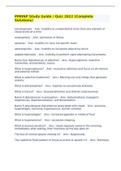
simultagnosia Ans:- Inability to comphrehend more than one element of visual scene at a time anosognosia Ans:- Ignorance of illness apraxias Ans:- Inability to carry out specific tasks astereognosis Ans:- Inability to recognize objects by touch adiadochokinesia Ans:- Inability to perform rapid alternating movements Name four disturbances of attention Ans:- Hypervigliance, selective inattention, distractibility, trance What is hypervigilance? Ans:- excessive attention and focus on all internal and external stimuli What is selective inattenion? Ans:- Blocking out only things that generate anxiety What is distractability? Ans:- Inability to concentrate attention What is trance? Ans:- focused attention and altered consciousness Name 4 disturbances in preception Ans:- Hallunications, hypagonic experiences, depersonalization, and derealization Name 5 physiological disturbances associated with mood Ans:- anorexia, hyperphagia, insomnia, hypersomnia, durinal variation What is hyperphagia? Ans:- increased appiette or intake of food What is hypersomnia? Ans:- excessive sleeping What is durinal variation? Ans:- mood regularly worse in the morning, immediately after waking, then improves as the day goes on The loss of normal speech melody is? Ans:- Dysprosody The repetitive fixed pattern of physical action or speech is? Ans:- Sterotypy The pathological imiatation of movements of one's person is? Ans:- Echopraxia Temporary loss of muscle tone and weakness precipatated by variety of emotional states is? Ans:- Cataplexy Ingrained, habitual involuntary movements are? Ans:- Mannerisms Subjectuve feelings of muscular tension secondary to psych meds is? Ans:- Akathisia Coherent patients that never gets to the point has a disturbance in the form of thought Ans:- Tangentality Sundowning is usually associated with? Ans:- Being over medicated What are neologisms? Ans:- new words created by patients What is loosening of associations? Ans:- Flow of thoughts in which ideas shift from one subject to another in completly unrelated way Define flight of ideas Ans:- rapid, continious verbalization or play on words that produces a shift from one idea to another, ideas tend to be connected What is blocking? Ans:- an abrupt interruption in a train of thinking before an idea or though is finished Narcolepsy Ans:- Sudden attacks of irresistible sleepiness Klein-Levin Syndrome Ans:- affects young men, periods of sleepiness alternate with confusional states, ravenous hunger and protracted sexual activity Nocturnal myoclonus Ans:- repetitive myoclonic jerking of the legs, awakening both patients and their partners Describe Cluster A personality disorders Ans:- odd, ecentric Describe Cluster B personality disorders Ans:- dramatic, emotional, erratic Describe Cluster C personality disorders Ans:- anxious and fearful Name the personality disorders in Cluster A Ans:- paranoid, schizoid, schizotypal Name the personality disorders in Cluster B Ans:- borderline, histronic, narcissitic, and antisocial Name the personality disorders in Cluster C Ans:- avoidant, dependent, obsessive-compulsive Describe deja vu Ans:- regarding a new situation as a repetition of a previous experience Describe Deja entendu Ans:- an illusion of auditory recognition Describe Deja pense Ans:- regarding a new thought as a repetition of a previous thought Describe Jamais vu Ans:- feeling an unfamiliarity with a familiar situation Which of the following is not an example of reconstructive psychotherapy: psychodrama freudian analysis kleinian analysis alderian therapy brief dynamic therapy Ans:- Psychodrama Who popularized Gesalt therapy? Ans:- Fritz Perls Describe id, ego, and superego Ans:- Id: unorganized, unconscious, instinctual Ego: modified by direct external influences, is rational Supergo: spawns self-hatred, self-critism, self-control and self-recrimination What are characterstics of a therapeutic relationship? (7) Ans:- Genuiness, Acceptance, Nonjudgemental attitude, authencity, empathy, respect, and professional boundaries What age group deals with the developmental task of trust vs. mistrust? Ans:- Infants- Age 0-1 According to Erikson, what developmental task should be achieved with early childhood? Ans:- Early childhood- 1-3 Autonomy vs. shame and doubt
École, étude et sujet
- Établissement
- PMHNP
- Cours
- PMHNP
Infos sur le Document
- Publié le
- 23 juin 2022
- Nombre de pages
- 10
- Écrit en
- 2021/2022
- Type
- Examen
- Contient
- Questions et réponses
Sujets
-
pmhnp study guide quiz 2022 complete solutions

Document également disponible en groupe