CHAPTER 13: Price and customer value (!exam last year)
13.1 The price elasticity of demand
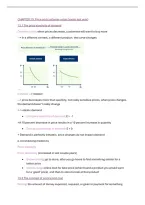
Demand curve: when prices decrease, customers will want to buy more
--> in a different context, a different product: the curve changes
Inelastic --> steeper
--> price decreases more than quantity, not really sensitive prices, when price changes,
the demand doesn’t really change
<-> elastic demand
• Unit price elasticity of demand: E = -1
→A 10 percent decrease in price results in a 10 percent increase in quantity
• Zero price elasticity of demand: E = 0
→ Demand is perfectly inelastic, price changes do not impact demand
p.ex livesaving medecins
Price elasticity
Price sensitivity (increased in last couple years)
• Showrooming: go to store, after you go home to find something similar for a
better price
• webrooming: online look for best price (when found a product you would want
for a ‘good’ price) and then to store to look at that product
13.2 The concept of pricing and cost
Pricing: the amount of money expected, required, or given in payment for something
, • Income
• Flexible
• Easy to imitate (visable to everyone)
--> right price is determined by customers (perceived value)
13.3 The relationship between pricing and costs
Mileage allowances: kilometervergoeding
Total revenue = volume sold x price sold
Profit= total revenue –total costs
--> inprovement in pricing leads to the highest positive change in revenue
-->The price at which a proposition is set is important because increases in price have a
disproportionately positive effect on profitsand decreases in price have a
disproportionately negative effect on profits
13.4 Customer perceptions of price, quality, and value
Proposition quality: mental bias(highly priced goods, are of high quality)
Quality: degree of excellence of something, the standard of something when compared
to other things of a similar kind
--> perceived quality (if people don’t see the benefits, they will not pay more for it, so
something can be of the best quality but doesn’t get the highest pricing)
,Value
• Importance, worth, or usefulness of something
• Only count for goods that you have paid for
13.5 influences on customer price perceptions
Don't learn by heart know the important lines (the graph on dia 19)
Important elements of pricing: price perception formation
• Antecedents: prior beliefs, ...
• Price perception: influenced by reference prices, ...
• Willingness to pay: presenting of prices (p.ex 4.99 (looks better than 5)),...
• Purchase behavior: ...
Reference price: price in mind by customers when considering a product = ANCHOR
• Fair price
• Typical price
• Last paid price
• ...
--> can be affected by the context, store type
Price anchoring: cognitive bias (relying too hard on the information that was first
presented to us) --> mental reference point (p.ex when there is a discount mention the
, price it was ‘before’)
Willingness to pay:
Pink tax (female products are more expensive than men p.ex razors)
Price consciousness: The extent to which people are aware of prices in a certain
category
p.ex (bread loaf --> 2.70, in the other example opinions were more varied --> in some
categories you know which price you can except)
--> contactless payments (you become less conscious in comparison with paying in
cash)
Pricing cues (changes our perception of a price):
• sale signs (scarcity)
• odd number pricing (demand increases)
p.ex when price is 34 (reference to 30), when price is 39 (reference to 40), pricing 39 will
be bought more frequently
• Lucky prices
• Compromise effect (bias where the middle option is chosen the most), three
good deals, customer choose the middle option p.ex starburcks sizes effects
• Decoy effect: (exam), you add a less attractive option to the choice-set to let
them pick another choice
• Price bundling: products are bought together because there is price for them all,
higher than picking one meal-deal, ...