Ethics: Definition and Types
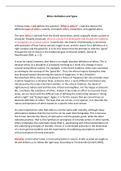
In these notes, I will address the question "What is ethics?". I will also discuss the
different types of ethics, namely, normative ethics, metaethics, and applied ethics.
The term ethics is derived from the Greek word ethos, which originally means custom or
character. Broadly construed, ethics is a branch of philosophy that studies the rightness
or wrongness of a human action. In particular, this branch of philosophy is concerned
with questions of how human persons ought to act, and the search for a definition of a
right conduct and the good life. It is for this reason that the attempt to seek the “good”
through the aid of reason is the traditional goal of ethicists (Albert, Denise &
Peterfreund 1984, p. 1-2).
It must be noted, however, that there is no single, absolute definition of ethics. This is
because ethics as a discipline is constantly evolving as a result of a change in socio-
cultural and political context. For example, in the Greek tradition, ethics was conceived
as relating to the concept of the “good life”. Thus, the ethical inquiry during this time
was directed toward discovering the nature of happiness. In fact, Aristotle’s
Nicomachean Ethics does not only present a theory of happiness but also provides ways
in which happiness is attained. Now, centuries later, a quite different orientation was
introduced by the Judeo-Christian tradition. In this ethical tradition, the ideals of
righteousness before God and the love of God and neighbor, not the happy or pleasant
life, constitute the substance of ethics. Indeed, if we make an effort to reconcile these
views, we are faced with the difficult task of defining the relationship between “doing
what is right” and “being happy”. Again, it is for this reason that we cannot have an
absolute definition of ethics. The least that we can do, in my opinion, is to describe the
nature and dynamics of ethics based on a specific time and context.
It is also important to note that ethics is not the same with morality, although many
philosophers believe that the two terms can be used interchangeably. This is because
the former denotes the theory of right action and the greater good, while the latter
indicates practice, that is, the rightness or wrongness of a human action. In other words,
ethics undertakes the systematic study (that is, questioning and critical examination) of
the underlying principles of morality. Hence, it is interested primarily in the illustration
of a more general problem and the examination of underlying assumptions and the
critical evaluation of moral principles.
Morality, on the other hand, is more prescriptive in nature. It tells us what we ought to
do and exhorts us to follow the right way. According to Terrance McConnell (1994),
In these notes, I will address the question "What is ethics?". I will also discuss the
different types of ethics, namely, normative ethics, metaethics, and applied ethics.
The term ethics is derived from the Greek word ethos, which originally means custom or
character. Broadly construed, ethics is a branch of philosophy that studies the rightness
or wrongness of a human action. In particular, this branch of philosophy is concerned
with questions of how human persons ought to act, and the search for a definition of a
right conduct and the good life. It is for this reason that the attempt to seek the “good”
through the aid of reason is the traditional goal of ethicists (Albert, Denise &
Peterfreund 1984, p. 1-2).
It must be noted, however, that there is no single, absolute definition of ethics. This is
because ethics as a discipline is constantly evolving as a result of a change in socio-
cultural and political context. For example, in the Greek tradition, ethics was conceived
as relating to the concept of the “good life”. Thus, the ethical inquiry during this time
was directed toward discovering the nature of happiness. In fact, Aristotle’s
Nicomachean Ethics does not only present a theory of happiness but also provides ways
in which happiness is attained. Now, centuries later, a quite different orientation was
introduced by the Judeo-Christian tradition. In this ethical tradition, the ideals of
righteousness before God and the love of God and neighbor, not the happy or pleasant
life, constitute the substance of ethics. Indeed, if we make an effort to reconcile these
views, we are faced with the difficult task of defining the relationship between “doing
what is right” and “being happy”. Again, it is for this reason that we cannot have an
absolute definition of ethics. The least that we can do, in my opinion, is to describe the
nature and dynamics of ethics based on a specific time and context.
It is also important to note that ethics is not the same with morality, although many
philosophers believe that the two terms can be used interchangeably. This is because
the former denotes the theory of right action and the greater good, while the latter
indicates practice, that is, the rightness or wrongness of a human action. In other words,
ethics undertakes the systematic study (that is, questioning and critical examination) of
the underlying principles of morality. Hence, it is interested primarily in the illustration
of a more general problem and the examination of underlying assumptions and the
critical evaluation of moral principles.
Morality, on the other hand, is more prescriptive in nature. It tells us what we ought to
do and exhorts us to follow the right way. According to Terrance McConnell (1994),