

Rédigé par des étudiants ayant réussi Disponible immédiatement après paiement Lire en ligne ou en PDF Mauvais document ? Échangez-le gratuitement 4,6 TrustPilot
logo-home
Document preview thumbnail
Aperçu 4 sur 223 pages
Resume

Samenvatting Marketing| UA | 2025/2026

Document preview thumbnail
Aperçu 4 sur 223 pages

samenvatting van alle hoofdstukken van Marketing semester 1

Aperçu du contenu

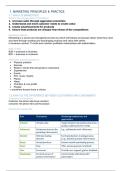
1. MARKETING PRINCIPLES & PRACTICE
1.1 WHAT IS MARKETING?
What is the primary goal of marketing?
1. Increase sales through aggressive promotion
2. Understand and meet customer needs to create value
3. Create advertisements for products
4. Ensure that products are cheaper than those of the competitions

Marketing defined
Marketing is a social and managerial process by which individuals and groups obtain what they need
and want through creating and exchanging products and value with others.
In business context: To build and maintain profitable relationships with stakeholders

B2B vs B2C
B2B = business to business
B2C = business to customer

What does marketing apply to?
• Physical products
• Services
• Retail (= stores that sell goods to customers)
• Experiences
• Events
• Film, music, theatre
• Places
• Ideas
• Charities & non-profits
• People
→ anywhere buyers have a choice

1.2 WHAT IS THE DIFFERENCE BETWEEN CUSTOMERS AND CONSUMERS?
Customers vs consumers
Customer: the person who buys a product
consumer: the person who use the product

Consumers’ buying roles

,e.g. Advertising men's shampoo targeted at women, so they’ll tell their partner to buy it, …

1.3 MARKET ORIENTATION
Market orientation
The organization-wide generation of market intelligence pertaining to current and future customer needs,
dissemination of the intelligence across the departments, and organization-wide responsiveness to it” (Kohli and
Jaworski, 1990: 6).
▪ Organization-wide belief in delivering customer value
▪ Create products to meet existing and latent needs

e.g., cars instead of faster horses
The 3 components of market orientation
− Customer orientation
Developing and redeveloping offerings to meet customer
needs. So, we should measure customer satisfaction on a
continuous basis and train our service staff
− Competitor orientation
understanding of its competitors short-term strengths and
weaknesses, and its long-term capabilities and strategies
− Interfunctional coordination
requiring all an organization’s functions to work together for
long-term profit growth

Customer centricity is also…
= you put the customer at the center of everything you do
Not trying to please all customers
Fulfilling needs in a profitable way
=> focus on your target group instead of pleasing all your customers because it’s impossible

,1.5 DIFFERENCES BETWEEN SALES AND MARKETING
Marketing Sales
long-term satisfaction short-term satisfaction
greater input into customer design of offering lesser input into customer design of offering
high focus on stimulation of demand low focus on stimulation of demand
More focused on meeting existing demand

Sales: Product push, short-term focus on satisfaction of customer needs

Marketing: Product pull, long-term focus on satisfaction of customer needs, high focus on stimulation of demand

Sales is more short-term, aiming to sell as much as possible as quickly as possible, while marketing ensures that
the product meets the needs of customers and has value for them, so that they will readily return to purchasing
the product repeatedly, building a strong brand and convincing them to buy it.

Acquisition vs retention

If you acquire customers, you need to be able to retain them in the long term.

Retention is cheaper than acquisition.

Tip of the iceberg

• What consumers see is only a fraction of companies’ overall business strategies


United colors of Benetton


ZARA

, 1.5 WHAT DO MARKETERS DO?

Marketing competencies


Placing the customer at the center of a company’s operations and decision-making processes
• Generate customer insights
• Develop marketing strategy

Marketing within organizations
▪ Marketing inherently puts customers first
▪ Marketing should enhance a firm’s relationships with its customers
▪ Marketing is present in all aspects of an organization since all departments play a role in creating, delivering,
and satisfying customers
▪ Marketers do not control all the marketing mix elements


▪ CEOs with a marketing background outperform CEOs from nearly all other backgrounds when it comes to
being socially responsible, inclusive, and having a strong strategy and long-term vision
▪ They have a better overall reputation than business leaders from nearly all other areas (Tesseras, 2021)


Table des matières

  1. 01 1._MARKETING_PRINCIPLEs_&_PRACTICE 1
  2. 02 1.1_WHAT_IS_MARKETING? 1
  3. 03 1.2_What_is_the_difference_between_custo 1
  4. 04 1.3_MARKET_ORIENTATION 2
  5. 05 1.4_Marketing’s_intellectual_roots 3
  6. 06 1.6_WHAT_DO_marketers_DO? 4
  7. 07 Marketing_within_organizations 4
  8. 08 1.7_Marketing_as_exchange 5
  9. 09 1.8_The_marketing_mix_and_the_4P’S_(p._2 7
  10. 10 1.9_The_extended_marketing_mix 7
  11. 11 1.10_Relationship_marketing,_service-dom 7
  12. 12 Marketing_automation_VS._CRM 9
  13. 13 CRM_and_Marketing_automation 9
  14. 14 Selective_relationship_management 9
  15. 15 1.11_Marketing’s_impact_in_society 10
  16. 16 2._The_marketing_environment 11
  17. 17 2.1_Understanding_the_external_environme 12
  18. 18 Demographic_environment 12
  19. 19 Economic_environment 13
  20. 20 =_The_factors_that_affect_consumer_buyin 13
  21. 21 Socio-cultural_environment 13
  22. 22 Technological_environment 13
  23. 23 Ecological_environment 14
  24. 24 Political-legal_environment 15
  25. 25 2.2_Environmental_scanning 16
  26. 26 2.3_Understanding_the_performance_enviro 19
  27. 27 Competitors 19
  28. 28 2.4_Understanding_the_internal_environme 20
  29. 29 3._CONSUMER_BUYING_behaviour 23
  30. 30 3.1_Consumer_behaviour:_between_rational 23
  31. 31 ⟹_So_now_what? 26
  32. 32 3.2_Proposition_Acquisition 26
  33. 33 Cognitive_dissonance 29
  34. 34 Advocacy 29
  35. 35 The_traditional_marketing_funnel_model 29
  36. 36 Consumer_decision_journey 32
  37. 37 Influencers 32
  38. 38 3.3_Perception,_learning_and_memory 33
  39. 39 Perceptions 33
  40. 40 Learning_and_memory 34
  41. 41 3.4_Personality 36
  42. 42 The_Trait_Approach 36
  43. 43 The_Self-Concept_Approach 38
  44. 44 3.5_Motivation 40
  45. 45 Maslow’s_hierarchy_of_human_needs 40
  46. 46 Marketing_based_on_motivations 40
  47. 47 Extrinsic_VS._intrinsic_motivation 40
  48. 48 Theory_of_planned_behaviour_(Fishbein_&_ 41
  49. 49 3.6_The_Importance_of_Social_Contexts 42
  50. 50 Opinions,_Attitudes_and_Values 42
  51. 51 Group_influence 42
  52. 52 Social_Grade 42
  53. 53 Life_stage 46
  54. 54 Culture_and_ethnic_group 46
  55. 55 4.1_What_is_Business-to-business_marketi 47
  56. 56 4.2_The_characteristics_of_business_mark 47
  57. 57 4.3_Types_of_B2B_Customers,_Goods,_and_S 48
  58. 58 Types_of_business_organizations: 48
  59. 59 Types_of_business_goods_and_service 49
  60. 60 4.4_Organizational_Buying_Behaviour 49
  61. 61 Decision-Making_Units 49
  62. 62 The_processes_of_DMU 50
  63. 63 Buy_phases 50
  64. 64 Product_specification 51
  65. 65 Supplier_selection 52
  66. 66 Buygrid 52
  67. 67 4.5_Developing_a_Customer_Portfolio_Matr 53
  68. 68 4.6_Key_Account_Management_(KAM) 53
  69. 69 Changes_in_the_Competitive_Environment 54
  70. 70 KAM_development_stages 55
  71. 71 4.7_Corporate_Social_Responsibility 55
  72. 72 The_corporate_communications_mix 55
  73. 73 Business_practice_CSR 55
  74. 74 Philantropic_CSR 56
  75. 75 5._Services_and_relationship_marketing 57
  76. 76 5.1_The_Unique_Characteristics_of_Servic 57
  77. 77 Characteristics_of_services_(p._311) 57
  78. 78 5.2_Service_Processes 60
  79. 79 Key_Dimensions_of_Services_Marketing 60
  80. 80 The_service_marketing_triangle_(p._316) 60
  81. 81 Service_differentiation 61
  82. 82 Measuring_Service_Quality_and_Performanc 62
  83. 83 “Gaps”_that_cause_unsuccessful_service_d 63
  84. 84 Customer_relationship_intensity 64
  85. 85 Service_failure_and_service_recovery 64
  86. 86 5.5_The_Principles_of_Relationship_Marke 64
  87. 87 5.6_Loyalty_and_Retention 65
  88. 88 The_Commitment-Trust_Theory_of_Relations 65
  89. 89 Customer_experience_model: 66
  90. 90 Customer_Engagement 67
  91. 91 6._Marketing_strategy 67
  92. 92 6.1_The_Strategic_Context 67
  93. 93 6.2_Strategic_Marketing_Planning 67
  94. 94 Vision 67
  95. 95 Mission 67
  96. 96 Organizational_values 68
  97. 97 Organizational_goals 70
  98. 98 Corporate_strategy_(=_organizational_str 71
  99. 99 6.3_Process_and_Activities 71
  100. 100 Process 71
  101. 101 Strategic_Market_Analysis 72
  102. 102 ‘Five_Forces’_Model 72
  103. 103 SWOT_analysis 72
  104. 104 Strategic_Marketing_Goals 74
  105. 105 Ansoff’s_Matrix(p._225) 74
  106. 106 6.4_Strategic_Market_Action 75
  107. 107 Competitive_Advantage 76
  108. 108 Generic_strategies_by_Porter 78
  109. 109 Value_disciplines 79
  110. 110 Cooperating 80
  111. 111 6.5_Strategic_Marketing_Implementation 81
  112. 112 Implementing_Marketing_Plans 81
  113. 113 6.6_Writing_the_Marketing_Plan 82
  114. 114 7._Marketing_Research_and_Analytics 83
  115. 115 7.1_Definitions_of_Marketing_Research,_A 83
  116. 116 Market_research_(p107) 83
  117. 117 Marketing_Analytics 83
  118. 118 7.2_Customer_Insight 83
  119. 119 Customer_insight_(p.101) 83
  120. 120 Marketing_Information_System_(p.102,103) 83
  121. 121 Big_data_(p.104) 84
  122. 122 Competitive_Intelligence_(p.105) 85
  123. 123 7.3_Big_Data_and_Marketing_Analytics 85
  124. 124 7.4_The_Marketing_Research_Process 85
  125. 125 Step_1:_Problem_definition 85
  126. 126 The_outline_of_marketing_research_propos 85
  127. 127 Executive_summary__A_brief_summary_of_th 85
  128. 128 Step_2:_Decide_the_research_plan 97
  129. 129 Information_from_panel_data 98
  130. 130 Step_3:_Undertake_the_data_collection 100
  131. 131 8._Market_Segmentation_and_Positioning 100
  132. 132 8.1_The_STP_process 100
  133. 133 STP_process 100
  134. 134 Benefits_of_STP_Process 101
  135. 135 8.2_The_Concept_of_Market_Segmentation 101
  136. 136 Market_segmentation 101
  137. 137 Market_segmentation_and_product_differen 101
  138. 138 8.3_The_Process_of_Market_Segmentation 102
  139. 139 Process_of_Market_Segmentation 102
  140. 140 Market_Segmentation_in_Consumer_Markets 102
  141. 141 Segmenting_consumer_markets: 103
  142. 142 1._Geo-demographic: 103
  143. 143 Profile_segmentation:_Geographic 103
  144. 144 2._Demographic: 103
  145. 145 BMRB-TGI_lifestage_segmentation_groups 104
  146. 146 3.__Psychological: 104
  147. 147 Psychographic_segmentation 104
  148. 148 Segmentation_in_recession 105
  149. 149 Behavioural_segmentation 105
  150. 150 RFM_metrics 105
  151. 151 8.5_Segmentation_in_Business_Markets 107
  152. 152 Organizational_characteristics 107
  153. 153 Customer_characteristics 107
  154. 154 8.6_Target_Markets 107
  155. 155 Segment_attractiveness_factors 108
  156. 156 Mission_fit 108
  157. 157 Targeting_approaches 108
  158. 158 Full_market_coverage 109
  159. 159 Target_groups 111
  160. 160 Holistic_consumer_profile 111
  161. 161 Persona 111
  162. 162 The_customer_journey 112
  163. 163 8.7_Positioning 112
  164. 164 Positioning 112
  165. 165 Perceptual_mapping 114
  166. 166 The_Centrality_–_Distinctiveness_map_(CD 114
  167. 167 Value_proposition 115
  168. 168 Value_proposition_canvas 116
  169. 169 Unique_Selling_Proposition_(USP) 116
  170. 170 Communicating_positioning 116
  171. 171 Proposition_positioning 116
  172. 172 9._International_Market_Development 118
  173. 173 9.1_The_Drivers_of_International_Market_ 118
  174. 174 Drivers 118
  175. 175 9.2_The_International_Marketing_Environm 118
  176. 176 Understand_foreign_marketing_environment 118
  177. 177 Hofstede’s_cultural_dimensions 119
  178. 178 Consumers_and_International_Marketing 120
  179. 179 Consumer_segments 120
  180. 180 Market_Entry_Selection_Criteria 120
  181. 181 Types_of_Market_Entry_Methods 122
  182. 182 EPRG_Classification_for_International_Ma 122
  183. 183 9.4_International_Competitive_Strategy 125
  184. 184 International_competitive_strategy 125
  185. 185 10._Branding_Decisions 125
  186. 186 The_three_brand_P’s 125
  187. 187 10.1_What_is_a_Brand 126
  188. 188 Brand 126
  189. 189 Dimensions_of_brand 126
  190. 190 Attributes 126
  191. 191 10.2_Types_of_Brands 126
  192. 192 Manufacturer_brands 126
  193. 193 Distributor_brands 127
  194. 194 Generic_brands 127
  195. 195 Non-commercial_brands 127
  196. 196 10.3_Why_Brand? 127
  197. 197 Brands_as_a_means_of_self-expression 128
  198. 198 Marketers_and_retailers_use_brands_becau 128
  199. 199 10.4_How_to_Build_Brands 129
  200. 200 10.5_Brand_Names 129
  201. 201 Good_brand_names 129
  202. 202 Other_branding_elements 130
  203. 203 10.6_Brand_Meaning 130
  204. 204 Brand_personality 130
  205. 205 Brand_personality_scale: 130
  206. 206 10.7_Brand_Strategies 132
  207. 207 Branding_strategies(p.328) 132
  208. 208 Line_and_brand_extensions:_Risks 133
  209. 209 10.8_Contemporary_Brand_Building 133
  210. 210 Co-creation 133
  211. 211 Semiotics_perspective 134
  212. 212 The_brand_value_chain 134
  213. 213 Brand_equity_(p.321) 135
  214. 214 11._New_Proposition_Development_and_Inno 135
  215. 215 11.1_Introduction 135
  216. 216 11.2_The_(Non-)Physical_Nature_of_Propos 135
  217. 217 11.3_The_Three_Levels_of_a_Proposition 136
  218. 218 11.4_Classifying_Physical_Propositions 136
  219. 219 11.5_Product_Range,_Line,_and_Mix 140
  220. 220 11.6_Product_Life_Cycles 140
  221. 221 Alternative_shapes 147
  222. 222 11.6_Developing_New_Propositions 147
  223. 223 Development_process_of_new_products(p.34 147
  224. 224 11.7_The_Process_of_Adoption 151
  225. 225 Factors_influencing_rate_of_adoption_in_ 151
  226. 226 11.8_Diffusion_Theory 151
  227. 227 The_process_of_diffusion(p._171) 151
  228. 228 12._Place:_Channels,_supply_chains,_and_ 155
  229. 229 Introduction 155
  230. 230 Supply_chain_(p._436) 155
  231. 231 Marketing_channel 155
  232. 232 12.1_Channel_management 155
  233. 233 Value_delivery_network 155
  234. 234 How_channel_members_help_reduce_uncertai 155
  235. 235 Disadvantages_to_the_use_of_intermediari 157
  236. 236 12.2_types_of_intermediary 157
  237. 237 12.3_Managing_marketing_channels 158
  238. 238 A._Channel_design 158
  239. 239 12.4_Channel_intenisty 161
  240. 240 12.5_MANAGING_RELATIONSHIPS_IN_THE_CHANN 163
  241. 241 Behavior_in_marketing_channels 163
  242. 242 Channel_conflict 163
  243. 243 12.6_Supply_chain_management 163
  244. 244 Supply_chain 163
  245. 245 12.7_retailing 164
  246. 246 Customer_needs_online 165
  247. 247 Customer_needs_in_physical_stores 166
  248. 248 Types_of_retail_stores 166
  249. 249 12.8_Channel_Trends 167
  250. 250 Lightning_speed_of_change 167
  251. 251 E-commerce 167
  252. 252 Consolidation 167
  253. 253 Growing_importance_of_technology 167
  254. 254 Convergence_in_retail 167
  255. 255 Loyalty_is_dead 167
  256. 256 13._Price 169
  257. 257 13.1_The_Price_Elasticity_of_Demand 169
  258. 258 13.2_The_Concept_of_Pricing_and_Cost 170
  259. 259 13.3_The_Relationship_between_Pricing_an 170
  260. 260 The_Relationship_between_Pricing_and_Pro 170
  261. 261 13.4_Customer_Perceptions_of_Price,_Qual 170
  262. 262 13.5_Influences_on_Customer_Price_Percep 172
  263. 263 A_Framework_for_Price_Perception_Formati 172
  264. 264 Reference_price 172
  265. 265 Pink_tax 172
  266. 266 Price_cues 172
  267. 267 Compromise_effect_/_Decoy_effect 173
  268. 268 Price_bundling 173
  269. 269 Price_lining 173
  270. 270 13.6_Pricing_Approaches 174
  271. 271 Cost_oriented_approach 174
  272. 272 13.7_Pricing_Strategies_and_Objectives 177
  273. 273 13.8_Pricing_ManagementList_pricing 180
  274. 274 13.9_Business-to-business_Pricing 180
  275. 275 Relational_pricing 180
  276. 276 Frequent_mistakes_in_pricing 181
  277. 277 14._Promotions_I:_Principles_of_Marketin 182
  278. 278 14.1_defining_marketing_communications 182
  279. 279 Marketing_communication 182
  280. 280 Three_elements_of_marketing_communicatio 182
  281. 281 14.2_The_scope_of_marketing_communicatio 182
  282. 282 14.3_how_marketing_communications_work 183
  283. 283 Linear_model_of_communication 183
  284. 284 Two_step_model_of_communication_=_the_in 184
  285. 285 The_interaction_model_of_communication 184
  286. 286 Opinion_leader 184
  287. 287 Opinion_former 184
  288. 288 Word_of_mouth 184
  289. 289 14.4_Marketing_communications_theory 186
  290. 290 AIDA_model 186
  291. 291 Hierarchy_of_effects 186
  292. 292 Two_theory’s_of_advertising 188
  293. 293 Attitude_construct:_a_composite_approach 188
  294. 294 14.5_The_Role_of_Marketing_Communication 189
  295. 295 Successful_communications 189
  296. 296 Marketing_Communication_task:_DRIP 189
  297. 297 Content_marketing 191
  298. 298 Traditional_publicity 191
  299. 299 Storytelling 191
  300. 300 Planning_marketing_communications 192
  301. 301 14.6_The_Elements_of_the_Marketing_Commu 193
  302. 302 Communication_objectives 193
  303. 303 Push_versus_Pull_promotion_strategy_(p49 193
  304. 304 Feedback_measurement 194
  305. 305 14.7_Cultural_aspects_of_marketing_commu 196
  306. 306 Layers_of_culture 196
  307. 307 15._Promotion_II:_Configuring_the_Market 196
  308. 308 15.1_The_Role_of_the_Marketing_Communica 196
  309. 309 Media_fragmentation 196
  310. 310 The_Marketing_Communications_Mix 197
  311. 311 15.2_Selecting_the_Right_Tools 197
  312. 312 Advertising 197
  313. 313 Personal_selling 199
  314. 314 Sales_promotion 202
  315. 315 Direct_marketing 202
  316. 316 Selecting_the_Right_Tools_for_the_Mix 202
  317. 317 15.3_Marketing_Communications_Messages 203
  318. 318 4_Types_of_Messages_for_the_Mix 203
  319. 319 15.4_Marketing_Communications_Media 205
  320. 320 Main_media_forms: 205
  321. 321 15.5_The_Changing_Marketing_Communicatio 208
  322. 322 The_Changing_Marketing_Communications_La 208
  323. 323 15.6_Integrated_Marketing_Communications 208
  324. 324 16._Digital_and_Social_Media_Marketing 209
  325. 325 16.1_Digital_Marketing 209
  326. 326 Mobile_Marketing 210
  327. 327 Email_Marketing 210
  328. 328 Search_[Engine]_Marketing 210
  329. 329 Programmatic_advertising 210
  330. 330 16.2_Social_media_marketing 210
  331. 331 Social_media 210
  332. 332 16.3_How_Digitalization_Is_Transforming_ 212
  333. 333 Digital_strategy 212
  334. 334 Culture 213
  335. 335 16.4_The_Impact_of_Social_Media_on_Marke 215
  336. 336 Power:_Consumers’_increasing_influence 215
  337. 337 Shifting_control 215
  338. 338 Facilitating_conversations 215
  339. 339 Evaluating_Social_Media_Marketing_Commun 215
  340. 340 Performance_measures_linked_to_costs 215
  341. 341 16.5_Consumer_Co-creation 215
  342. 342 Crowdsourcing 215
  343. 343 Crowdfunding 216
  344. 344 17._Not-for-Profit_and_Social_Marketing 217
  345. 345 17.1_Introduction 217
  346. 346 Not-for-profit 217
  347. 347 Social_marketing 217
  348. 348 Not-for-profit_and_social_marketing 217
  349. 349 Key_differences_with_commercial_marketin 217
  350. 350 17.3_Types_of_Not-for-Profit_Organizatio 220
  351. 351 2._Social_enterprises 220
  352. 352 3._The_public_sector 220
  353. 353 4._Political_Parties_and_Campaigning_Org 220

Infos sur le Document

Publié le
24 juillet 2026
Nombre de pages
223
Écrit en
2025/2026
Type
Resume
€10,49

Mauvais document ? Échangez-le gratuitement Dans les 14 jours suivant votre achat et avant le téléchargement, vous pouvez choisir un autre document. Vous pouvez simplement dépenser le montant à nouveau.
Rédigé par des étudiants ayant réussi
Disponible immédiatement après paiement
Lire en ligne ou en PDF

Vendu
0
Abonnés
0
Éléments
3
Dernière vente
-


Pourquoi les étudiants choisissent Stuvia

Créé par d'autres étudiants, vérifié par les avis

Une qualité sur laquelle compter : rédigé par des étudiants qui ont réussi et évalué par d'autres qui ont utilisé ce document.

Le document ne convient pas ? Choisis un autre document

Aucun souci ! Tu peux sélectionner directement un autre document qui correspond mieux à ce que tu cherches.

Paye comme tu veux, apprends aussitôt

Aucun abonnement, aucun engagement. Paye selon tes habitudes par carte de crédit et télécharge ton document PDF instantanément.

Student with book image

“Acheté, téléchargé et réussi. C'est aussi simple que ça.”

Alisha Student

Foire aux questions