
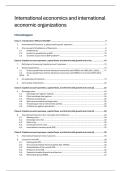
International economics and international
economic organizations
Inhoudsopgave
Class 1: introduction: GPG and the BOP ......................................................................................... 3
1. International Economics: a ‘global public goods‘ approach ........................................................3
2. The concept of the Balance of Payments ...................................................................................6
2.1. (Im)balances ..................................................................................................................6
2.2. Economic perspective on BoP........................................................................................ 10
2.3. So when do you have a BOP problem? ............................................................................ 10
Class 2: Capital account openness, capital flows, and the link with growth and crisis.....................10
1. Defining and measuring ‘capital account’ openness ................................................................ 10
2. Global capital flows ............................................................................................................... 13
2.1. Gross capital flows to/from Advanced economies and EMDEs mln USD (2012-2023) ........ 17
2.2. Gross capital flows to/from Advanced economies and EMDEs in % of world GDP (2012-
2023) 19
3. An explanatory framework...................................................................................................... 19
4. Some policy implications ....................................................................................................... 22
Class 3: Capital account openness, capital flows, and the link with growth and crisis (2) ................22
5. Exchange rates ...................................................................................................................... 22
5.1. Exchange rate regimes: flexible ...................................................................................... 23
5.2. Other exchange rate regimes ......................................................................................... 24
5.3. Effective exchang rate ................................................................................................... 25
5.4. Spot versus forward exchange rates ............................................................................... 26
5.5. Forwards give rise to interest rate parities ....................................................................... 26
5.6. A (Tobin) tax against speculation .................................................................................... 28
Class 4: Capital account openness, capital flows, and the link with growth and crisis (3) ................28
6. International financial crisis: concepts and institutions ............................................................ 28
6.1. Banking crisis ............................................................................................................... 29
6.2. Exchange rate crisis ...................................................................................................... 32
6.3. Debt crisis .................................................................................................................... 32
6.4. Consequences of crisis ................................................................................................. 33
6.5. International monetary fund (IMF) .................................................................................. 33
Class 5: Capital account openness, capital flows, and the link with growth and crisis (4) ................35
7. International financial crisis in practice ................................................................................... 35
8. Lessons for the IMS ............................................................................................................... 39
8.1. Defining the IMS ............................................................................................................ 39
8.2. The (current) ‘Global Financial Safety Net’ (GFSN) ........................................................... 40
8.3. Vulnerabilities of the current IMS .................................................................................... 41
8.4. Problems of the IMS ...................................................................................................... 42
8.5. Towards a broader financial architecture ........................................................................ 43
8.6. World bank group (WBG) ............................................................................................... 43
,Class 6: International trade, the WTO, and preferential trade agreements ......................................45
1. The WTO ............................................................................................................................... 45
1.1. Liberalization commitments and rules ............................................................................ 45
1.2. A forum for intergovernmental bargaining ....................................................................... 46
1.3. Institution for enforcement: the WTO Dispute Settlement System .................................... 47
2. Two collective action problems ............................................................................................... 47
2.1. International cooperation on trade ................................................................................. 47
2.2. Domestic commitment ................................................................................................. 48
3. Preferential trade agreement (PTA) & the WTO ......................................................................... 49
3.1. A political economy of trade agreements ........................................................................ 50
3.2. Why PTAs then? ............................................................................................................. 51
3.3. PTA versus WTO ............................................................................................................ 51
4. Conclusion ........................................................................................................................... 52
Class 7: The evolution of international trade and global economic integration ................................52
1. Globalization and the evolution of trade .................................................................................. 52
2. Comparative advantage ......................................................................................................... 59
3. Intra-industry trade ................................................................................................................ 63
4. Globalization, trade and the role of GVCs ................................................................................ 65
Class 8: The political economy of trade policy ...............................................................................68
1. Society-centered approach to trade policy .............................................................................. 68
2.State-centered approach to trade policy ....................................................................................... 72
3. Trade liberalization ................................................................................................................ 75
4. Trade protection .................................................................................................................... 82
Class 9: Recent developments in international trade and industrial policy .....................................91
1. Trade and inequality .............................................................................................................. 91
2. Globalization’s polycrisis ....................................................................................................... 96
3. Industrial policy 2.0 ............................................................................................................. 105
4. New world order .................................................................................................................. 109
,Class 1: introduction: GPG and the BOP
1. International Economics: a ‘global public goods‘ approach
- Global public good has two characteristics:
o Non-exclusion: when this good is produced, it can’t be excluded to
individuals from enjoying its benefits
o Non-rivalry in consumption: everyone can enjoy the good in equal terms
▪ My consumption doesn’t change your ability to enjoy the good
o In reality, very rare
o Alternative: Private market produced goods
▪ To enjoy the good, you must pay for it
▪ If I consume it, it isn’t available for others to enjoy
▪ Private goods are those produced by the market mechanism
▪ Private goods are produced by a market mechanism: supply and
demand determine the price of that good + they are excludable(if
you dont pay the market price you can be excluded for excluding that
good) and they are rivalrous (if I cansume a good then that good is
not longer available for others to consume) -> the market system is a
great thing to produce this goods
▪ There are some goods and services (desirable thing) for which is it is
not so easy to make them for the market mechanism, because they
have non excludability and/or non rivalry possible + yoou cant
exclude peoplefrom consuming that good, even if they are not willing
to pay for it -> market mechanism is not working because it cannot
force people to pay
▪ Non rivalry means that if I consume a good that others are still able
to consume it, my consumption do not interrupt others to consume
it
▪ Not so many goods have these charecteristics of the public goods
▪ If you just let the market mechanism play: these public goods will
not be produced or they will be underproduced -> like clean air,
security, … (desirable things)
- Problem: under provision due to free riding
o Market mechanisms cannot provide these goods, but no one is prepared
to pay for public goods
o You cannot rely on the free will of the people to pay for these goods
o Example: clean breathable air
o Solution: regulations, rules, and institutions
▪ We regulate market behavior in such a way that the public good is
produced in desirable quantities
▪ The government (public sector) intervenes and uses tax money to
guarantee the needed quantities of the public good
, - Pure public goods are rare, most of them are quasi-public goods or joint products
o Joint products: can be produced by market mechanisms but have public
characteristics; for example, public transport
o Quasi-public goods: only has one of the two characteristics, but not both
- Global public goods (GPGs): concept applied to an international level
o Public goods are sometimes not produced enough when it is the
responsibility of the country and/or market
o Free riding at the level of states
▪ Could lead to world problems (= global public bad)
o Example: clean air (GPG) and pollution (GPB)
▪ Transnational nature: pollution doesn’t stop at the state border
o Needs international agreements/rules/institutions to be guaranteed
o Globalization lead also to more/new international global goods (originally
national goods)
o International institutions help provide global public goods
- Different technologies of provision exist
o Summation: relationship between individual efforts and the aggregate
efforts, in terms of adding to the supply of GPG
▪ The total is the sum of individual efforts
▪ Example pollution
• Individual effort to reduce pollution matters
• But the aggregate is what we all do to reduce pollution
▪ Policy consequences: everyone matters; the more you do, the
better the results
▪ Other provision technologies have different policy consequences
o Weakest link: you are just as strong as your weakest link
▪ The effect of everyone’s contributions on the aggregate is only the
sum of that person that does the least
▪ Example: island surrounded by water
• We all have a plot on the island that boarders the sea
• Globalization → no fences/borders between the different
plots
• Danger: rising sea levels
• Solution: build walls; some high, some low, some won’t
build walls
• If one doesn’t build a wall, everyone on the island drowns
despite of the efforts of others
• Collective effort of protection is the effort of the weakest:
NO PROTECTION
▪ Policy consequences: you should target the weakest link;
intervention is only efficient when targeted at the weakest link
▪ Example: global financial crisis (GPB) is something we try to
prevent
economic organizations
Inhoudsopgave
Class 1: introduction: GPG and the BOP ......................................................................................... 3
1. International Economics: a ‘global public goods‘ approach ........................................................3
2. The concept of the Balance of Payments ...................................................................................6
2.1. (Im)balances ..................................................................................................................6
2.2. Economic perspective on BoP........................................................................................ 10
2.3. So when do you have a BOP problem? ............................................................................ 10
Class 2: Capital account openness, capital flows, and the link with growth and crisis.....................10
1. Defining and measuring ‘capital account’ openness ................................................................ 10
2. Global capital flows ............................................................................................................... 13
2.1. Gross capital flows to/from Advanced economies and EMDEs mln USD (2012-2023) ........ 17
2.2. Gross capital flows to/from Advanced economies and EMDEs in % of world GDP (2012-
2023) 19
3. An explanatory framework...................................................................................................... 19
4. Some policy implications ....................................................................................................... 22
Class 3: Capital account openness, capital flows, and the link with growth and crisis (2) ................22
5. Exchange rates ...................................................................................................................... 22
5.1. Exchange rate regimes: flexible ...................................................................................... 23
5.2. Other exchange rate regimes ......................................................................................... 24
5.3. Effective exchang rate ................................................................................................... 25
5.4. Spot versus forward exchange rates ............................................................................... 26
5.5. Forwards give rise to interest rate parities ....................................................................... 26
5.6. A (Tobin) tax against speculation .................................................................................... 28
Class 4: Capital account openness, capital flows, and the link with growth and crisis (3) ................28
6. International financial crisis: concepts and institutions ............................................................ 28
6.1. Banking crisis ............................................................................................................... 29
6.2. Exchange rate crisis ...................................................................................................... 32
6.3. Debt crisis .................................................................................................................... 32
6.4. Consequences of crisis ................................................................................................. 33
6.5. International monetary fund (IMF) .................................................................................. 33
Class 5: Capital account openness, capital flows, and the link with growth and crisis (4) ................35
7. International financial crisis in practice ................................................................................... 35
8. Lessons for the IMS ............................................................................................................... 39
8.1. Defining the IMS ............................................................................................................ 39
8.2. The (current) ‘Global Financial Safety Net’ (GFSN) ........................................................... 40
8.3. Vulnerabilities of the current IMS .................................................................................... 41
8.4. Problems of the IMS ...................................................................................................... 42
8.5. Towards a broader financial architecture ........................................................................ 43
8.6. World bank group (WBG) ............................................................................................... 43
,Class 6: International trade, the WTO, and preferential trade agreements ......................................45
1. The WTO ............................................................................................................................... 45
1.1. Liberalization commitments and rules ............................................................................ 45
1.2. A forum for intergovernmental bargaining ....................................................................... 46
1.3. Institution for enforcement: the WTO Dispute Settlement System .................................... 47
2. Two collective action problems ............................................................................................... 47
2.1. International cooperation on trade ................................................................................. 47
2.2. Domestic commitment ................................................................................................. 48
3. Preferential trade agreement (PTA) & the WTO ......................................................................... 49
3.1. A political economy of trade agreements ........................................................................ 50
3.2. Why PTAs then? ............................................................................................................. 51
3.3. PTA versus WTO ............................................................................................................ 51
4. Conclusion ........................................................................................................................... 52
Class 7: The evolution of international trade and global economic integration ................................52
1. Globalization and the evolution of trade .................................................................................. 52
2. Comparative advantage ......................................................................................................... 59
3. Intra-industry trade ................................................................................................................ 63
4. Globalization, trade and the role of GVCs ................................................................................ 65
Class 8: The political economy of trade policy ...............................................................................68
1. Society-centered approach to trade policy .............................................................................. 68
2.State-centered approach to trade policy ....................................................................................... 72
3. Trade liberalization ................................................................................................................ 75
4. Trade protection .................................................................................................................... 82
Class 9: Recent developments in international trade and industrial policy .....................................91
1. Trade and inequality .............................................................................................................. 91
2. Globalization’s polycrisis ....................................................................................................... 96
3. Industrial policy 2.0 ............................................................................................................. 105
4. New world order .................................................................................................................. 109
,Class 1: introduction: GPG and the BOP
1. International Economics: a ‘global public goods‘ approach
- Global public good has two characteristics:
o Non-exclusion: when this good is produced, it can’t be excluded to
individuals from enjoying its benefits
o Non-rivalry in consumption: everyone can enjoy the good in equal terms
▪ My consumption doesn’t change your ability to enjoy the good
o In reality, very rare
o Alternative: Private market produced goods
▪ To enjoy the good, you must pay for it
▪ If I consume it, it isn’t available for others to enjoy
▪ Private goods are those produced by the market mechanism
▪ Private goods are produced by a market mechanism: supply and
demand determine the price of that good + they are excludable(if
you dont pay the market price you can be excluded for excluding that
good) and they are rivalrous (if I cansume a good then that good is
not longer available for others to consume) -> the market system is a
great thing to produce this goods
▪ There are some goods and services (desirable thing) for which is it is
not so easy to make them for the market mechanism, because they
have non excludability and/or non rivalry possible + yoou cant
exclude peoplefrom consuming that good, even if they are not willing
to pay for it -> market mechanism is not working because it cannot
force people to pay
▪ Non rivalry means that if I consume a good that others are still able
to consume it, my consumption do not interrupt others to consume
it
▪ Not so many goods have these charecteristics of the public goods
▪ If you just let the market mechanism play: these public goods will
not be produced or they will be underproduced -> like clean air,
security, … (desirable things)
- Problem: under provision due to free riding
o Market mechanisms cannot provide these goods, but no one is prepared
to pay for public goods
o You cannot rely on the free will of the people to pay for these goods
o Example: clean breathable air
o Solution: regulations, rules, and institutions
▪ We regulate market behavior in such a way that the public good is
produced in desirable quantities
▪ The government (public sector) intervenes and uses tax money to
guarantee the needed quantities of the public good
, - Pure public goods are rare, most of them are quasi-public goods or joint products
o Joint products: can be produced by market mechanisms but have public
characteristics; for example, public transport
o Quasi-public goods: only has one of the two characteristics, but not both
- Global public goods (GPGs): concept applied to an international level
o Public goods are sometimes not produced enough when it is the
responsibility of the country and/or market
o Free riding at the level of states
▪ Could lead to world problems (= global public bad)
o Example: clean air (GPG) and pollution (GPB)
▪ Transnational nature: pollution doesn’t stop at the state border
o Needs international agreements/rules/institutions to be guaranteed
o Globalization lead also to more/new international global goods (originally
national goods)
o International institutions help provide global public goods
- Different technologies of provision exist
o Summation: relationship between individual efforts and the aggregate
efforts, in terms of adding to the supply of GPG
▪ The total is the sum of individual efforts
▪ Example pollution
• Individual effort to reduce pollution matters
• But the aggregate is what we all do to reduce pollution
▪ Policy consequences: everyone matters; the more you do, the
better the results
▪ Other provision technologies have different policy consequences
o Weakest link: you are just as strong as your weakest link
▪ The effect of everyone’s contributions on the aggregate is only the
sum of that person that does the least
▪ Example: island surrounded by water
• We all have a plot on the island that boarders the sea
• Globalization → no fences/borders between the different
plots
• Danger: rising sea levels
• Solution: build walls; some high, some low, some won’t
build walls
• If one doesn’t build a wall, everyone on the island drowns
despite of the efforts of others
• Collective effort of protection is the effort of the weakest:
NO PROTECTION
▪ Policy consequences: you should target the weakest link;
intervention is only efficient when targeted at the weakest link
▪ Example: global financial crisis (GPB) is something we try to
prevent

