Problem 7
Learning goals:
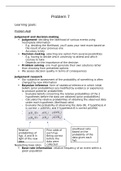
Problem A&B
Judgement and decision-making
Judgement- deciding the likelihood of various events using
incomplete information
- E.g. deciding the likelihood, you’ll pass your next exam based on
the result of your previous one
- Accuracy is key
Decision-making- selecting one option from several possibilities
- E.g. having to decide which university to attend and which
courses to take
- Depends on the importance of the decision
Problem solving- one must generate their own solutions rather
than choosing from presented options
We assess decision quality in terms of consequences
Judgement research
Our subjective assessment of the probability of something is often
changed by new information
Bayesian inference- form of statistical inference in which initial
beliefs (prior probabilities) are modified by evidence or experience
to produce posterior probabilities
- Evaluate beliefs concerning the relative probabilities of the 2
hypotheses before the data are obtained (prior probabilities)
- Calculate the relative probabilities of obtaining the observed data
under each hypothesis (likelihood ratio)
- Evaluate the probability of observing the data (D), if hypothesis A
is correct = p(D/HA), and if hypothesis B is correct p(D/HA)
-
-
Likelihood ratio
Relative Prior odds of
based on the
probabilities of each hyp.
probability of the
hyp. A and B in Being correct
data given each
light of the new before the
hyp.
data data were
Neglecting base rates collected
Base-rate information- relative frequency of an event within a
given population
, - Often ignored – taxi problem- don’t take into account the fact
that there are much more green cabs than blue cabs
Kahneman and Tversky- lawyer-engineer problem (example of
ignoring base rate information)
- Ppt told the description had been selected at random from 100
descriptions
- Half were told 70 descriptions were of engineers and 30 of
lawyers, whereas the others were told 70 were of lawyers and 30
of engineers
- On average ppt decided there was a 0.90 probability that jack
was an engineer regardless of whether most of the 100
descriptions were of lawyers or engineers
- Ppt ignored the base rate information i.e. 70:30 split in the
descriptions
Heuristics- strategies that ignore part of the information, with the
goal of making decisions more quickly, carefully and/or accurately
than more complex methods
- Often greatly reduce the effort associated with cognitive tasks
Representativeness heuristic- deciding an object or person
belongs to a given category because it appears typical or
representative of that category
- E.g. jack’s description seems that of a typical engineer
Conjunction fallacy- the mistaken belief that the conjunction or
combination of two events (A and B) is more likely than one event
(A or B) on its own
- E.g. Linda is more likely to be a feminist bank teller than just a
bank teller alone
- Assumed to occur due to the high perceived probability of the
additional info (i.e. Linda is a feminist activist) given the
description
- Others argue that the hypothesis that Linda is a feminist activist
is strongly supported by her description
Double conjunction fallacy- a stronger form of the conjunction
fallacy in which a conjunction of two statements (A + B) is judged to
be more probable than statement (A) and then statement (B) when
considered on their own
- Common cognitive biases were anchoring (relying heavily on the
first symptom identified), omission bias (preferring inaction over
action) and overconfidence (excessive confidence in the
correctness of one’s judgement)
Heeding base rates
Bialek- found many ppt made use of base-rate information irrelevant
to the judgement task
Krynski & Tenenbaum- we possess valuable causal knowledge
allowing us to make accurate judgements using base-rate
information in our everyday lives
- Brest cancer scenario – either with or without the benign cyst
scenario (giving a false positive on the mammogram)
Learning goals:
Problem A&B
Judgement and decision-making
Judgement- deciding the likelihood of various events using
incomplete information
- E.g. deciding the likelihood, you’ll pass your next exam based on
the result of your previous one
- Accuracy is key
Decision-making- selecting one option from several possibilities
- E.g. having to decide which university to attend and which
courses to take
- Depends on the importance of the decision
Problem solving- one must generate their own solutions rather
than choosing from presented options
We assess decision quality in terms of consequences
Judgement research
Our subjective assessment of the probability of something is often
changed by new information
Bayesian inference- form of statistical inference in which initial
beliefs (prior probabilities) are modified by evidence or experience
to produce posterior probabilities
- Evaluate beliefs concerning the relative probabilities of the 2
hypotheses before the data are obtained (prior probabilities)
- Calculate the relative probabilities of obtaining the observed data
under each hypothesis (likelihood ratio)
- Evaluate the probability of observing the data (D), if hypothesis A
is correct = p(D/HA), and if hypothesis B is correct p(D/HA)
-
-
Likelihood ratio
Relative Prior odds of
based on the
probabilities of each hyp.
probability of the
hyp. A and B in Being correct
data given each
light of the new before the
hyp.
data data were
Neglecting base rates collected
Base-rate information- relative frequency of an event within a
given population
, - Often ignored – taxi problem- don’t take into account the fact
that there are much more green cabs than blue cabs
Kahneman and Tversky- lawyer-engineer problem (example of
ignoring base rate information)
- Ppt told the description had been selected at random from 100
descriptions
- Half were told 70 descriptions were of engineers and 30 of
lawyers, whereas the others were told 70 were of lawyers and 30
of engineers
- On average ppt decided there was a 0.90 probability that jack
was an engineer regardless of whether most of the 100
descriptions were of lawyers or engineers
- Ppt ignored the base rate information i.e. 70:30 split in the
descriptions
Heuristics- strategies that ignore part of the information, with the
goal of making decisions more quickly, carefully and/or accurately
than more complex methods
- Often greatly reduce the effort associated with cognitive tasks
Representativeness heuristic- deciding an object or person
belongs to a given category because it appears typical or
representative of that category
- E.g. jack’s description seems that of a typical engineer
Conjunction fallacy- the mistaken belief that the conjunction or
combination of two events (A and B) is more likely than one event
(A or B) on its own
- E.g. Linda is more likely to be a feminist bank teller than just a
bank teller alone
- Assumed to occur due to the high perceived probability of the
additional info (i.e. Linda is a feminist activist) given the
description
- Others argue that the hypothesis that Linda is a feminist activist
is strongly supported by her description
Double conjunction fallacy- a stronger form of the conjunction
fallacy in which a conjunction of two statements (A + B) is judged to
be more probable than statement (A) and then statement (B) when
considered on their own
- Common cognitive biases were anchoring (relying heavily on the
first symptom identified), omission bias (preferring inaction over
action) and overconfidence (excessive confidence in the
correctness of one’s judgement)
Heeding base rates
Bialek- found many ppt made use of base-rate information irrelevant
to the judgement task
Krynski & Tenenbaum- we possess valuable causal knowledge
allowing us to make accurate judgements using base-rate
information in our everyday lives
- Brest cancer scenario – either with or without the benign cyst
scenario (giving a false positive on the mammogram)