First Aid USMLE

First Aid USMLE

Aquí están los mejores recursos para pasar First Aid USMLE. Encuentra First Aid USMLE guías de estudio, notas, tareas, y mucho más.
54 resultados

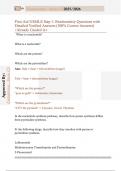
First Aid USMLE Step 1: GI Study Guide Questions with Correct Answers 2026
  • Examen

    First Aid USMLE Step 1: GI Study Guide Questions with Correct Answers 2026

  • First Aid USMLE Step 1: GI Study Guide Questions with Correct Answers 2026 For the following terms, define their anatomic boundaries: Foregut Midgut Hindgut What significant development events occurs during the 6th and 10th week of gut development? - Correct Answer *Foregut:* - pharynx to the duodenum *Midgut:* - duodenum to the proximal 2/3 of the transverse coon *Hindgut:* - distal 1/3 of transverse colon to anal canal above the pectinate line *What significant develop...
  • karugahjohn993
    $11.99 Más información
FIRST AID USMLE STEP 2 CS - MINI CASES EXAM QUESTIONS AND ANSWERS. VERIFIED 2026.
  • Examen

    FIRST AID USMLE STEP 2 CS - MINI CASES EXAM QUESTIONS AND ANSWERS. VERIFIED 2026.

  • FIRST AID USMLE STEP 2 CS - MINI CASES EXAM QUESTIONS AND ANSWERS. VERIFIED 2026.
  • TheStar
    $14.99 Más información
First Aid USMLE Step 3 Questions With High Expert Verified Solutions | A+ Rated
  • Examen

    First Aid USMLE Step 3 Questions With High Expert Verified Solutions | A+ Rated

  • A 30 year old high school guidance counselor presents to her dermatologist for irritation of her hands. She states that she washed her hands under hot water about 20 times a day and uses a variety of alcohol-based hand sanitizer products to avoid picking up germs. What is the best treatment for her disorder? - Correct Answer SSRIs and CBT. A 15 year old boy presents to the pediatrician. He states that he has been exercising more and eating less so that he can make the school wrestling ...
  • jackline98
    $9.99 Más información
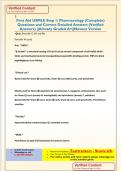
First Aid USMLE Step 1: Pharmacology (Complete) Questions with Detailed Verified Answers (100% Correct  Answers) /Already Graded A+
  • Examen

    First Aid USMLE Step 1: Pharmacology (Complete) Questions with Detailed Verified Answers (100% Correct Answers) /Already Graded A+

  • Penicillin G (IV and IM) Penicillin M (oral) Ans: *MOA:* *β-lactam*: a structural analog of D-ala-D-ala (a normal component of cell walls) which binds and inactivates bacterial transpeptidases (penicillinbinding protein, PBPs) to block peptidoglycan cross linking *Clinical use:* Bactericidal for Gram-⊕ cocci/rods, Gram-⊖ cocci (Neisseria), and spirochetes Mostly used for Gram-⊕ organisms (S. pneumoniae, S. pyogenes, Actinomyces). Also used for Gram-⊖ cocci (mainly N. menin...
  • ScholarsAscend
    $14.49 Más información
First Aid USMLE Step 1: Cardiovascular Questions with  Detailed Verified Answers (100% Correct Answers)  /Already Graded A+
  • Examen

    First Aid USMLE Step 1: Cardiovascular Questions with Detailed Verified Answers (100% Correct Answers) /Already Graded A+

  • Truncus arteriosus gives rise to __________. Ans: Ascending aorta and pulmonary trunk Bulbus cordis gives rise to __________. Ans: Smooth parts (outflow tract) of left and right ventricles Endocardial cushion gives rise to? Ans: Atrial septum ,membraneous interventricular septum; AV & semilunar valves Primitive atrium gives rise to __________. Ans: Trabeculated (muscular) portions of the left and right atria Primitive ventricle gives rise to __________. Ans: Trabeculated (muscular) po...
  • ScholarsAscend
    $13.99 Más información
First Aid USMLE Step 1: Biochemistry Questions with  Detailed Verified Answers (100% Correct Answers)  /Already Graded A+
  • Examen

    First Aid USMLE Step 1: Biochemistry Questions with Detailed Verified Answers (100% Correct Answers) /Already Graded A+

  • What is a nucleoside? What is a nucleotide? Which are the purines? Which are the pyrimidines? Ans: Side = base + (deoxy)ribose [sugar] Tide = base + (deoxy)ribose [sugar] *Which are the purines?* "pure as gold" = Adenosine, Guanosine *Which are the pyrimidines?* "CUT the pyramid" = Cytosine, Uracil, Thymine In the nucleotide synthesis pathway, describe how purine synthesis differs from pyrimidine synthesis. Fr the following drugs, describe how they interfere with purin...
  • ScholarsAscend
    $14.49 Más información
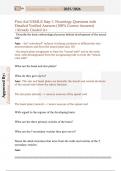
First Aid USMLE Step 1: Neurology Questions with  Detailed Verified Answers (100% Correct Answers)  /Already Graded A+
  • Examen

    First Aid USMLE Step 1: Neurology Questions with Detailed Verified Answers (100% Correct Answers) /Already Graded A+

  • Describe the basic embryological process behind development of the neural tube Ans: - the* notochord* induces overlying ectoderm to differentiate into neuroectoderm and form the neural plate (day 18) - the neural plate invaginates to form the *neural tube* and at the same time, cells demarginated from the invaginating tube to form the *neural crest cells* What are the basal and alar plates? What do they give rise to? Ans: The alar and basal plates are basically the dorsal and ventra...
  • ScholarsAscend
    $13.99 Más información
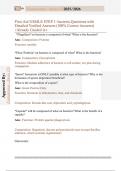
First Aid USMLE STEP 1: bacteria Questions with  Detailed Verified Answers (100% Correct Answers)  /Already Graded A+
  • Examen

    First Aid USMLE STEP 1: bacteria Questions with Detailed Verified Answers (100% Correct Answers) /Already Graded A+

  • *Flagellum* on bacteria is composed of what? What is the function? Ans: Composition: Proteins Function: motility *Pilus/Fimbria* on bacteria is composed of what? What is the function? Ans: Composition: Glycoprotein Function: Mediate adherence of bacteria to cell surface, sex plus during conjugation. *Spore* formation is ONLY possible is what type of bacteria? Why is the formation of spores important/beneficial? What is the composition of a spore? Ans: Gram Positive Only Function: R...
  • ScholarsAscend
    $13.99 Más información
First Aid USMLE Step 1: Pharmacology (Complete) Questions and Correct Detailed Answers (Verified  Answers) ||Already Graded A+||Newest Version
  • Examen

    First Aid USMLE Step 1: Pharmacology (Complete) Questions and Correct Detailed Answers (Verified Answers) ||Already Graded A+||Newest Version

  • Quiz: Penicillin G (IV and IM) Penicillin M (oral) Ans: *MOA:* *β-lactam*: a structural analog of D-ala-D-ala (a normal component of cell walls) which binds and inactivates bacterial transpeptidases (penicillin-binding protein, PBPs) to block peptidoglycan cross linking *Clinical use:* Bactericidal for Gram-⊕ cocci/rods, Gram-⊖ cocci (Neisseria), and spirochetes Mostly used for Gram-⊕ organisms (S. pneumoniae, S. pyogenes, Actinomyces). Also used for Gram-⊖ cocci (mainly N....
  • ScholarsAscend
    $13.49 Más información
First Aid USMLE Step 1: Biochemistry Questions and  Correct Detailed Answers (Verified Answers)  ||Already Graded A+||Newest Version
  • Examen

    First Aid USMLE Step 1: Biochemistry Questions and Correct Detailed Answers (Verified Answers) ||Already Graded A+||Newest Version

  • Quiz: What is a nucleoside? What is a nucleotide? Which are the purines? Which are the pyrimidines? Ans: Side = base + (deoxy)ribose [sugar] Tide = base + (deoxy)ribose [sugar] *Which are the purines?* "pure as gold" = Adenosine, Guanosine *Which are the pyrimidines?* "CUT the pyramid" = Cytosine, Uracil, Thymine Quiz:In the nucleotide synthesis pathway, describe how purine synthesis differs from pyrimidine synthesis. o © 2025 TestTrackers o or call [] o Resource...
  • ScholarsAscend
    $13.99 Más información
First Aid USMLE Step 1: MSK Questions with Detailed  Verified Answers (100% Correct Answers) /Already  Graded A+
  • Examen

    First Aid USMLE Step 1: MSK Questions with Detailed Verified Answers (100% Correct Answers) /Already Graded A+

  • Anterior drawer sign Ans: Movement of tibia anterior relative to femur due to ACL injury Posterior drawer sign Ans: Movement of tibia posterior relative to femur due to PCL injury Abnormal passive abduction Ans: Movement of knee laterally (valgus) causes medial space widening of tibia due to MCL injury Abnormal passive adduction Ans: Movement of knee medially (varus) causes lateral space widening of tibia (LCL injury) McMurray Test Ans: Knee externally rotated with pain/popping: med...
  • ScholarsAscend
    $13.99 Más información
First Aid USMLE Step 1: Renal Questions with Detailed  Verified Answers (100% Correct Answers) /Already  Graded A+
  • Examen

    First Aid USMLE Step 1: Renal Questions with Detailed Verified Answers (100% Correct Answers) /Already Graded A+

  • With regard to kidney embryology: What tissue is it? What are the three kidney systems? What is the uteric bud? What does it give rise to? What is the metanephrine mesenchyma? What does it do? 2 Exampromax - Stuvia US2025/2026 Approved By: Exampromax - Stuvia US Ans: *What tissue is it?* - derived from intermediate mesoderrm on the posterior wall of the abdominal cavity *What are the three kidney systems?* - this tissue forms the following 3 kidney systems: 1. Pronephros - rudim...
  • ScholarsAscend
    $14.49 Más información
First Aid USMLE Step 1: Hematology & Oncology Questions with Detailed Verified Answers (100% Correct  Answers) /Already Graded A+
  • Examen

    First Aid USMLE Step 1: Hematology & Oncology Questions with Detailed Verified Answers (100% Correct Answers) /Already Graded A+

  • Erythrocytes carry O2 to ____ and CO2 to ______ Ans: *Tissues, Lungs* True or false, erythrocytes are biconcave and anucleate Ans: True What is the lifespan of an erythrocyte and what is its energy source? Ans: Glucose (90% used in glycolysis, 10% used in HMP shunt). Lifespan - 120 days What does the Cl−/HCO3− anti porter allow RBCs to do? Ans: Allows export of HCO3− and transport of CO2 from the periphery to the lungs for elimination What is a reticulocyte? Ans: Immature RBC;...
  • ScholarsAscend
    $13.99 Más información
First Aid USMLE STEP 1: Respiratory Questions with  Detailed Verified Answers (100% Correct Answers)  /Already Graded A
  • Examen

    First Aid USMLE STEP 1: Respiratory Questions with Detailed Verified Answers (100% Correct Answers) /Already Graded A

  • Already Graded A+ How many periods does it take to develop the lung? What are they? Ans: 5 1) Embryonic (weeks 4-7) 2) Pseudoglandular (weeks 5-16) 3) Canalicular (weeks 16-26) 4) Saccular (weeks 26-birth) 5) Alveolar (weeks 32-8 years) Describe the embryonic stage Ans: Lung bud-> trachea-> mainstem bronchi-> secondary (lobar) bronchi- > tertiary (segmental) bronchi **Errors at this stage can lead to TE fistula Describe the Pseudoglandular stage 2 Exampromax - Stuvia ...
  • ScholarsAscend
    $13.99 Más información
First Aid USMLE Step 1: Renal Questions and  Correct Detailed Answers (Verified Answers)  ||Already Graded A+||Newest Version
  • Examen

    First Aid USMLE Step 1: Renal Questions and Correct Detailed Answers (Verified Answers) ||Already Graded A+||Newest Version

  • First Aid USMLE Step 1: Renal Questions and Correct Detailed Answers (Verified Answers) ||Already Graded A+||Newest VersionFirst Aid USMLE Step 1: Renal Questions and Correct Detailed Answers (Verified Answers) ||Already Graded A+||Newest Version
  • ScholarsAscend
    $13.99 Más información
First Aid USMLE Step 1: Cardiovascular Questions  and Correct Detailed Answers (Verified Answers)  ||Already Graded A+||Newest Version
  • Examen

    First Aid USMLE Step 1: Cardiovascular Questions and Correct Detailed Answers (Verified Answers) ||Already Graded A+||Newest Version

  • First Aid USMLE Step 1: Cardiovascular Questions and Correct Detailed Answers (Verified Answers) ||Already Graded A+||Newest VersionFirst Aid USMLE Step 1: Cardiovascular Questions and Correct Detailed Answers (Verified Answers) ||Already Graded A+||Newest Version
  • ScholarsAscend
    $13.99 Más información
First Aid USMLE Step 1: Biochemistry Questions and  Correct Detailed Answers (Verified Answers)  ||Already Graded A+||Newest Version
  • Examen

    First Aid USMLE Step 1: Biochemistry Questions and Correct Detailed Answers (Verified Answers) ||Already Graded A+||Newest Version

  • First Aid USMLE Step 1: Biochemistry Questions and Correct Detailed Answers (Verified Answers) ||Already Graded A+||Newest Version First Aid USMLE Step 1: Biochemistry Questions and Correct Detailed Answers (Verified Answers) ||Already Graded A+||Newest Version
  • ScholarsAscend
    $13.99 Más información
First Aid USMLE STEP 1: Respiratory Questions and  Correct Detailed Answers (Verified Answers)  ||Already Graded A+||Newest Version
  • Examen

    First Aid USMLE STEP 1: Respiratory Questions and Correct Detailed Answers (Verified Answers) ||Already Graded A+||Newest Version

  • First Aid USMLE STEP 1: Respiratory Questions and Correct Detailed Answers (Verified Answers) ||Already Graded A+||Newest Version First Aid USMLE STEP 1: Respiratory Questions and Correct Detailed Answers (Verified Answers) ||Already Graded A+||Newest Version
  • ScholarsAscend
    $12.99 Más información
First Aid USMLE Step 1: Psychiatry Questions with  Detailed Verified Answers (100% Correct Answers)  /Already Graded A+
  • Examen

    First Aid USMLE Step 1: Psychiatry Questions with Detailed Verified Answers (100% Correct Answers) /Already Graded A+

  • Transference? Ans: Patient projects feelings about formative or other important persons onto physician. Countertransference? Ans: *Doctor* projects feelings about formative or other important persons onto patient. What is the central goal of Freudian psychoanalysis? Ans: Make patient aware of what is hidden in his/her unconsciousness. *Primal* urges (food, sex, aggression) - "Drives" instinct - Entirely subconcious Ans: ID *Mediator* between primal urges and behavior accepted...
  • ScholarsAscend
    $13.99 Más información
First Aid USMLE Step 1: Neurology Questions and  Correct Detailed Answers (Verified Answers)  ||Already Graded A+||Newest Version
  • Examen

    First Aid USMLE Step 1: Neurology Questions and Correct Detailed Answers (Verified Answers) ||Already Graded A+||Newest Version

  • Quiz: Describe the basic embryological process behind development of the neural tube Ans: - the* notochord* induces overlying ectoderm to differentiate into neuroectoderm and form the neural plate (day 18) - the neural plate invaginates to form the *neural tube* and at the same time, cells demarginated from the invaginating tube to form the *neural crest cells* Quiz: What are the basal and alar plates? What do they give rise to? Ans: The alar and basal plates are basically the dorsal an...
  • ScholarsAscend
    $12.99 Más información
Y así es como ganas dinero extra
¿Sabías que, de media, un vendedor en Stuvia gana 76 euros al mes con la venta de recursos de estudio? Hmm, pista, pista.