- Guías de estudio, Notas de estudios & Resúmenes
¿Buscas las mejores guías de estudio, notas de estudio y resúmenes para ? En esta página encontrarás 20 documentos de estudio para .
All 20 resultados
Ordenador por:

-
Examen
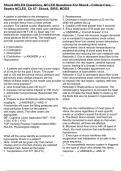
Shock NCLEX Questions, NCLEX Questions For Shock - Critical Care, Sepsis NCLEX, Ch 67: Shock, SIRS, MODS
-
---49octubre 20252025/2026A+
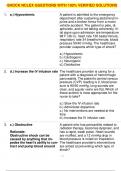
- A patient is admitted to the emergency 
department after sustaining abdominal injuries 
and a broken femur from a motor vehicle 
accident. The patient is pale, diaphoretic, and is 
not talking coherently. Vital signs upon admission 
are temperature 98 F (36 C), heart rate 130 
beats/minute, respiratory rate 34 breaths/minute, 
blood pressure 50/40 mmHg. The healthcare 
provider suspects which type of shock? 
a.) Hypovolemic 
b.) Cardiogenic 
c.) Neurogenic 
d.) Distr
-
$14.99 Más información
learndirect
-
Examen
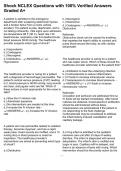
Shock NCLEX Questions with 100% Verified Answers Graded A+
-
---10agosto 20252025/2026A+
- A patient is admitted to the emergency 
department after sustaining abdominal injuries 
and a broken femur from a motor vehicle 
accident. The patient is pale, diaphoretic, and is 
not talking coherently. Vital signs upon admission 
are temperature 98 F (36 C), heart rate 130 
beats/minute, respiratory rate 34 breaths/minute, 
blood pressure 50/40 mmHg. The healthcare 
provider suspects which type of shock? 
a.) Hypovolemic 
b.) Cardiogenic 
c.) Neurogenic 
d.) Distributive - ANSWERS - a.) 
Hypo...
-
$13.99 Más información
MERCYTRISHIA
-
Examen
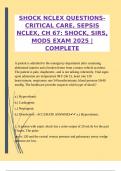
SHOCK NCLEX QUESTIONS- CRITICAL CARE, SEPSIS NCLEX, CH 67: SHOCK, SIRS, MODS EXAM 2025 |COMPLETE
-
---136febrero 20252024/2025A+
- A patient is admitted to the emergency department after sustaining abdominal injuries and a broken femur from a motor vehicle accident. The patient is pale, diaphoretic, and is not talking coherently. Vital signs upon admission are temperature 98 F (36 C), heart rate 130 beats/minute, respiratory rate 34 breaths/minute, blood pressure 50/40 mmHg. The healthcare provider suspects which type of shock? 
 
a.) Hypovolemic 
b.) Cardiogenic 
c.) Neurogenic 
d.) Distributive - ACCURATE ANSWERS a.) Hyp...
-
$23.99 Más información
EXAMLINKS
-
Examen
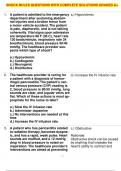
SHOCK NCLEX QUESTIONS WITH COMPLETE SOLUTIONS GRADED A+
-
---16enero 20252024/2025A+
- SHOCK NCLEX QUESTIONS WITH COMPLETE SOLUTIONS GRADED A+ 
1. A patient is admitted to the emergency 
department after sustaining abdomi- 
nal injuries and a broken femur from 
a motor vehicle accident. The patient 
is pale, diaphoretic, and is not talking 
coherently. Vital signs upon admission 
are temperature 98 F (36 C), heart rate 
130 beats/minute, respiratory rate 34 
breaths/minute, blood pressure 50/40
-
$13.49 Más información
MERCYTRISHIA
-
Examen
SHOCK NCLEX QUESTIONS WITH 100% VERIFIED SOLUTIONS
-
---16enero 20252024/2025A+
- SHOCK NCLEX QUESTIONS WITH 100% VERIFIED SOLUTIONS 
1. a.) Hypovolemic 
2. d.) Increase the IV infusion rate 
3. c.) Obstructive 
Rationale: 
Obstructive shock can be 
caused by anything that im- 
pedes the heart's ability to con- 
tract and pump blood around 
A patient is admitted to the emergency 
department after sustaining abdominal in- 
juries and a broken femur from a motor 
vehicle accident. The patient is pale, di- 
aphoretic, and is not talking coherently. Vi- 
tal signs upon admissi...
-
$12.99 Más información
MERCYTRISHIA
-
Examen
Exam 2: Shock NCLEX Questions with Verified Answers
-
---13diciembre 20242024/2025A+
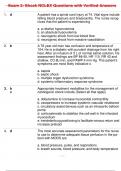
- Exam 2: Shock NCLEX Questions with Verified Answers 
1. d A patient has a spinal cord injury at T4. Vital signs include 
falling blood pressure and bradycardia. The nurse recog- 
nizes that the patient is experiencing 
a. a relative hypervolemia 
b. an absolute hypovolemia 
c. neurogenic shock from low blood flow 
d. neurogenic shock from massive vasodilation 
2. b A 78 year ol
-
$11.19 Más información
MERCYTRISHIA