
- Guías de estudio, Notas de estudios & Resúmenes
¿Buscas las mejores guías de estudio, notas de estudio y resúmenes para ? En esta página encontrarás 130 documentos de estudio para .
Examen
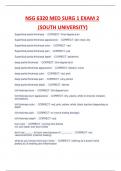
Nsg 6320 Med Surg 1 Exam 2 (South University) Rated A.
Nsg 6320 Med Surg 1 Exam 2 (South University) Rated Nsg 6320 Med Surg 1 Exam 2 (South University) Rated Nsg 6320 Med Surg 1 Exam 2 (South University) Rated Nsg 6320 Med Surg 1 Exam 2 (South University) Rated Nsg 6320 Med Surg 1 Exam 2 (South University) Rated Nsg 6320 Med Surg 1 Exam 2 (South University) Rated Nsg 6320 Med Surg 1 Exam 2 (South University) Rated
 saraciousstuvia
Examen
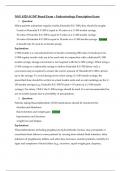
NSG 6320 AGNP Board Exam – Endocrinology Prescription Exam.
NSG 6320 AGNP Board Exam – Endocrinology Prescription Exam.1. Question: When patients administer regular insulin (Humulin R U-500), they should be taught: 5 units of Humulin R U-500 is equal to 10 units on a U-100 insulin syringe. 10 units of Humulin R U-500 is equal to 5 units on a U-100 insulin syringe. 10 units of Humulin R U-500 is equal to 10 units on a U-500 insulin syringe. Correct it should only be used in an insulin pump. Explanation: U-500 insulin is a concentrated form of ins...
 consultant001
Examen
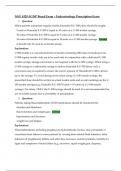
NSG 6320 AGNP Board Exam – Endocrinology Prescription Exam.
NSG 6320 AGNP Board Exam – Endocrinology Prescription Exam.1. Question: When patients administer regular insulin (Humulin R U-500), they should be taught: 5 units of Humulin R U-500 is equal to 10 units on a U-100 insulin syringe. 10 units of Humulin R U-500 is equal to 5 units on a U-100 insulin syringe. 10 units of Humulin R U-500 is equal to 10 units on a U-500 insulin syringe. Correct it should only be used in an insulin pump. Explanation: U-500 insulin is a concentrated form of ins...
 classrep
Examen
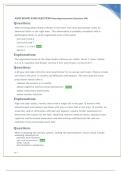
NSG 6320 AGNP BOARD EXAM QUESTIONS Neurology Assessment (Questions 194)
NSG 6320 AGNP BOARD EXAM QUESTIONS Neurology Assessment (Questions 194)/NSG 6320 AGNP BOARD EXAM QUESTIONS Neurology Assessment (Questions 194)/NSG 6320 AGNP BOARD EXAM QUESTIONS Neurology Assessment (Questions 194)
 examsetters
Examen
NSG 6320 Exam 1 Comprehensive Med Surg 3 Study Guide Notes Latest
NSG 6320 Exam 1 Comprehensive Med Surg 3 Study Guide Notes Latest
 Excellentgrader
Examen
NSG 6320 Exam 1 Comprehensive Med Surg 3 Study Guide Notes Latest
NSG 6320 Exam 1 Comprehensive Med Surg 3 Study Guide Notes Latest
Autonomousgrades
Examen
NSG 6320 Exam 1 Comprehensive Med Surg 3 Study Guide Notes Latest
NSG 6320 Exam 1 Comprehensive Med Surg 3 Study Guide Notes Latest
 Pronurse
Examen
NSG 6320 Exam 1 Comprehensive Med Surg 3 Study Guide Notes Latest
NSG 6320 Exam 1 Comprehensive Med Surg 3 Study Guide Notes Latest
 Onlineexam
Examen
NSG 6320 AGNP BOARD EXAM QUESTIONS Dermatology assessment.
NSG 6320 AGNP BOARD EXAM QUESTIONS Dermatology assessment.
 DOCSEXPERT001
Examen
NSG 6320 AGNP BOARD EXAM QUESTIONS Dermatology assessment.
NSG 6320 AGNP BOARD EXAM QUESTIONS Dermatology assessment.
Bestnursesolution001
Examen
NSG 6320 AGNP Board exam – EENT Assessment
NSG 6320 AGNP Board exam – EENT Assessment 1. Question: Ophthalmoscopic examination of the fundus reveals small, rounded, slightly irregular red spots embedded in the retina. These findings are consistent with: superficial retinal hemorrhages. preretinal hemorrhages. microaneurysms. deep retinal hemorrhages. Correct Explanation: Deep retinal hemorrhages appear as small, rounded, slightly irregular red spots and are sometimes called dot or blot hemorrhages. They occur in a deeper layer of the r...
keenstar
Examen
NSG 6320 AGNP Board Exam Eye, Ear, Nose, Throat Prescription Exam
NSG 6320 AGNP Board Exam Eye, Ear, Nose, Throat Prescription Exam 1. Question: Oral tetracycline (Sumycin), for the treatment of acute frontal sinusitis, should be administered: with milk. with meals. on an empty stomach. Correct with an antacid. Explanation: Tetracycline (Sumycin) should be administered on an empty stomach (i.e., 1 hour prior to, or 2 hours after meals) to increase total absorption and with adequate amount of fluid to reduce the risk of esophageal irritation and ulceration. It ...
keenstar
Examen
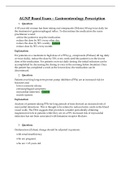
NSG 6320 AGNP Board Exam – Gastroenterology Prescription
NSG 6320 AGNP Board Exam – Gastroenterology Prescription 1. Question: A 45-year-old woman has been taking oral omeprazole (Prilosec) 40 mg twice daily for the treatment of gastroesophageal reflux. To discontinue the medication the nurse practitioner would: advise the patient to stop the medication. reduce the dose by 50% every other day. reduce the dose by 50% weekly. Correct reduce dose by 50% every month. Explanation: For patients on a moderate to high dose of a PPI (e.g., omeprazole (Prilos...
keenstar
Examen
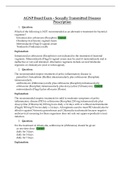
NSG 6320 AGNP Board Exam – Sexually Transmitted Diseases Prescription
NSG 6320 AGNP Board Exam – Sexually Transmitted Diseases Prescription 1. Question: Which of the following is NOT recommended as an alternative treatment for bacterial vaginosis? Intramuscular ceftriaxone (Rocephin) Correct Clindamycin (Cleocin) vaginal cream Metronidazole (Flagyl) vaginal cream Tinidazole (Tindamax) orally Explanation: Intramuscular ceftriaxone (Rocephin) is not indicated in the treatment of bacterial vaginosis. Metronidazole (Flagyl) vaginal cream may be used if metronidazole...
keenstar
Examen
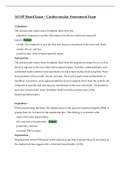
NSG 6320 AGNP Board Exam – Cardiovascular Assessment Exam
NSG 6320 AGNP Board Exam – Cardiovascular Assessment Exam 1.Question: The preauricular nodes drain lymphatic fluid from the: palpebral conjunctiva and the skin adjacent to the ear within the temporal region. Correct eyelids, the conjunctiva, and the skin and mucous membrane of the nose and cheek. mouth, throat, and face. posterior part of the temporoparietal region. Explanation: The preauricular nodes drain lymphatic fluid from the palpebral conjunctiva as well as the skin adjacent to the ear ...
keenstar
Examen
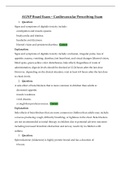
NSG 6320 AGNP Board Exam – Cardiovascular Prescribing Exam
NSG 6320 AGNP Board Exam – Cardiovascular Prescribing Exam 1. Question: Signs and symptoms of digitalis toxicity include: constipation and muscle spasms. bradycardia and tinnitus. headache and dizziness. blurred vision and persistent diarrhea. Correct Explanation: Signs and symptoms of digitalis toxicity include: confusion, irregular pulse, loss of appetite, nausea, vomiting, diarrhea, fast heart beat, and visual changes (blurred vision, blind spots, green-yellow color disturbances, halo effec...
keenstar
Examen
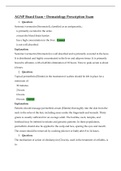
NSG 6320 AGNP Board Exam – Dermatology Prescription Exam
NSG 6320 AGNP Board Exam – Dermatology Prescription Exam 1. Question: Systemic ivermectin (Stromectol), classified as an antiparasitic,: is primarily excreted in the urine. crosses the blood-brain barrier. has a high concentration in the liver. Correct is not well absorbed. Explanation: Systemic ivermectin (Stromectol) is well absorbed and is primarily excreted in the feces. It is distributed and highly concentrated in the liver and adipose tissue. It is primarily bound to albumin, with a half...
keenstar
Examen
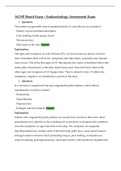
NSG 6320 AGNP Board Exam – Endocrinology Assessment Exam
NSG 6320 AGNP Board Exam – Endocrinology Assessment Exam 1. Question: The earliest recognizable clinical manifestation(s) of cystic fibrosis in an infant is: History of poor intestinal absorption Foul smelling, frothy, greasy stools Meconium ileus Salty taste on the skin Correct Explanation: The signs and symptoms of cystic fibrosis (CF) vary from person to person and over time. Sometimes there will be few symptoms and other times, symptoms may become more severe. One of the first signs of CF ...
keenstar
Examen
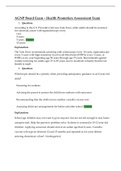
NSG 6320 AGNP Board Exam – Health Promotion Assessment Exam
NSG 6320 AGNP Board Exam – Health Promotion Assessment Exam AGNP Board Exam – Health Promotion Assessment Exam 1. Question: According to the U.S. Preventive Services Task Force, older adults should be screened for colorectal cancer with sigmoidoscopy every: year. 2 years. 5 years. Correct 10 years. Explanation: The Task Force recommends screening with colonoscopy every 10 years, sigmoidoscopy every 5 years with high-sensitivity fecal occult blood tests (FOBTs) every 3 years, or FOBTs every y...
keenstar
Examen
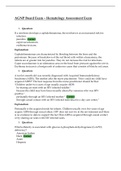
NSG 6320 AGNP Board Exam – Hematology Assessment Exam
NSG 6320 AGNP Board Exam – Hematology Assessment Exam 1. Question: If a newborn develops a cephalohematoma, the newborn is at an increased risk for: infection. jaundice. Correct caput succedaneum. erythema toxicum. Explanation: Cephalohematomas are characterized by bleeding between the bone and the periosteum. Because of breakdown of the red blood cells within a hematoma, the infants are at greater risk for jaundice. They do not increase the risk for infections. Caput succedaneum is...
keenstar