
- Guías de estudio, Notas de estudios & Resúmenes
¿Buscas las mejores guías de estudio, notas de estudio y resúmenes para ? En esta página encontrarás 7 documentos de estudio para .

Examen
NSG 526 Midterm Exam — Questions & Answers
NuevoNSG 526 Midterm Exam — Questions & Answers Part I — Alliance and Relationship Scenarios 1. A client says, "You remind me of my critical father." What is this an example of? A. Countertransference B. Transference C. Projection by the therapist D. Resistance only Answer: B. Transference Rationale: Transference. 2. A PMHNP feels unusually protective of a client who resembles her younger brother. What is occurring? A. Countertransference B. Transference C. Splitting D. Sublim...
 ARVEX
Examen
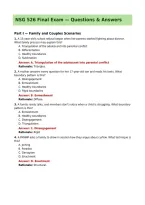
NSG 526 Final Exam — Questions & Answers
PopularNSG 526 Final Exam — Questions & Answers Part I — Family and Couples Scenarios 1. A 15-year-old's school refusal began when her parents started fighting about divorce. What family process may explain this? A. Triangulation of the adolescent into parental conflict B. Differentiation C. Healthy boundaries D. Sublimation Answer: A. Triangulation of the adolescent into parental conflict Rationale: Triangles. 2. A mother answers every question for her 17-year-old son and reads his te...
ARVEX

Examen
NSG 526 Exam 1 — Questions & Answers
NuevoNSG 526 Exam 1 — Questions & Answers Part A — Foundations of Psychotherapy in APRN Practice 1. What is the strongest common factor predicting psychotherapy outcomes across modalities? A. The specific technique used B. The therapeutic alliance C. The length of sessions D. The therapist's age Answer: B. The therapeutic alliance Rationale: Common factors research. 2. What three components make up Bordin's working alliance? A. Agreement on goals, agreement on tasks and the emoti...
ARVEX

Examen
NSG 526 Clinical Practical Exam — Questions & Answers
NuevoNSG 526 Clinical Practical Exam — Questions & Answers Station 1 — Opening and Engagement 1. At the start of a first session, what should the PMHNP do first? A. Begin exposure therapy B. Introduce herself, explain confidentiality limits and obtain informed consent C. Prescribe medication D. Ask about childhood trauma in detail Answer: B. Introduce herself, explain confidentiality limits and obtain informed consent Rationale: Engagement.
ARVEX

Examen
NSG 526 Unit Tests 1–6 — Questions & Answers
NuevoNSG 526 Unit Tests 1–6 — Questions & Answers Unit Test 1 — Therapeutic Relationship, Ethics and Assessment 1. What percentage of therapy outcome variance is often attributed to the alliance in meta-analyses? A. A modest but robust portion (about 5–8% of variance; r ≈ 0.28) B. Over 90% C. 0% D. Exactly 50% Answer: A. A modest but robust portion (about 5–8% of variance; r ≈ 0.28) Rationale: Flückiger. 2. What is "empathic attunement"? A. Accurately sensing and respo...
ARVEX

Examen
NSG 526 Exam 2 — Questions & Answers
NuevoNSG 526 Exam 2 — Questions & Answers Part A — Dialectical Behavior Therapy 1. Who developed DBT? A. Marsha Linehan B. Aaron Beck C. Steven Hayes D. Albert Ellis Answer: A. Marsha Linehan Rationale: Linehan. 2. For which condition was DBT originally developed? A. Schizophrenia B. Panic disorder C. ADHD D. Chronically suicidal clients with borderline personality disorder Answer: D. Chro
ARVEX

Examen
NSG 526 Exam 3 — Questions & Answers
NuevoNSG 526 Exam 3 — Questions & Answers Part A — Family Therapy 1. What is the core idea of family systems theory? A. Individuals act alone B. Only the identified patient needs treatment C. The family functions as an emotional unit; change in one member affects others D. Families are irrelevant Answer: C. The family functions as an emotional unit; change in one member affects others Rationale: Systems. 2. Who developed family systems theory emphasizing differentiation of self? A. Mur...
ARVEX