
- Guías de estudio, Notas de estudios & Resúmenes
¿Buscas las mejores guías de estudio, notas de estudio y resúmenes para ? En esta página encontrarás 7 documentos de estudio para .

Examen
NSG 252 Final Exam — Questions & Answers
NuevoNSG 252 Final Exam — Questions & Answers Part A — Sepsis and Infection 1. A patient with pneumonia has temperature 39.1°C, HR 118, RR 26, BP 88/52 and lactate 4.4. Which order should be completed first? A. Draw blood cultures and start broad-spectrum antibiotics B. Obtain a sputum sample later C. Give acetaminophen and reassess D. Order a CT scan of the abdomen Answer: A. Draw blood cultures and start broad-spectrum antibiotics Rationale: Antibiotics within an hour are a priority i...
 ARVEX

Examen
NSG 252 Clinical Practical Exam — Questions & Answers
PopularNSG 252 Clinical Practical Exam — Questions & Answers Case 1 — Mr. Reyes: Septic Shock from a Urinary Source (78 kg) 1. Mr. Reyes, 70, arrives from a nursing home with confusion, temperature 39.3°C, HR 122, RR 28 and BP 84/46. What is his MAP, rounded? A. 65 mm Hg B. 59 mm Hg C. 46 mm Hg D. 72 mm Hg Answer: B. 59 mm Hg Rationale: (84 + 92) ÷ 3 = 58.7, about 59 mm Hg. 2. Mr. Reyes's lactate is 4.8 mmol/L. How much crystalloid does the 30 mL/kg bolus equal for his 78 kg? A. 1...
ARVEX
Examen
NSG 252 Exam 2 — Questions & Answers
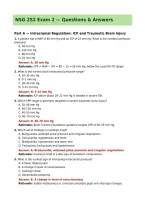
NuevoNSG 252 Exam 2 — Questions & Answers Part A — Intracranial Regulation: ICP and Traumatic Brain Injury 1. A patient has a MAP of 80 mm Hg and an ICP of 22 mm Hg. What is the cerebral perfusion pressure? A. 58 mm Hg B. 102 mm Hg C. 80 mm Hg D. 22 mm Hg Answer: A. 58 mm Hg Rationale: CPP = MAP − ICP = 80 − 22 = 58 mm Hg, below the usual 60–70 target. 2. What is the normal adult intracranial pressure range? A. 20–30 mm Hg B. 0–2 mm Hg C. 30–40 mm Hg D. 5–15 mm Hg Ans...
ARVEX

Examen
NSG 252 Unit Tests 1–6 — Questions & Answers
NuevoNSG 252 Unit Tests 1–6 — Questions & Answers Unit Test 1 — Perfusion 1. Which factor most directly increases preload? A. Increased venous return, such as from IV fluid boluses B. Vasodilation from nitroglycerin C. Diuresis D. Hemorrhage Answer: A. Increased venous return, such as from IV fluid boluses Rationale: Preload is end-diastolic volume and rises with circulating volume. 2. Which medication primarily reduces preload? A. Nitroglycerin B. Norepinephrine C. Phenylephrine D...
ARVEX
Examen
NSG 252 Midterm Exam — Questions & Answers
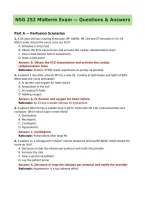
NuevoNSG 252 Midterm Exam — Questions & Answers Part A — Perfusion Scenarios 1. A 64-year-old has crushing chest pain, BP 148/90, HR 104 and ST elevation in V1–V4. Which order should the nurse carry out first? A. Schedule a stress test B. Obtain the ECG transmission and activate the cardiac catheterization team C. Give a beta-blocker before assessment D. Draw a lipid panel Answer: B. Obtain the ECG transmission and activate the cardiac catheterization team Rationale: Anterior STEMI ne...
ARVEX

Examen
NSG 252 Exam 3 — Questions & Answers
NuevoNSG 252 Exam 3 — Questions & Answers Part A — Infection: Sepsis and Septic Shock 1. What is the current Sepsis-3 definition of sepsis? A. Two SIRS criteria with suspected infection B. Positive blood cultures C. Life-threatening organ dysfunction caused by a dysregulated host response to infection D. Fever over 38.3°C Answer: C. Life-threatening organ dysfunction caused by a dysregulated host response to infection Rationale: Organ dysfunction is measured as a SOFA increase of 2 or ...
ARVEX

Examen
NSG 252 Exam 1 — Questions & Answers
NuevoNSG 252 Exam 1 — Questions & Answers Part A — Perfusion: Hemodynamics and Shock 1. A patient's blood pressure is 120/60 mm Hg. What is the mean arterial pressure (MAP)? A. 90 mm Hg B. 80 mm Hg C. 60 mm Hg D. 100 mm Hg Answer: B. 80 mm Hg Rationale: MAP = (SBP + 2 × DBP) ÷ 3 = (120 + 120) ÷ 3 = 80 mm Hg. 2. What is the minimum MAP generally needed to perfuse vital organs such as the kidneys and brain? A. 65 mm Hg B. 45 mm Hg C. 50 mm Hg D. 100 mm Hg Answer: A. 65 mm Hg R...
ARVEX